Confession – A Villanelle

Walking Toward His Light

This poem is written in the “villanelle* form. I wrote it as a reminder to myself of how hard the darkness of depression can be so that I don’t lose my compassion for those in my world who are struggling to find the Light. But it is also a reminder that the Light of Christ does shine in that darkness, however faintly, and will never be extinguished. If you feel oppressed by the darkness, seek His Light.

Confession

The light shines in the darkness
Faintly I see His light
My need I will confess
Toward the light I press
Keeping hope in my sight
The light shines in the darkness
Despair my soul’s distress
Entangled in the night
My need I will confess
His grace I will profess
Giving me the strength to fight
The light shines in the darkness
I feel anguish oppress
Crushing with all its might
My need I will confess
Feeling His love’s caress
Compassion burning bright
The light shines in the darkness
      My need I will confess

__________________________________________

* vil·la·nelle, [vil-uh-nel]

noun, Prosody

a short poem of fixed form, written in tercets, usually five in number,

followed by a final quatrain, all being based on two rhymes.


Check out Linda’s site @ anotherfearlessyear.net


T
 

w

A.W. Tozer, on Having a Personal Revival

How to Have a Personal Revival,
Serious Repentance and Restitution, and
Steps to Spiritual Growth.

by A.W. Tozer

1) Put yourself in the way of the blessing. 

It is a mistake to look for grace to visit us as a kind of benign magic, or to expect God’s help to come as a windfall apart from conditions known and met. There are plainly marked paths that lead straight to the green pastures; let us walk in them.  To desire revival, for instance, and at the same time to neglect prayer and devotion is to wish one way and walk another.

2) Do a thorough job of repenting. 

Do not hurry to get it over with.  Hasty repentance means shallow spiritual experience and lack of certainty in the whole life.  Let godly sorrow do her healing work. Until we allow the consciousness of sin to wound us, we will never develop a fear of evil. It is our wretched habit of tolerating sin that keeps us in our half-dead condition.

3) Make restitution whenever possible. 

If you owe a debt, pay it, or at least have a frank understanding with your creditor about your intention to pay, so your honesty will be above question. If you have quarreled with anyone, go as far as you can in an effort to achieve reconciliation. As fully as possible make that crooked things straight.

*****

Thought 

Repentance and restitution result when we seriously reflect on what God shows us in His Word. What is it of which we need to repent and is there restitution to be made?


Scripture

“Bring forth fruit that is consistent with repentance [let your lives prove your change of heart];”

Matthew 3:8 (Amplified Bible)

Prayer

My tendency, Lord, is not to take seriously my sin that hurts other people and to leave unrepaired the damage I have left in the lives of others. Make me sensitive, Lord!


tozer
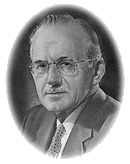
Aiden Wilson Tozer was born on April 21, 1897, on a small farm in Western Pennsylvania, the third of six children. And although he would inspire millions with his preaching and writing, he was given very little education during his childhood.

A. W. Tozer was 66 when he died of a heart attack on May 12, 1963. Buried in a small cemetery in Akron, his tombstone simply and appropriately reads, “A Man of God.” He left behind many books that continue to give Christians encouragement and guidance. His writings are as fresh today as when he was alive. His honest and colloquial humor has been known to sweep up congregations in gales of laughter. And his wisdom has left them silent and stunned. For almost 50 years Tozer walked with God, and even though he is gone, he continues to minister to those who are eager to experience God.

Are There Benefits to Being Bipolar?

Bipolar people can be really different.

Originally Published on July 20, 2010 in “Psychology Today”

Let me start by acknowledging what is well known: Manic Depression or Bipolar disorder can be a devastating illness. Affecting at least 1% of the population, it can, untreated, result in suicide, ruined careers and devastated families. Bipolar disorder is often accompanied by alcohol and drug abuse and addiction, criminal and even violent behavior. I acknowledge this because I do not want to make light of the burden this illness places on people’s lives, families, and communities.

On the other hand, the history of the world has been influenced very significantly by people with manic depression (see website www.wholepsychiatry.com for details). They include:

“It seems clear that for at least some people with Bipolar disorder, there is an increased sense of spirituality, creativity, and accomplishment. It may be that having bipolar disorder holds great potential, if one is able to master or effectively channel the energies, which are periodically available, to some higher task. This would of course presume the ability to abstain from harmful drugs and alcohol, to have good character, and at least some supportive relationships and community networks.”

Y
It might be helpful to consider a reconceptualization. Perhaps instead of it being a disorder, we can think of people with bipolarity as having access to unusual potency. This potency will find a way to be outstanding-either in a destructive way, or in a constructive way. If such a choice is presented to the person, perhaps it can open some doors.
——————————————–
 

“And we know that God causes everything to work together for the good of those who love God and are called according to his purpose for them”

Romans 8:28

Source of this article: Psychology Today 

Bryan’s note: A great book, a favorite of mine, that works a lot of this out is Exuberance: The Passion for Life,” by Kay Redfield Jamison.


Setting Yourself on Fire

Difficulty and pain sometimes come from others, and challenges to the Lordship of Jesus often come from our unique circumstances.

But what if it was something we’ve done?

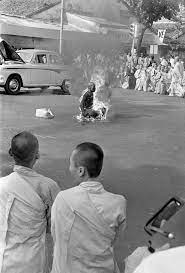
I remember the classic picture of a Buddhist monk who sat in the middle of a street. He was serene as he soaked himself with gasoline, and lit himself on fire as a protest against a war he believed was wrong and evil. He burned himself in front of the cameras.

All too often we’re pretty much responsible for our own self-immolation. It is we (and we alone) that set ourselves ablaze. Sin affects our minds and hearts. We set ourselves on fire.

When we sin– when we walk in ‘known’ disobedience we always put ourselves in an awful place. We love it but learn to hate it too. But we continue to do it regardless of the awful death that ensues.

God promises to forgive us. Out of our ashes, He keeps bringing us life and hope.

You can be forgiven. You can find life again, even if you’re fully responsible for the evil we’ve done to yourself. Yes, we all sin, and yes we walk in our own personal rebellion. But Jesus knows it all. These awful things we’ve all done can be forgiven.

As a man and a preacher of the Gospel, I realize that I often choose to sin. In spite of all I know and teach I realize that I can live in the ashes of my own making. As one who also struggles with bipolar, I understand that I’m even more susceptible to doing awful things. I understand that I choose darkness even though others will call me “a man of God.”

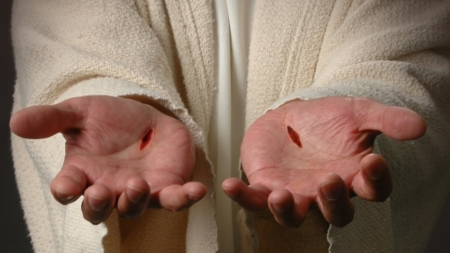
As you read this I’m praying that you find His forgiveness and mercy. You’ve come a long way it seems, but you must see His blood that was ‘released’ from His veins and arteries for you.

He desperately loves you–even if you’ve set yourself on fire, and sit in the ashes of your doing.

“To appoint unto them that mourn in Zion, to give unto them beauty for ashes, the oil of joy for mourning, the garment of praise for the spirit of heaviness; that they might be called trees of righteousness, the planting of the Lord, that he might be glorified.

Isaiah 61:3