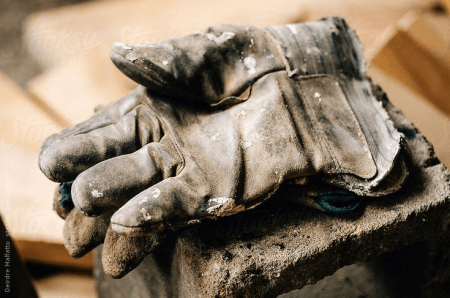
Love Wears Work Gloves

 “But if anyone has the world’s goods and sees his brother in need, yet closes his heart against him, how does God’s love abide in him?”

“Little children, let us not love in words or talk but in deeds and in truth.”

1 John 3:17-18, ESV

Love is a noble idea, it’s admired and extolled by practically everyone–we see it in our music and poetry, ethics and religion. For the most part it’s a word for something decent and virtuous and honorable. It’s a good thing, but I’m afraid it’s not always scriptural.

You see, Bible love wears work gloves.

It labors and sweats and works. Bible love has chores to do, and it actively looks and sees what needs to be done. 1 John 3 tells us that we shouldn’t deceive ourselves and only see the world’s definition. That love a believer has is to be different.

Love, in John’s eyes, is most assuredly “doing.” It burns spiritual calories as it labors to serve our brothers and sisters. Love finds things it can do–it doesn’t just talk but it gets busy. Love sees the need and then gets down to serve.

“You must show sincere love to each other as brothers and sisters. Love each other deeply with all your heart.”

1 Peter 1:22

Working (serving) has nothing to do with our salvation, that is a free gift. We’re saved by grace through the blood of Jesus–that’s a given. But this love isn’t  drudgery, as a matter of fact, working and serving each other is a joy. The deepest kind of joy there is.

Our words, although important, are really an insufficient way of proving our authenticity.  The love we serve another with isn’t “pretty poetry” kind of love. It’s so easy to just shout out truth and never ever show a working, serving kind of love. That sort of love is impressive, and can’t ever be duplicated.

That disconnect is a bit disturbing.

But when do we start to realize that this love is really a verb?

Our prayer and intercession really begins when we go to work for someone else. (Our lunch box is our Bible.) We read it and it energizes us to work for one  another. When we pray we truly are loving another brother or sister. It’s work that they can’t or won’t do for themselves. At least not yet. So we pray.

John is calling believers to a more real kind of love. His love is a love that sweats.

“The church is made up of individuals. It can do nothing except as its members work, and work together.”

     James H. Aughey

Dear reader–I really do pray for you. Your love impacts so many.


When Faith Doesn’t Seem to Work

by Terry Powell

I am not a Christian because my faith “works” for me. Talk to a devout Mormon, Muslim, or Buddhist and he’ll extol the here-and-now benefits of his faith. He’ll cite a serenity of spirit, or a sense of order that believing brings to his life. Yet his belief system contradicts mine, so logically these various faiths cannot all be true!

If I were a Christian just because faith has utility for me, because my days are more likely to unfold in a smooth, trouble-free manner, I’d be a pragmatist, pure and simple. And I’d be prone to shuck my commitment to Christ the moment a different philosophy or religion appeared to offer me more.

Don’t get me wrong. Following Christ is not without rewards in the present. My faith often sustains me, provides perspective for decision-making, and injects happiness rooted in a biblical worldview.

But not all the time.

There’s the inevitable warfare with the world, the flesh, and the devil to contend with. And in my case, either chronic depression or other weaknesses of temperament sometime get the best of me. I’ll keep praying for relief and I’ll strive for sound mental health, yet I don’t want to be among the growing number of Christians who expect God to give them on earth what He only promised for heaven.

From a theological perspective, I’m a Christian because God chose me and initiated a relationship with me (Eph. 2:1-10). From a human perspective, my faith is in Christ not because it works, but because I believe Christianity is true. And truth is objective reality, not a subjective experience. No matter how I feel, or how my day goes, truth doesn’t change. Truth just is. I wrote this poem to convey this point.

Nature of Truth

When all hope yields to despair

and I doubt that God is there;

when my heart is cold, unfeeling,

and my prayers bounce off the ceiling;

when depression takes its toll

and winter winds assault my soul;

when the race seems all uphill

and dying grows in its appeal;

when things don’t go as expected—

still, God’s Truth is unaffected.

In the long run, faith works in the sense that I’ll enjoy eternity with my Savior (thanks to His works, not mine). But being a Christian doesn’t shield me from affliction in the here and now. It does assure me of God’s compassion and healing presence: “He heals the brokenhearted, and binds up their wounds” (Ps. 147:3).

Love, Terry


Terry teaches in the areas of Church Ministry and Ministry Leadership at Columbia International University in South Carolina. He has served as a Christian Education staff member for three  churches, and he’s a licensed preacher in the Presbyterian Church of America.  His current books in print are Serve Strong:  Biblical Encouragement to Sustain God’s Servants, and  Now That’s Good A Question!  How To Lead Quality Bible Discussions. Terry has been married for 46 years, and has two sons, a daughter-in-law, one grandson, and a dachshund.  His constant prayer is, “Lord, make me half the man my dog thinks I am!”

Check out his blog at https://penetratingthedarkness.com/. His ministry is focused on Christians experiencing clinical  depression and other mental issues.


Walking the Tightrope

The Balancing Act

Circus performers have my enthusiastic admiration– especially the tightrope walkers! They move with such grace and courage. Their work above the crowds must be perfect, or else. I don’t even want to consider their failure. (I hope they can bounce).

To be a mentally ill or disabled Christian is just as formidable. We must walk out our condition 24/7, 365 days a year. It is relentless. We struggle with a weakness that pits us against symptoms and gravity of a spiritual kind. We get little support from others– sometimes criticism. It often is a very solitary feeling. We are often overlooked or scorned.

My particular rope is depression. Everyday I mount up and walk out on to it, holding my breath. I still fall a lot, but have a good safety net, and the Holy Spirit is my strength. Losing my balance happens. I pick myself up and climb up the ladder for another go at it.

“In fact, we expected to die. But as a result, we stopped relying on ourselves and learned to rely only on God, who raises the dead. 10 And he did rescue us from mortal danger, and he will rescue us again. We have placed our confidence in him, and he will continue to rescue us. 11 And you are helping us by praying for us.”

2 Corinthians 1:9-11, NLT

We must rely on God. It is His “job” to keep us, repeatedly. So day by day I “walk the line.” My meds are my balance pole, and I don’t need any special attention. I do whatever the day brings, and even that is from His hand.

Deeply Hurt for a Reason

Pastor A.W. Tozer seems to have gotten a hold on something here. Those who step into discipleship or ministry will inevitably be hurt in some significant way. I wouldn’t say it was a ‘given’, but it seems to be the common path we must take. We must be aware–but often we can’t or won’t understand. This is hard and we’re easily confused.

God really isn’t our problem.

He loves us and saves us and He really wants to bless us. He is all goodness and grace. He has no evil intentions concerning you, and certainly has no desire to see you suffer in a crisis of suffering or trial. Even in times of temptation, He simply views it as a step to strengthen us–He never is out to trip us up.

I really think that the issue is us.

Our old nature–the sinner inside, delights in things like pride and selfishness (even in religious matters). Some of the most difficult people I have ever had to work with were in places of oversight within the Church!  May I suggest something?

Could it be that the problem isn’t that we are too weak, rather, it is because we are too strong?

God’s intention is ‘to bless greatly.’ But my pride and self-will must be left at the door (repeatedly). My old nature cannot truly work in the Kingdom. Only when these issues are dealt with (repeatedly) will humility and brokenness transform us. Quite simply, there is no way around this. God uses broken things. We must be broken as well.

“It takes broken soil to produce a crop, broken clouds to give rain, broken grain to give bread, broken bread to give strength. It is the broken alabaster box that gives forth perfume.”

“It is Peter, weeping bitterly, who returns to greater power than ever.”

Vance Havner

Becoming broken often takes years of trial, temptation, and affliction.

But God is patient. He’s not in any hurry.

You will ‘log-in’ many hours in the desert. Many of His best soldiers have been recruited from that barren place. The Holy Spirit is our best guide through the difficult loneliness and aridity of this place. He will guide you, and comfort you.

I sometimes teach at a local Bible college–I love Song of Solomon and choose to teach it whenever I can. Here’s a verse that has encouraged me over and over:

“Who is that coming up from the wilderness, leaning on her beloved?”

Songs 8:5, ESV

“Before God could bring me to this place He has broken me a thousand times.” 

Smith Wigglesworth