Night Terrors, [Protected Children]

night-terrors-21467698 “You will not fear the terror of night, nor the arrow that flies by day,”

Psalm 91:5

flourish14

It is easy to fear. This can be the true reaction of a soul smacking up against the vicissitudes of life. Things do fluctuate, and we really can’t predict its issues with us. We hit it at an alarming speed, which only adds to the confusion. Who can act and react to all the twists and turns?And life can get strange. If you’re not afraid sometimes, you may not be human, lol.

But fear can be extracted from the believing Christian. 

“You will not fear” is the ‘buzzword’ repeated over and over. in scripture. And fear is such a complicated thing. (It really doesn’t ‘snack,’ it devours a person.) The believer carries the only antidote to the stark raving fear that eats away at the soul.

“The terror of night,” is a clear description of all that can occur in this life. Terror is such a powerful word. It embeds within with foreboding and a noxious kind of fear. It’s a kind of ‘panic’ in the face of an acute evil. It is hostile to the spirit and it claims all that it gets. Fear can drive a person to do some regrettable things.

 “Nor the arrow that flies by day,” Daylight means that the archer can see his prey. He doesn’t work at night, but uses his eyesight during the day. The arrow he shoots focuses at a singular point. He wants to pierce the heart. He strains at his bow, at the precise moment lets loose.

But we are given this precious promise, that gives us faith and acts like a shield and a buckler. The promise is given to unworthy persons. No one deserves the grace that has been given so freely. But we do take what He gives. We have a ‘stark-raving’ fear on one side, and on the other is a soul under protection. Our decision is obvious.

“You will not fear the terror of night, nor the arrow that flies by day,”

Psalm 91:5

This simple verse puts everything in its place. I’ve read it, and now choose to make it live by faith in this ragged heart of mine. Yes, the promise is real– no mirage and no tricks, no ‘smoke, or mirrors.’ It is a true offer of protection for the ‘child of God.’ He alone meets the need inside our hearts for safety.

aabryscript

Like this? Check out:

https://brokenbelievers.com/2014/06/26/the-snare-of-the-fowler-psalms-91/

Devotions, [Eugene Peterson, Interview]

eugene-petersonInterview with Eugene Peterson

Why Can’t I Hear God? By Nancy Lovell

The musical group U2’s Bono quotes Eugene Peterson from the stage. Readers of the best selling Bible, ‘The Message,’ find themselves holding onto lines from his ‘fog-slicing’ Bible paraphrase, and many other works. For several years now, TheHighCalling.org has provided a daily prayer and reflection by Eugene Peterson. Recently, we asked the man himself: What are devotions and why do they matter in our daily work?

Why do so few people who believe in God bother to know Him?

The most obvious answer is that we’re in a hurry and not used to listening. We’re trained to use our minds to get information and complete assignments; but the God revealed to us in Jesus and our Scriptures is infinitely personal and relational. Unless we take the time to be quiet, in a listening way, in the presence of God, we never get to know him.

The same question is why so few married couples really know their spouses. People get divorced after 20 years of marriage, and the rejected spouse says, “I never knew this was coming. I thought everything was fine.” But there was not much listening in those 20 years. Devotions are the discipline of being quiet and listening for what we don’t hear in the streets, in the media, in the workplace.

What about people who sincerely set apart time, read the Bible, stay still, and hear nothing? They ask themselves whether God’s voice is anything more than their own thoughts.

We’re not good at this. We’ve had no practice doing it. No wonder we only hear our own thoughts. This is why the church is so insistent that we do this whether anything happens or not. Supported by 2000 years of history, we know that God does commune with us in our listening. But because we’re so unused to this way of communion, we don’t hear it. So it takes time.

How would you direct someone trying to start?

I would say: Get your Bible and find a place. If you can’t do this daily (some people can’t because of their life circumstances; mothers with young children are obvious instances), try for at least 20-30 minutes, two or three times a week, or four. Don’t make demands on yourself too high. Don’t ask questions about, “How long is this going to take?” Believe that something does happen in that silence—usually through Scripture, but not always—in prayerful, attentive listening, knowing that you’re in the presence of God.

I ask for a commitment of six months; so don’t come back in three weeks and say nothing’s happened. I’ve never had anyone who’s done this at least six months who came back to me and said, “I did it and nothing happened; I’m going on to something else.” Not many who give this a fair test ever say that nothing happens. Also, when I’ve asked people to do this as their pastor, I also ask them to worship regularly. This is a place where the whole community is gathered and listening and being in the presence of God.

Is that how you started?

I was lucky. In the family I grew up in, I started when I was about 14 …mostly with the Psalms, but all the Scriptures become part of it.

In your writing and speaking, you must have seen moments when a person realizes, “Yes, I want more and I want God.” What turns on the light for people?

Often the motivation is that people are tired of the way they’re living. They think there’s got to be more than just the motions they’re going through and the work they’re doing. There’s a craving and hunger that they identify with God. There’s enough pain or boredom or something to motivate them to do something that the culture’s not telling them to do. I got a letter recently from a friend of 40 years. She had been a parishioner of mine for a long time. Then she was ill, and divorced; and she quit, just gave up. She quit reading the Bible, quit going to church. Six months ago she wrote me a lovely letter that she was sitting with a group of friends and, in her words, “a rooster crowed”—it all came back and she was a Christian again and aware of the presence of God. Isn’t that a wonderful phrase? ‘A rooster crowed.’

Who knows what went into that statement of hers? Twenty years of unhappiness, pain, suffering, disillusionment …but still there was the need.She would have said during that time she didn’t believe in God. But the rooster crowed. That’s why we use the term the Holy Spirit to explain times like this. Given that it’s hard to discipline ourselves to silence, listening—and to daily time in quiet—tell us about your devotions on this website. I wrote those in the early morning for 20 years, maybe 25 years. And what I was trying to do was be present to the Scripture, listen to God, and to write as honestly as I could. I wasn’t thinking about anybody else but me.

It’s really hard to be honest as a writer. You get these wonderful ideas, and you love to manipulate words and see if you can make it sound good. It’s hard to be honest, especially working for God. That was the thing I was most aware of. “Eugene: Don’t say anything that is not relational, immediate, honest; stay present to the text and be honest before God.” I believed if I could be honest, I could draw some other people to honesty, too.

To read the rest of this interview, you will need to follow this link: http://www.christianitytoday.com/workplace/articles/interviews/eugenepeterson.html

 

cropped-christiangraffiti1-3

The Difference the Holy Spirit Makes

Chesterton-disciple

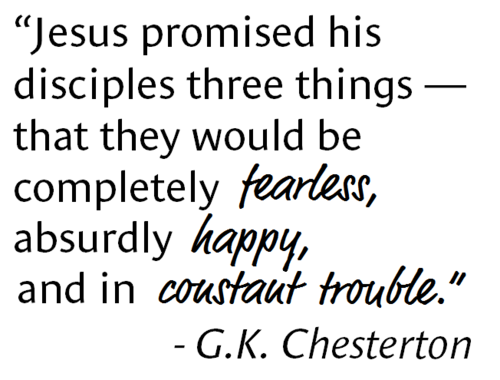
I like this quote. The early Church was all of these things: Fearless, happy, and very much in trouble. Luke wrote of the nascent exploits of this group of people in the Book of Acts, and while some believers will debate different aspects of theology, none can diminish the reality. These were human beings irrevocably touched by the Holy Spirit.

Some have even suggested that the title of the book be changed to “the Acts of the Holy Spirit.” (Instead of “Acts of the Apostles”).

When the fire of the Holy Spirit meets the dry tinder of the heart, it explodes into a conflagration that can’t be contained. It boils over and touches everyone around it. The disciples became fearless. Their boldness could not be diminished or diluted. They were so courageous (and contagious) that they preached to both kings and beggars.

They were “happy.” Once they had surrendered their personal ‘agendas’ they became immune to the negative issues of life. They soared with the eagles of contentment and joy. They no longer lived in the ‘mud’ of human life. They were ‘Teflon’ to that which can be so sticky. Happiness is the deep evidence of a personal contact with God’s own spirit.

But they ‘were in constant trouble.’ There may never been a people so maligned and persecuted. The apostle Paul faced daily obstacles. As the de facto leader of the church, he absorbed a lot of hatred and wrath that was focused on the early Church. Everywhere he went this darkness would descend, and each time God met him.

I suppose that we might ask ourselves, is this our experience? Am I fearless, and happy? Am I in ‘constant trouble” for the sake of the Gospel? (Do the police have my ‘mug shot?’)

Honest reflection is in order I think. We should really determine if we have the very same spirit that the early Church possessed. Whether or not, we should amend our relationship with the Spirit of God, and seek to be more tractable to His work. We start by believing the truth about our hearts and lives. The Truth is stronger than the lies.

This post was not intended to condemn. If you have read that into these words, I ask forgiveness. But reading this over, I will retract nothing. But I still ask that you ‘spiritually check’ each thought. Is it biblical, and does it glorify the Lord Jesus?

“I have told you all this so that you may have peace in me. Here on earth you will have many trials and sorrows. But take heart, because I have overcome the world.”

John 16:33, NLT


aabryscript


cropped-christiangraffiti1-3

Feeding the Dogs, [Choosing Holiness]

A toy I grew up with, they were magnetized pushing against each other.

There is a story of a Native American elder who once described his own inner struggles to understand the Bible and Christianity.

Inside of me there are two dogs. One is black, and the other is white. The black dog is mean and tries to talk me into making the wrong choices. The white dog is good and encourages me to make the right choices. The black dog fights the white dog all day.” When asked by the friend which dog wins, the elder reflected for a moment and replied;

“The one I feed the most.”

White Dog: As a believing Christian, there is a part of us that is Christ-spirited, compassionate, trusting, open, abundant and focused on helping others. We pray and are being filled with the Holy Spirit.

Black Dog: The other part is our flesh. We can be proud, evil, self-centered, greedy, manipulative, sullen, promiscuous, drunken, and only wants to he served by others.

“An analogy is made between the good white dog, our new nature in Christ, and the bad black dog, our old fallen nature. While we cannot eliminate the old nature, we can choose to feed the white dog.”

(From “The Holy Spirit: Activating God’s Power in our Life,” by Billy Graham 1978.)
 

howlingwolf3-300x281The main key for us to remember is that these two parts are in constant struggle.

Two Scriptures to help: One– “If you use your lives to do the wrong things your sinful selves want, you will die spiritually. But if you use the Spirit’s help to stop doing the wrong things you do with your body, you will have true life.”   Rom. 8:13, NCV

Two– “Our sinful selves want what is against the Spirit, and the Spirit wants what is against our sinful selves. The two are against each other, so you cannot do just what you please.”   Gal. 5:17

In thinking this through this analogy might help.  I’m inclined to think that holiness is not so much like an “on and off” switch.  But I think it’s more like a “dimmer” switch is turned to brighten or darken a room.  I actually think there are times when we should make a deliberate decision for God.  And yet other times we just need to turn up the dimmer from 30% to 80%. Maybe all the way?

I’m just thinking out loud here.

 bry-signat

flourish31