Coming Apart at the Seams, [S.A.D.]

sad-guy-alone
Seasonal Affective Disorder is real

If you notice periods of depression that seem to accompany seasonal changes during the year, you may suffer from seasonal affective disorder (SAD). This condition is characterized by recurrent episodes of depression – usually in late fall and winter – alternating with periods of normal or high mood the rest of the year.

Most people with SAD are women whose illness typically begins in their twenties, although men also report SAD of similar severity and have increasingly sought treatment. SAD can also occur in children and adolescents, in which case the syndrome is first suspected by parents and teachers. Many people with SAD report at least one close relative with a psychiatric condition, most frequently a severe depressive disorder (55 percent) or alcohol abuse (34 percent).

What are the patterns of SAD? Symptoms of “winter SAD” usually begin in October or November and subside in March or April. Some patients begin to slump as early as August, while others remain well until January. Regardless of the time of onset, most patients don’t feel fully back to normal until early May.

Their depressions are usually mild to moderate, but they can be severe. Very few patients with SAD have required hospitalization, and even fewer have been treated with electroconvulsive therapy.

The usual characteristics of recurrent winter depression include:

  • oversleeping,
  • daytime fatigue,
  • carbohydrate craving
  • and weight gain, although a patient does not necessarily show these symptoms.

Additionally, there are the usual features of depression, especially decreased sexual interest, lethargy, hopelessness, suicidal thoughts, lack of interest in normal activities, and social withdrawal.

Treating your SAD

Light therapy is now considered the first-line treatment intervention, and if properly dosed can produce relief within days. Antidepressants may also help, and if necessary can be used in conjunction with light. In about 1/10th of cases, annual relapse occurs in the summer rather than winter, possibly in response to high heat and humidity. During that period, the depression is more likely to be characterized by insomnia, decreased appetite, weight loss, and agitation or anxiety.

Interestingly, patients with such “reverse SAD” often find relief with summer trips to cooler climates in the north. Generally, normal air conditioning is not sufficient to relieve this depression, and an antidepressant may be needed. In still fewer cases, a patient may experience both winter and summer depressions, while feeling fine each fall and spring, around the equinoxes. The most common characteristic of people with winter SAD is their reaction to changes in environmental light.

Latitudes effect attitudes

Patients living at different latitudes note that their winter depressions are longer and more profound the farther north they live. Patients with SAD also report that their depression worsens or reappears whenever the weather is overcast at any time of the year, or if their indoor lighting is decreased. SAD is often misdiagnosed as hypothyroidism, hypoglycemia, infectious mononucleosis, and other viral infections.

http://www.ncpamd.com/seasonal.htm

http://www.mayoclinic.com/health/seasonal-affective-disorder/DS00195

http://www.alaskanorthernlights.com/


cropped-christiangraffiti1.jpg

My Pretend Jesus [Reality]

Aslan-lion-girl-sleeping

Question. Is the real you, touching the “real Jesus?”

For some time now, I am asking myself this simple question. I’ve had some convicting  moments as I swirled this question around in my heart. There is no condemnation in this; believe me– it’s just a question (But I think it has pretenses of being more.)

First, I truly believe that God does not hide Himself the way we might think He does. As new covenant people; those purchased through Jesus’ death and resurrection, there is no room for doubt about this. We now truly have access into the very throne room. We are free to come and go, according to our desire.

Second, I’m starting to realize that I want to approach Him, but I draw back in fear, guilt and doubt. I hide in the bushes when I hear Him approaching (sound familiar?) And although I have assurance that Jesus wants me, I’m not fully convinced that He likes being with me– deep down.

And I’m not sure I always like Him. So, all too often, I creep up (in my creepy kind of way) and try to get enough of His Holy Spirit, without getting pulled into anything too authentic. I’m of the (false) opinion that He will demand something for me I won’t like.

In the C.S. Lewis book, “The Silver Chair” we are introduced to Jill. She is thirsty, she looks for water and finds it in a nearby stream. But, there is a difficult problem. You see the lion Aslan is very close, and to drink would make her vulnerable. The Lion speaks. He invites her to come and drink all the water she wants. She stalls. He waits. The thirst quickly intensifies until she can think of nothing else.

I have a ‘Jill-heart.’  God is present, and quite eager for me to come satisfy my thirst. But it terrifies me to become open and vulnerable. It is hard. It seems I still have to work through this issue.

Sometimes, I find I construct a modified Jesus to allow me to cope with this problem. He is not the real Jesus, and somehow I know this. But encountering the real is a bit too much. So I have a Jesus that is really kind, and never corrects me. He lets me get away with a lot of things. And I don’t have to have contact with the homeless or tithe. I admit I’m fairly comfortable with Him. (He is like me, but more “god-like.”)

OK, new thought. Many centuries ago, a monk by the name of Lawrence wrote the classic book,  The Practice of the Presence of God. In it he directs the seeker to be in habitual awareness of God. And I’m thinking about this. I know it’s really not a fluid or unending experience, but throughout my day I take a moment and invite Jesus to come closer. And, it’s best if you don’t turn “the means into the end.” After  all, its the presence of God we seek– and not the mechanics of seeking.  Big difference.

I have gotten very dissatisfied with my fake Jesus. He’s not a bad guy, but he is only a “knock-off,” an imitation– an imaginary Jesus.

I’m coming to this place where I want the real Jesus– in contact with the real me, as often as I can. For years I have dodged Him, ducking in alleys and in dark places. I have propped up a Jesus that I found easier. Those days are done, I hope.

Question. Is the real you touching the “real” Jesus?

ybic, Bryan


cropped-christiangraffiti1-2

Of Adjectives and Disorders [Mental Illness]

4e327a2ad597c5b4d01de2a30649b04d

“Therefore each of you must put off falsehood and speak truthfully to your neighbor, for we are all members of one body.”

Ephesians 4:25, NIV

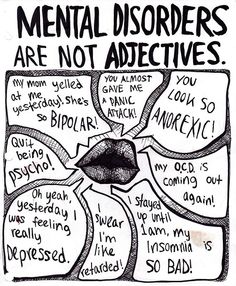
I catch myself using this strange new vocabulary quite a bit. There is a tendency to make adjectives where there should be nouns. There is an ‘in exactness’ in our thinking and speech.

Now we’re not the ‘policemen’ of other people’s grammar. We just should be aware of becoming too casual with mental disorders that can be quite debilitating to quite a few people. Do I ‘joke about’ having OCD when I try to do something precisely? (Sometimes.) Can I make light of being rather ‘retarded’ by some bone-head action I do? (More often than I’d like.)

I find I use terminology like this to explain ‘actions’ to give them a legitimacy as well as a medical reason to a situation. But when I do so, I can demean other people who actually are going through them for real. I also can label myself when I use these adjectives this way.

We really must be careful. We can use our language in such way that reveals our ignorance of the medical and psychological status of disorders. When we use words casually we start to ‘dilute’ them. They can describe a ‘reality’ of things that don’t really exist; we then end up speaking falsely and minimize the severity of a disorder.

“The true test of a man’s spirituality is not his ability to speak, as we are apt to think, but rather his ability to bridle his tongue.”

R. Kent Hughes

As a Christian believer, I also suffer from Bipolar disorder with delusions and anxiety. And yet, the Word tells me to always “speak the truth in love.” (Eph. 4:15). Listen to yourself, and let the Holy Spirit guard your words.

“Set a guard over my mouth, Lord;
    keep watch over the door of my lips.”

Psalm 141:3

bry-signat (1)

cropped-christiangraffiti1.jpg

When Anxiety Becomes An Issue

anxiety

 Can all your worries add a single moment to your life?”

Matthew 6:27, NLT

“And who of you by worrying and being anxious can add one unit of measure (cubit) to his stature or to the span of his life?”

Matthew 6:27, AMP

Anxiety can be described as “misplaced concern.”  Many are over-wrought and disturbed by the way life is developing for them.  They can’t make it work, and find themselves in a place they regard as perilous.  They are stressed and then try to imagine themselves to a place of success.  But a year from now, they will not have improved and find themselves in pretty much in the same place.

The evil of anxiety is that we become overly concerned with the future— today. 

Under a great deal of worry, we develop a deep tendency for fear.  Soon doubt filters in and we work ourselves up into a significant problem.  Seeking success we find ourselves in the chains of anxiety and worry.

Jesus declared that we should never ever be anxious.  He suggests that anxiety will never pay-off.  Our fear over our future can bring us nothing but spiritual poverty, and emotional crisis  We find a bag and we try to collect some security and certainty, but little do we know that our bag has holes.  It holds nothing, and leaks everything.

No matter what we think, we change a single thing.  Concentrating on wealth and success will in the long run, is futile and empty.  We can’t make an iota of a difference.

6 “Don’t worry about anything; instead, pray about everything. Tell God what you need, and thank him for all he has done. Then you will experience God’s peace, which exceeds anything we can understand. His peace will guard your hearts and minds as you live in Christ Jesus.”

Philippians 4:6-7, NLT

Security for us is not what we can scrape up, but it is found in coming under the control of Jesus Christ.  We have an awareness that life is cruel, capricious and demanding.  We sift through our life, our eyes eager to find something, anything that will help us.  And, we find nothing. But faith in God will push the anxious thoughts out.

“An unpeaceful mind cannot operate normally. Hence the Apostle teaches us to “have no anxiety about anything” (Phil. 4:6). Deliver all anxious thoughts to God as soon as they arise. Let the peace of God maintain your heart and mind (v. 7).”

Watchman Nee

Anxiety seems to be a disturbing companion to those of us with a mental illness.  (We definitely don’t like his company.)  Anxiety shapes us and victimizes us, and we often find ourselves in a confusing place. But understanding the presence of anxiety is just a half-step towards freedom. We must shake ourselves of the fear and doubt that accompanies this sin.

We must trust our Father, and completely lean on his grace. We must learn to pray again.

Important to Know:

General Anxiety Disorder (GAD) is a seperate category of mental illness, and although similar to the anxiety experienced by many, requires the help of medical professionals.  We should not confuse the two. GAD is an illness and not just basic anxiety. Panic attacks can often accompany GAD. Get help if you think this might be an issue for you. 

Visit http://www.medicinenet.com/panic_disorder/article.htm for more information.


1brobry-sig4


cropped-christiangraffiti1 (1)

#