Counseling Others


“Rash language cuts and maims, but there is healing in the words of the wise.”

Proverbs 12:18, Message

Lately, I have grown skeptical of my own ability to give out sound counsel.  For the most part I have refrained from doing so, lately, I introduce them to the wisdom and love of Jesus.  It seems like a it’s a bit like a triangle– Jesus, them and myself–we each have a corner.  All I do when I counsel someone is to help them see the Lord.  Hopefully, once a dialogue has taken place I step back and let the supernatural happen.

Much of counseling is facilitating or creating an environment that you can gather information.  Probably your friend feels that you and your surroundings are “safe” and he/she can open up in that situation.  Almost all of the time, a certain level of confidentiality must exist and be understood as being “in place” even among peers.  

A key fact is getting permission to counsel.This should happen in order for the counselee to really receive.

Job3friends
Job with his Friends

Usually when if I meet with someone, I don’t want to sound profound, or wise; I’m still trying to follow Jesus myself.  I recognize the Holy Spirit gifts the un-gifted. But I’m also pretty much aware of my own short-comings. (I guess this can make me a better listener and not a talker?)

Remember that Job’s friends were at their best when silently sitting with him in the ash and rubble. At that moment, they were very effective counselors.  The problem came when they verbally explain why Job’s personal disaster took place.  Very often I find that people have a need to be needed.  Some well-meaning believers give counsel so they can feel good about themselves. 

I’m afraid there is a lot of Christian counseling out there that is sabotaged by this inherent flaw.

Part of speaking wisely to a friend must include the option that I might be totally off-the-wall! Whatever I say must not be “ex cathedra“, or as truth unchallenged.  And just because I’m giving you counsel does not make me superior, wiser or more authoritative.  It really should take as much humility to counsel, as it takes to be counseled. I can think of an easy dozen encounters that I’m embarrassed by– and will never be able to retract. Mistakes are made, but we should trust the Holy Spirit to use those missteps. He is sovereign.

Peer-to-peer counseling is very much a blessing.  A great need exists in the church for this particular ministry.  But to be a source of wisdom to another should be both a sobering, and a clarifying experience.  To be a counselor can be quite dangerous, spiritually speaking, and I should not seek this place unless its thrust on me. A good counselor is almost always reluctant.


“If you young fellows were wise, the devil couldn’t do anything to you, but since you aren’t wise, you need us who are old.”  Martin Luther

“If you have knowledge, let others light their candles at it.”   Thomas Fuller


bry-signat-1-1


cropped-christiangraffiti1 (3)


Spellbound Captives of the Night


“We are all infected and impure with sin.
      When we display our righteous deeds,
      they are nothing but filthy rags.
   Like autumn leaves, we wither and fall,
      and our sins sweep us away like the wind.”

Isaiah 64:6, NLT

There are bad things that happen to us— ugly, awful and evil things, that only God himself can explain.  We read theology and we read our Bibles, we listen dutifully to preachers, but we still ‘can’t’ fathom this terrible ‘mystery of iniquity.’ “Filthy rags is what we wear. Our sins have destroyed us.

We are seem to be playing ‘ping-pong’ with the most challenging  issues.  We come to Him, because there is no one left who can answer things that have perplexed everyone else.  Why do we suffer?  Why does evil exist?  Why do people who live in blatant sin, succeed?  Why am I sick all the time?

If God is really God, why doesn’t he just give us an explanation about these questions?  Our title talks about being “spellbound.”  Are we really that inured, attached to a truly sinister evil, that we are being confused about what is real or true?  To be spellbound means we’re being hypnotized by something quite awful.  A cobra rises up, and opens its “hood.”  Its victim is entranced by what it sees in front of it.  He soon becomes supper.

Being held captive seems to be an ordinary occurrence for human beings.  Captivity implies imprisonment.  Usually in a dark, dirty and unpleasant place.  But yet, it intrigues us so much, and after all the “light” is such a boring and dull thing.  We feel great as we trade the truth for lies. We never realize that satanic power has blinded us.

 “And you were dead in the trespasses and sins in which you once walked, following the course of this world, following the prince of the power of the air, the spirit that is now at work in the sons of disobedience— among whom we all once lived in the passions of our flesh, carrying out the desires of the body and the mind, and were by nature children of wrath, like the rest of mankind.”

Ephesians 2:1-3, ESV

From this new and fresh influence we come under the control and will of ‘the dark side’.  (And this is not merely “Star Wars” mythos.  It is very real.)  We gradually give ourselves over to the dark. We think we are pretty much impervious to being deceived, but the truth is that we’re already blind. In our lostness we can only stumble through life.

And this is the judgment: the light has come into the world, and people loved the darkness rather than the light because their works were evil.”

John 3:19

At this point things have gotten desperately grim.  From a human standpoint, there will be no way to avert the inevitable.  Sin will roll over you, blasting into your life, and worst of all into the hearts of your family.  In a stark way— things get very dark, very fast.

Sin will always enslave.  It will turn on you and rock your world. 

But we are so entranced by what it wants to give us.  It looks so good…one could call it “self-actualizing.”  (Maybe even “liberating!”)  But in one of the many purposes of the Old Testament, is to clarify what happens in people’s hearts when we step down and let the sin and confusion take over.  You could say, that there will be pleasure for a brief season, but  it will always have a very savagely grim and a black conclusion. ”For the wages of sin is death.”

Jesus forgives us, and lifts the darkness. We start to see things as they are, reality breaks out in our minds. He has changed everything. His blood covers us, and we start to walk in what is true. We finally understand what sin has done to us, and we turn from it to what He now gives freely.

“If God thinks this state of war in the universe a price worth paying for free will then we may take that it is worth paying.”  

–C.S. Lewis

Your brother in Christ,

Bryan

Treasures Found in the Clay

“But we have this treasure in earthen vessels, that the surpassing greatness of the power may be of God and not from ourselves; we are afflicted in every way, but not crushed; perplexed, but not despairing”

2 Corinthians 4:7-8 (NASB).

Paul speaks of treasure, or of something of tremendous worth. We seldom place value on things with the same intensity that God does. Its obvious that as a culture our values aren’t really biblical. Paul understands this overriding principle of the eternal over the temporary. God’s power–treasured. Our weakness– accepted.

The rationale for this “making room” for the power must be understood. Its only when we grasp this holy ‘mechanism’ can we sparkle and shine as believers. It is of God, not of ourselves. Paul says that we are afflicted in everyway imaginable. From disease, to injury, to difficult relationships, to a simple toothache. Believers run the full gamut of affliction.

It all is significant, it all means something!

As a former Army medic, some of the worst injuries were “crushing” ones. The human body experiences things that are so heavy that they simply collapse.  At times like these it seems the best you can do is make a pile.  To be crushed is a terrible thing.

God’s Rubik’s Cube

He says that we are “perplexed”. The word means, “to feel completely baffled by.” It’s when something is so complicated that we can’t figure it out. Have you ever been given a ‘Rubik’s Cube?’ You twist and turn, trying to get the same colors on the same side. Every move affects the outcome. And you just can’t seem to get it right.  (I once peeled of all the colored stickers off and re-stuck them, but I was having “ego problems” that day.)

God gives His children a spiritual ‘Rubik’s Cube.’

It maybe a family crisis, or a medical issue. You could be trying to figure out your spouse. But the problem is that it totally baffles you. There is no rhyme or reason that you can see. Everyday you try again and again.

There are some things that so confuse and mystify that we begin to doubt everything we have been taught. But, we are not to despair. Despair is not for the believer. We may not understand, we are baffled by the present circumstances. We may come close, but we can not despair. God has promised that he will use this time of affliction, and its outcome will be glorious.

 “And I am convinced that nothing can ever separate us from God’s love. Neither death nor life, neither angels nor demons, neither our fears for today nor our worries about tomorrow—not even the powers of hell can separate us from God’s love.”

Romans 8:38

In the KJV of Romans 8:38, the phrase used is “nor things present.” What is your present predicament? It cannot separate you from the love of God. He cares for you, even if the moment is hard and miserable. God often tests His real friends more severely then the lukewarm ones.

At the end, God will not look you over for medals, or diplomas, He will look you over for scars.

bry-signat (1)

cropped-christiangraffiti1.jpg


Little Pieces of Obedience

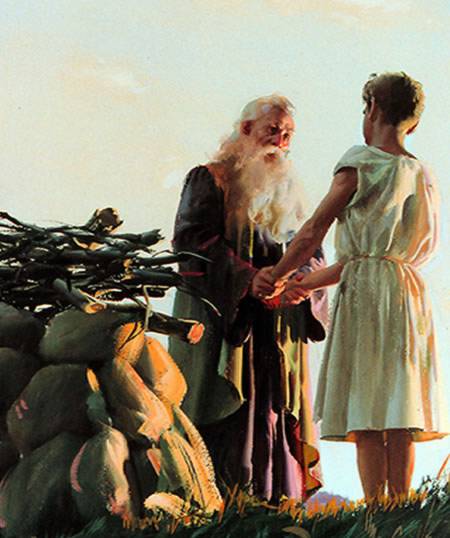
abraham_isaac_1

“It was by faith that Abraham offered Isaac as a sacrifice when God was testing him. Abraham, who had received God’s promises, was ready to sacrifice his only son, Isaac, 18 even though God had told him, “Isaac is the son through whom your descendants will be counted.”19 Abraham reasoned that if Isaac died, God was able to bring him back to life again. And in a sense, Abraham did receive his son back from the dead.”

Hebrews 11:17-19, NLT

The faith of Abraham is understood by believers everywhere. This simple man followed God to a obscure mountain in Judea. He came fervently, and yet logically to the command of the Lord. Abraham’s confident assurance would carry him to Mt. Moriah were he would sacrifice his son. He would prefigure God’s own sacrifice of Jesus Christ, His only Son.

There were many steps Abraham had to take: the knife, the rope, the firewood, the donkey. There was a dozen details to arrange. Abraham would have had to plan ahead of time to prepare. I’m relatively certain he had ample time to consider what he was doing. The enormity of it all would’ve been staggering.

Hebrews reveals that ‘faith’ was what enabled Abraham. It was faith followed by a dozen little obediences that strengthened him to follow God’s instructions. Abraham would obey God, through faith, by doing many little things. All would lead up to the ‘big thing,’ the offering up of his only son.

I believe that no act is too small. Heavy doors swing on small hinges. Tiny obediences make for big ones. And sometimes we can’t tell them apart. It seems that several times during our daily grind we face little choices that often determine a far greater meaning. I’ve been told that there are flowers in alpine valleys that no man will ever see. Their sole beauty is visible only to God. Obedience is often like this. But the Lord knows.

God meets every act of obedience to Him with a smiling grace.

Hebrews 11 is known as the believer’s ‘hall of fame’. In its verses we’re pounded by the idea that the faith is visible only through obedience. What we do is as significant as what we believe. It has always been so.

“…but the people who know their God shall be strong, and carry out great exploits.”

Daniel 11:32, NKJV

Little obediences prepare us for big ones. If we won’t obey in the small ones, how will we in the big ones? The prophet Daniel spoke of a remnant that would do astonishing things, and that the core of their fame would come from knowing God. This is faith made visible. The ‘great exploits’ spring out of a faith in a strong God. To be regarded in this way would be wonderful, but faith needs those little obediences to be able to do the great ones. 

We must reclaim the reality that the details of our lives are not trivial.

bry-signat (1)


cropped-christiangraffiti1.jpg