A Few Bipolar Basics

Bipolar disorder symptoms are characterized by an alternating pattern of emotional highs (mania) and lows (depression). The intensity of signs and symptoms can vary from mild to severe. There may even be periods when your life doesn’t seem affected at all. Take care when this happens.

The manic phase of bipolar disorder–
Signs and symptoms of the manic phase of bipolar disorder may include:

  • Euphoria
  • Extreme optimism
  • Inflated self-esteem
  • Poor judgment
  • Rapid speech
  • Racing thoughts
  • Aggressive behavior
  • Agitation
  • Increased physical activity
  • Risky behavior
  • Spending sprees, credit card irresponsibility
  • Increased drive to perform or achieve goals
  • Increased sexual drive
  • Decreased need for sleep
  • Tendency to be easily distracted
  • Inability to concentrate
  • Drug abuse

The depressive phase of bipolar disorder–
Signs and symptoms of the depressive phase of bipolar disorder may include:

  • Sadness
  • Hopelessness
  • Suicidal thoughts or behavior
  • Anxiety
  • Guilt
  • Sleep problems
  • Appetite problems
  • Fatigue
  • Loss of interest in daily activities
  • Problems concentrating
  • Irritability
  • Chronic pain without a known cause

Types of bipolar disorder
Bipolar disorder is divided into three main subtypes:

  • Bipolar I disorder. You’ve had at least one manic episode, with or without previous episodes of depression.
  • Bipolar II disorder. You’ve had at least one episode of depression and at least one hypomanic episode. A hypomanic episode is similar to a manic episode but much briefer, lasting only a few days, and not as severe. With hypomania, you may have an elevated mood, irritability, and some changes in your functioning, but generally, you can carry on with your normal daily routine and functioning, and you don’t require hospitalization. In bipolar II disorder, the periods of depression are typically much longer than the periods of hypomania.
  • Cyclothymia. Cyclothymia is a mild form of bipolar disorder. Cyclothymia includes mood swings but the highs and lows are not as severe as those of full-blown bipolar disorder.

Other bipolar disorder symptoms:

In addition, some people with bipolar disorder may have rapid-cycling bipolar disorder. This is the occurrence of four or more mood swings within 12 months. These moods shifts can occur rapidly, sometimes within just hours. In mixed state bipolar disorder, symptoms of both mania and depression occur at the same time.

Severe episodes of either mania or depression may result in psychosis or a detachment from reality. Symptoms of psychosis may include hearing or seeing things that aren’t there (hallucinations) and false but strongly held beliefs (delusions).

Taken from the Mayo Clinic/Bipolar Disorder Symptoms.

Our Salvation Is Quite Sure

My favorite of all the apostles is John, “the disciple whom Jesus loved.” I love his Gospel, the three epistles that he wrote, and of course,  Revelation.

There are a couple of things I love about John’s writings:

  1. He reminds his readers that he was an eyewitness to Jesus’ life, death, and resurrection.
  2. He clearly sets out the evidence for Jesus’ divinity.
  3. He focuses, particularly in the epistles, on the love of God.
  4. He reveals the power and purpose of the Holy Spirit in the lives of believers.
  5. He provides believers with an assurance of salvation.

It is this last point that I want to write about today.

Early in the history of the Christian faith, deceivers had come into the church who taught that one had to achieve sinless perfection to be saved. John wrote his first epistle to combat this heresy. The same type of heresy has crept into many legalistic denominations even today. By outwardly following the rules, such people claim to be without sin. But as John writes:

If we claim to be without sin, we deceive ourselves and the truth is not in us. If we confess our sins, he is faithful and just and will forgive us our sins and purify us from all unrighteousness. If we claim we have not sinned, we make him out to be a liar and his word is not in us.

1 John 1:8-10 (NIV).

John here provides assurance that the fact that the believer sometimes sins does not negate their salvation, because Jesus is faithful and forgives our sin. One of the definitions of assurance on Dictionary.com is “full confidence; freedom from doubt; certainty.” Throughout this epistle, John provides further assurance that those who trust in Jesus can be assured of their salvation even though they are not sinless and perfect.

The word “know” appears 42 times in this short epistle.

John wants to make sure believers know that God loves them and that they can rely on His promise of salvation. In each of the chapters of the epistle, John includes his assurance:

I am writing to you, dear children,
   because your sins have been forgiven on account of his name.
I am writing to you, fathers,
   because you know him who is from the beginning.
I am writing to you, young men,
   because you have overcome the evil one.

1 John 2:12-13 (NIV).

“Dear friends, if our hearts do not condemn us, we have confidence before God and receive from him anything we ask, because we keep his commands and do what pleases him. And this is his command: to believe in the name of his Son, Jesus Christ, and to love one another as he commanded us. The one who keeps God’s commands lives in him, and he in them. And this is how we know that he lives in us: We know it by the Spirit he gave us.”

1 John 3:21-24 (NIV).

“If anyone acknowledges that Jesus is the Son of God, God lives in them and they in God. And so we know and rely on the love God has for us.”

1 John 4:15-16 (NIV).

“I write these things to you who believe in the name of the Son of God so that you may know that you have eternal life. This is the confidence we have in approaching God: that if we ask anything according to his will, he hears us.”

1 John 5:13-14 (NIV).

None of us is perfect and completely sinless. If we were, we would not need a Savior. But we do need Him, and we thrive best knowing that He is faithful in His promise of salvation for those who believe.

John does not advocate living a life in which we sin ‘willy-nilly’ simply because we know we can be forgiven.

Now don’t get me wrong. Those who truly believe in Jesus, and trust in Him for salvation, will desire to keep God’s commands. His Spirit living in our hearts will help us to overcome the temptations of the world and to love as He has commanded.

You may be struggling today with worries that you are not good enough, or that God will give up on you and you will lose your salvation. But remember – God is faithful in His promises and He has promised eternal life to all who believe in Jesus and allow His love to live in them. He has not hidden the truth from us but has made Himself known through His Son and the witness of the apostles so that we can be assured of our place in His Kingdom. Your salvation is sure.

Checkout my other page

Getting a Grip on Boredom

Monotony can easily become an issue for many. I had been told to be on alert for it, but it seems like I’ve got to learn for myself.

With any chronic illness, there can be something tedious and routine about life. To have a physical or mental illness is acutely painful in many different ways. Afflicted people understand what I’m talking about. Pain can be intense and intrusive. Sometimes these things can become really depressing.

The sheer boredom of my illness can strangle my walk. It seems every day is the same and the foreseeable future holds little hope of it changing. Now I’m a reasonably sedate person. I don’t need a lot of excitement. (I like a good book and a cup of tea.) I’m not after adventure, but I don’t care too much for monotony either.

Brain-numbing existence is quite common for the afflicted.

Many people don’t understand this. Others do. And it’s not limited to us who struggle with illness. It’s seen in other people too. This brain-numbing life happens to many as well. Consider–

  • the single mom working as a secretary
  • the man mopping floors
  • the college grad frying burgers
  • the resident at the old folks’ home, every day is the same

These situations seem inescapable. We see ourselves locked into a situation where escape is not possible. We are consigned to do whatever our circumstances dictate. We’re all trapped. Pure and simple. We can find no meaning in our lives; we start to despair, “Will it ever be different?”

I believe the drabness of our lives can often be attributed to a lack of intimacy with the Lord Jesus. We are built for fellowship with God, and anything else is just “treading water.” Nothing satisfies, except Him present. I need Him desperately.

When I’m filled with hopelessness, I often find myself filling the emptiness with anything I can find. This usually leads to even more sadness and deadness inside. It’s a vicious cycle that destroys as easily as more gross and obvious sin.

When I ponder my hopelessness I feel like giving up. I simply don’t want to take another step into the doldrums of what my life has become. I despair that life will continue its suffering grind.

I must have joy in order to survive.

“The joy of the Lord is your strength” (Neh. 8:10). I don’t have to dwell in the grey drabness of hopelessness. My heart can find a reason to “sing to the Lord.”

“The Lord is my strength and my shield; my heart trusts in him, and I am helped. Therefore my heart celebrates, and I give thanks to him with my song.”

Psalm 28:7, CSB

The Psalms repeatedly tell me the incredible power of a life that sings.

The Holy Spirit understands our brokenness. Jesus is interceding for us at this very moment, and I can rise above this tedious mess I have made for myself. This is the only way out for me. Depression is a form of suffering.

I give it to Him. I take the strength and joy He gives.

Jumpstarting a Prayer Life

We must (MUST!) pray as believers in Jesus. Prayer is the oxygen of our spiritual life. We must breathe, or else. When I go to my doctor she puts an 0ximeter on my finger so she can assess how my lungs are using oxygen. I suppose if we would put it on our “spiritual finger,” might it reveal something?

We don’t know exactly how to pray, I think communicating with God isn’t natural. We must be taught. The disciples wanted desperately how to pray–they didn’t know how, (Luke 11:1-2). So, we too must have Jesus teach us.

We can only learn how if the Spirit teaches us.

Also, we must practice praying. We may do it terribly rotten, but we should never give up–it’s not natural–it’s supernatural. But we learn by doing. We may get discouraged but keep at it. Even if you’re a pro, the Holy Spirit will make sure you keep learning. Our walk should always grow deeper.

For me praying the Psalms is good practice, and there are 150 of them. The Jewish people have a 4000-year start on us–they’ve used the Psalms as their prayer/praise book. My sense is that this covers every human need–the entirety of our spiritual walk!

I think that Psalms 103 might be a great place to get started.

I’ve been told by some that the “Lord’s Prayer” is quite useful as well. I guess if you honestly take it phrase by phrase, something good will happen. I’m still learning (and I suspect I still will).

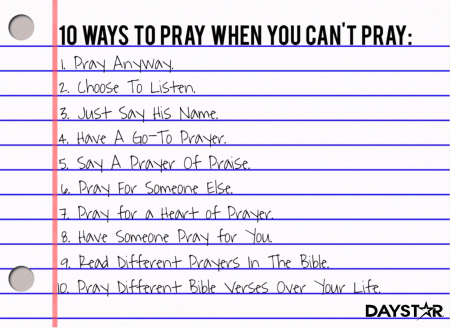
Below we find a way to jumpstart our prayer life. I hope you can use it.

One more thought. “Conversational Prayer” is a good thing for me lately. Talk with Jesus as if He was in the same room with you (He is) and just converse. Share your ups and downs, and it’s okay if you feel messed up. Relax. He’s your Father!

He absolutely loves talking with you.