Grasping Grace, an Excerpt

I was seventeen when I faced the most difficult decision of my life. At the time, I justified it as my only option.

Curled up on my bed, in what had once been my safe haven, I squeezed my eyes tight, holding back a flood of tears. I gasped for air and shuddered at the thought of telling my parents.

The scene played out in my mind over and over. Shaking and trembling, unable to look either of them in the eye, I would force the words “Mom, Dad, I was raped and I’m pregnant.” Dad’s cheerful grin would disappear. Mom would give me the silent stare that said it was all my fault.

Escape plan

With each passing day, I wasn’t getting any less pregnant. I had to do something. But what? I had my whole life ahead of me. I had college plans and a career, which didn’t mesh with becoming a teenage mom. College was going to be my escape from my crummy hometown.

Getting pregnant was a bit like the run on the Bailey Savings and Loan that kept poor George Bailey from getting out of Bedford Falls in It’s a Wonderful Life. Only I didn’t stay and save the town from Potter. I took the money and ran.


The Rest of the Story

This is my story. Well, one of my stories. I, just like you, am made up of many stories. To read the rest of this story, see the full article “Grasping Grace” on Now What?, the online magazine of Bible Advocate Magazine.

anotherfearlessyear.net

Walking in the Darkness

  • We are afflicted in every way, but not crushed
  • perplexed, but not driven to despair
  • persecuted, but not forsaken
  • struck down, but not destroyed;

2 Corinthians 4:8-9, ESV

The issues we face can be formidable. Our relationships and our circumstances can bring daunting obstacles to joyful Christlike living. We live out at times from unpleasant realities and less than ideal situations. We are broken believers who follow Jesus through our deadly minefields.

Struggling with mental illness is just as much a challenge as with any other handicap. The young man struggling with bipolar disorder or someone else who faces a clinical depression, may seem to be tangled up in something quite brutal and very hopeless. “Will I ever find normal again?

I know that struggle and at times it has ripped me apart. But I suppose the grinding hopelessness is the worst part of that.

I want to encourage you in this. The issues we face on a daily basis are hard. And we don’t minimize their complexity or diminish their bitterness. They can be awful. But the Holy Spirit is with you in the midst of your issues. That’s a promise.

There is a wisdom emanating from the fire. It’s only waiting for discovery. The flames can not destroy us when God shows up.

I believe that the constant presence of difficulty produces a faith and tenderness that can’t be just prayed for.

The most kind and gentle people are those who themselves have been afflicted.

Please understand we have a real challenge. We have to walk through the trials or tests, not around them. We see a mountain, and God gives us a shovel. But He also gives us the strength we need.

But I’ve discovered a tenuous joy in these issues— more precisely, a joy because of them. Our illness is not meant to destroy us. That is not why God has allowed you to be afflicted.

I definitely did not choose this path I’m on.

Think about Jesus’ great love for people with hard issues:

Luke 7:21

Jesus has special spot for the afflicted, we see him repeated touching them. He drew them like a magnet draws iron. And he is the same today in our time. It is comforting to know that he cares for us and that we are understood. Let him draw you into his caring presence.

Our disabilities do not trouble him. Yes, I know the issues are formidable. But your obedience in them is an exquisitely special commodity to Jesus. I believe He values the shaking faith of broken people far more than the happy shiny people with no pain or scars.

Faith is precious in his sight and holds its value for all eternity.

Understanding this should be a cause for joy for the broken believer. Having the lightness of heart, right in the middle of our disability, often transforms these issues into a lighter burden. We are  beaten but not totaled. Incredibly challenged but not completely devastated. The apostle wrote this in his letter to the Corinthians, and it gives us hope.

I have learned that if I can bless a difficult thing it will bless me.

If we curse it and it will curse us. If you bless a situation, it has no power to hurt you, and even if it is troublesome for a time, it will gradually fade out, but only you can only sincerely bless it.  

There’s a deep joy waiting for those who choose to do this.

I guarantee it!

Depression: A Few Questions

Here are things I’ve heard over the years that we must take a second look at. Here are some possible answers.

“There must be something wrong with your spiritual life.”

Yes, depression CAN be a result of sin. BUT depression is NOT always a result of sin! If it is, God will tell you loud and clear what the problem is. This saying piles on the guilt for the depressed Christian. It’s unlikely that their depression has a spiritual cause, and this implies that they are not good enough spiritually.  

“Repent and ask forgiveness for your sin!”

Depression is a result of sin, in that if there was no sin in the world depression wouldn’t exist. But then, neither would diabetes, cancer, or any other illness… Sin caused the world to be not-perfect, therefore illness exists. It’s a sin to be depressed, any more than it is to have any other illness. Depression can be used by God to encourage repentance, but in that case, it will be crystal clear exactly what sin you should repent of. If you don’t know or have just a vague sense of guilt, your depression is not the result of sin. 

You need to have more faith.” or  “Have faith in God.”

Hebrews 11:1, “Now faith is the substance of things hoped for, the evidence of things not seen.” How much faith does it take to hold onto the Christian faith when emotions scream at you daily to give up, get out and turn against God? Very often a depressed Christian will be hanging onto faith by their fingernails in something that requires a ton of faith.  

“Taking antidepressants is playing God, He can heal you.”

Yes, God can heal. Sometimes he doesn’t just flick a switch to make the illness vanish, sometimes the healing comes through the conventional ways of doctors, psychiatrists, counselors, therapists, and medication. By persuading someone not to take their medicines in preference for a quick, supernatural healing that God may not have in store for them, the sufferer is being denied something that will help them, right now. 

“Scripture says everything that happens is for your own good!”

The actual verse found in Romans 8:28, “And we know that in all things God works for the good of those who love him, who have been called according to his purpose.” This verse in no way implies that the sufferer should sit back and accept the illness for the rest of their life. It also does not say that illnesses are not to be fought with the intention of a cure. While God may well have things to do with a depressed person, the illness is not a good thing itself, and it may take years before you see positive results from it.  

“You’ve been prayed for, why has nothing changed?”

This can be expressed in several ways and spoken by one of two different groups of people: either the person who asked for prayer or those who prayed for them. We’ll break the underlying situation into two areas: something definite was experienced in the prayer time: chains were obviously broken and new freedom gained, or, nothing apparently happened at all. That is, “I know God set you free,” why aren’t you free yet?

“Depression is a self-discipline problem.”

Self-discipline is important to a Christian. We have to be disciplined enough not to break the laws of the land, and to obey our God. But no amount of discipline will get rid of a medical problem. This statement implies that the sufferer is lazy and could become better by sheer force of will. This is not possible and causes a lot of guilt.

“You’re depressed because you choose to be.” 

Why would anyone choose depression? It is hell on earth. It destroys everything it touches. Families, marriages, jobs, churches, and ministries- faith, peace, hope, and love. Depression corrodes all that it touches.

Does a diabetic or cancer patient choose their disease? Does the blind or the deaf person wake up in the morning and decide they aren’t going to keep being handicapped? These are the questions I would ask.

This image has an empty alt attribute; its file name is image-12.png

“You just need to rebuke that spirit of depression and tell it to leave you. Don’t let Satan steal your joy.”

There are two problems with this statement. One problem is the assumption that depression is caused by demonic oppression. The other problem is the assumption that joy and happiness are the same things. Blaming a “spirit of depression” can be a wonderful cop-out. Just cast out the spirit and you’re cured! No need for long-term support, prayer, counseling, or anything at all! And with this statement comes the implicit assumption that once again it’s your fault you’re depressed, this time because you’re not “spiritual” enough to get rid of the troublesome spirit yourself.

Yes, it is possible that demonic oppression can cause depression. No, demons are not responsible for every case of depression. Imagine what would happen if this statement was directed at someone with cancer, hemophilia, or osteoporosis (“Just cast out that demon attacking your bones and be strong again! God wants to see you running marathons!”).

The second problem with this statement is that joy is equated with happiness. People with depression are not going to be the happiest souls in the church. I’ve heard it said that happiness depends on what happens, whereas joy can exist in very unhappy situations.

“There’s no such thing as mental illness, it’s all in your mind”

Saying this denies that there is anything actually wrong with the depressed person, and implies that they are just making it up. This piles on the guilt again! A mental illness can be defined as one that affects the mind; the brain is allowed to get ill, just as the liver and lungs are.

“It’s your own fault you’re depressed”

This is the kind of thing that Job’s “comforters” said, and it didn’t help then either. Bad things can happen to good people. Denying this hurts the sufferer.

“Pull yourself together”

If you’ve been trying, someone saying this to you comes across as “You haven’t been trying hard enough, do more, and more, and more until you get it right.” So back you go, pushing more and more, and still getting nowhere because you cannot pull yourself out of depression by your bootstraps, and you can’t fix a medical problem by force of will.

bry-signat-1

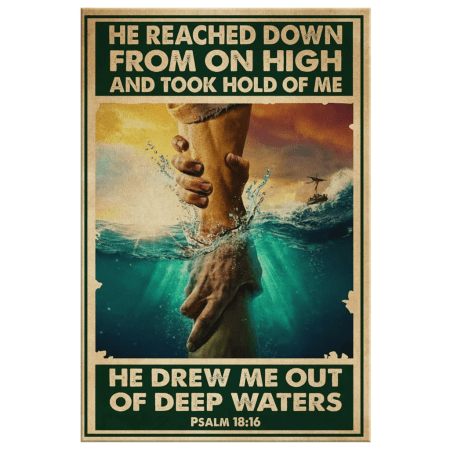
Deep Waters

     F.F. Bruce

I wrote a simple poem that I hope will bless:

Tears and sorrow overwhelmed me
day after day after week after year
No relief in sight as hopelessness
appeared to win and then

He drew me out of
deep waters

Each day presents a new challenge
or the same challenge never ending
And I feel like I’m drowning
in evasion and falsehood but

He draws me out of
deep waters

Tedium is like rising water
and I’m not that tall so
it’s sure to be over my head
eventually and yet

He draws me out of
deep waters

New loss reminds of past loss
and grief changes but never goes away
floods emotion unexpectedly
till I’m drowning and then

He draws me out of
deep waters

And in the end I soar above
the deep waters in faith
knowing He will always
draw me out

I love you so much, even though I’ve never met you.

Linda K.

My site can be found at AnotherFearlessYear.net