When Jesus Becomes Real to Me, by Vance Havner

Holy Spirit Power

“He will glorify me, for he will take what is mine and declare it to you.”

John 16:14

We do not make Jesus real by conjuring up a mental picture of Him long ago in Galilee and trying to walk in imagination with Him there. We do not have to go back two thousand years or travel to Palestine to find Jesus. There is a fad for that sort of thing, but so might one inwardly visualize any character of history. Such mental association may, indeed, affect one’s life to some degree, but it is far from the way Christ is made real to the believer.

The Holy Spirit has come for that purpose.

All things spiritual are from God through Christ and are communicated to us by the Spirit. It was expedient that Jesus should go that the Spirit might come. He does not testify of Himself but of Christ, and He makes the Lord real to the heart. It is not a mere mental exercise but the work of the Spirit that enables us to say, “He is real to me.”

—Vance Havner

cropped-cropped-christiangraffiti1.jpg

Thirsty For the Real? [Psalm 42]

deer-1 (1)

This particular Psalm is used by pastors and Christian therapists frequently in their counseling. It powerfully resonates to those afflicted with mental illness and the myriad of issues we all have to deal with. It is God’s word to this generation. It meets us precisely where we are at today.

For me personally, it is a potent antidepressant and reading it encourages me.  I copied this selection from Eugene Peterson’s “The Message.”  I so hope that it releases and refreshes you.  Read it slowly, and let it work inside you. (I use this translation sometimes to get a fresh take on the Word.) Try to read through it slowly, and maybe out loud, for maximum effect. Ask the Holy Spirit to help you.

Psalm 42

A psalm of the sons of Korah

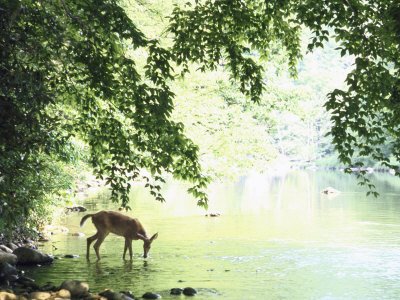
 1-3 A white-tailed deer drinks from the creek;
I want to drink God,
deep draughts of God.
I’m thirsty for God-alive.
I wonder, “Will I ever make it—
arrive and drink in God’s presence?”
I’m on a diet of tears—
tears for breakfast, tears for supper.
All day long
people knock at my door,
Pestering,
“Where is this God of yours?”

 4 These are the things I go over and over,
emptying out the pockets of my life.
I was always at the head of the worshiping crowd,
right out in front,
Leading them all,
eager to arrive and worship,
Shouting praises, singing thanksgiving—
celebrating, all of us, God’s feast!

 5 Why are you down in the dumps, dear soul?
Why are you crying the blues?
Fix my eyes on God—
soon I’ll be praising again.
He puts a smile on my face.
He’s my God.

 6-8 When my soul is in the dumps, I rehearse
everything I know of you,
From Jordan depths to Hermon heights,
including Mount Mizar.
Chaos calls to chaos,
to the tune of whitewater rapids.
Your breaking surf, your thundering breakers
crash and crush me.
Then God promises to love me all day,
sing songs all through the night!
My life is God’s prayer.

 9-10 Sometimes I ask God, my rock-solid God,
“Why did you let me down?
Why am I walking around in tears,
harassed by enemies?”
They’re out for the kill, these
tormentors with their obscenities,
Taunting day after day,
“Where is this God of yours?”

 11 Why are you down in the dumps, dear soul?
Why are you crying the blues?
Fix my eyes on God—
soon I’ll be praising again.
He puts a smile on my face.
He’s my God.

~Selah.
1brobry-sig4 (2)


cropped-christiangraffiti1 (3)

Feeding the Dogs, [Choosing Holiness]

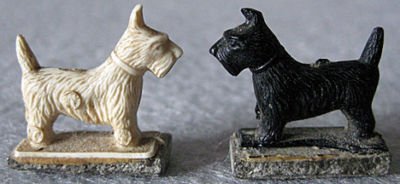
A toy I grew up with, they were magnetized pushing against each other.

There is a story of a Native American elder who once described his own inner struggles to understand the Bible and Christianity.

Inside of me there are two dogs. One is black, and the other is white. The black dog is mean and tries to talk me into making the wrong choices. The white dog is good and encourages me to make the right choices. The black dog fights the white dog all day.” When asked by the friend which dog wins, the elder reflected for a moment and replied;

“The one I feed the most.”

White Dog: As a believing Christian, there is a part of us that is Christ-spirited, compassionate, trusting, open, abundant and focused on helping others. We pray and are being filled with the Holy Spirit.

Black Dog: The other part is our flesh. We can be proud, evil, self-centered, greedy, manipulative, sullen, promiscuous, drunken, and only wants to he served by others.

“An analogy is made between the good white dog, our new nature in Christ, and the bad black dog, our old fallen nature. While we cannot eliminate the old nature, we can choose to feed the white dog.”

(From “The Holy Spirit: Activating God’s Power in our Life,” by Billy Graham 1978.)
 

howlingwolf3-300x281The main key for us to remember is that these two parts are in constant struggle.

Two Scriptures to help: One– “If you use your lives to do the wrong things your sinful selves want, you will die spiritually. But if you use the Spirit’s help to stop doing the wrong things you do with your body, you will have true life.”   Rom. 8:13, NCV

Two– “Our sinful selves want what is against the Spirit, and the Spirit wants what is against our sinful selves. The two are against each other, so you cannot do just what you please.”   Gal. 5:17

In thinking this through this analogy might help.  I’m inclined to think that holiness is not so much like an “on and off” switch.  But I think it’s more like a “dimmer” switch is turned to brighten or darken a room.  I actually think there are times when we should make a deliberate decision for God.  And yet other times we just need to turn up the dimmer from 30% to 80%. Maybe all the way?

I’m just thinking out loud here.

 bry-signat

flourish31

A Jubilate Discipleship: Psalm 95

Montage-Jubilate

A Psalms Study

“Come, let’s sing for joy to the Lord.
    Let’s shout praises to the Rock who saves us.
Let’s come to him with thanksgiving.
    Let’s sing songs to him,
because the Lord is the great God,
    the great King over all gods.
The deepest places on earth are his,
    and the highest mountains belong to him.
The sea is his because he made it,
    and he created the land with his own hands.

Come, let’s worship him and bow down.
    Let’s kneel before the Lord who made us,
because he is our God
    and we are the people he takes care of,
    the sheep that he tends.

Today listen to what he says:

Psalm 95:1-7, NCV

Such joy: it just bubbles through the words. This is a psalm saturated with excitement. These first seven verses are ‘carbonated joy.’ They pronounce an excitement of a living God that excels in every way. These are simple words made to escort us into a true worship, unlike any other. We might use the word, “jubilant” when hearing this psalm. And we wouldn’t be far off.

“The Lord is the great God,” and He is the King of any ‘so-called’ gods. Everything concerning the earth is His doing– for He created it, with His own hands! And our creating God is also our Shepherd, tending and caring for us as His very own flock.

These verses extol our God, to the point of exuberance. It channels us to the point of worship upon our knees, with the realization of the greatness of God. But this Psalm continues for four more verses.

Today listen to what he says:
“Do not be stubborn, as your ancestors were at Meribah,
    as they were that day at Massah in the desert.
There your ancestors tested me
    and tried me even though they saw what I did.
10 I was angry with those people for forty years.
    I said, ‘They are not loyal to me
    and have not understood my ways.’
11 I was angry and made a promise,
    ‘They will never enter my rest.’”

Psalm 95:7-11

There are two parts to Psalm 95. The first is of jubilant worship. But the second part emphasizes a solid obedience. The phrase, “Today listen to what he says:’ welds these two sections together.

Worship must always lead to obedience. You can do ‘cartwheels’ on Sunday morning, as long as you follow Him on Monday.

The issue is an history lesson that goes back to Israel’s days of Moses and the days following the Exodus. Because they were so hard and stubborn, they would wander for forty years in the desert. Their continued ‘stubbornness’ not only closed off the Promised Land, but also closed off their relationship with God— a relationship that would’ve been ‘jubilant’ and  profound (at the same time). They missed out on verses 1-6 and settled on verses 8-11. How tragically sad.

There is a thread that works through scripture called “the rest of God.” The book of Hebrews uses in 12x usually as a warning:“Now, since God has left us the promise that we may enter his rest, let us be very careful so none of you will fail to enter.” (Heb. 4:1).

 “Let us try as hard as we can to enter God’s rest so that no one will fail by following the example of those who refused to obey.”

Heb.4:11

To be in God’s rest is to be in harmony with Him. It is a mixture of confident faith mixed with a careful obedience. When you combine these two, you have the recipe for joy.

I believe this rest is the believer’s place of joy, peace and confident faith. It obeys because it really wants to. It is Psalm 95:1-7 in action. It is for the jubilant Christian.

bry-signat (1)

cropped-christiangraffiti1.jpg