Thinking About Mental Illness

“Brothers and sisters, do not be children in your thinking; yet in evil be infants, but in your thinking be mature.”

1 Corinthians 14:20

Those of us who are broken have to think through lots of stuff. But Jesus is our Teacher, and He fully intends to educate His disciples. Following Him is to be vibrantly alive, and yet I still must deal with the issues of living, and of having a growing faith that is becoming real at long last.

I’ve found that this really isn’t a “one and you’re done” experience.

The Bible describes a slow growth into the image of Jesus– -painstakingly learning about our frosty hearts, and how God keeps pouring His “super-heated” grace on the broken. We’re finally becoming ‘poor in Spirit’ and we’re learning to ‘mourn’ over our sins, perhaps we realize that we’ve fallen quite short of His will for us. (Matt. 5:3-4).

This list isn’t orderly or exhaustive, and it’s written primarily for the mentally ill Christian believer:

  • Stigma-This is one of the basic hazards that come with being a believer with a mental illness. People will whisper and treat you like you’re a moron, even in God’s church. You’ll try to become thick-skinned and ask Jesus for His help. He understands you completely. Even the Lord’s own family considered Him mentally disturbed. You’re in good company.

“And when those who belonged to Him (His kinsmen) heard it, they went out to take Him by force, for they kept saying, He is out of His mind (beside Himself, deranged)!” Mark 3:21, Amplified.

  • Medications– This will be a stretching time as you must determine what’s best for you, your family, and basic functionality. There will be many opinions and definite issues that ‘disciples.’ must navigate. Some say that therapy and ‘meds’ are wrong. Perhaps for some. No matter what though, your patience will be required and you’ll need to seek His wisdom. He will tell you what to do.
  • “Not neglecting to meet together, as is the habit of some” must anchor us. We were built for real fellowship.  It’s quite easy to attempt to go it alone, but that isn’t what God wants, it’s wrong. Not being with others is a disease of the spiritual heart. I’ve chafed at this from time to time. 
  • Therapy— To go or not to go? I happen to believe a good counselor is worth their weight in gold, but a bad therapist can be a real challenge to your faith. Figure out your tolerance level on this. Quite often I simply need a good listener, and listening is a skill that is developed over time. Find a listener.
  • Marriage—  A good spouse is your key to managing your mental illness. God has gifted them to deal with your disability; they’re your partner in this. Bring them into some of your appointments. Talk, and listen. Learn to pray and worship together. Read the Word out loud. Remember they are learning too. Your disability is also shaping their own discipleship to Jesus. 
  • Family— They’ll often feel the brunt of your issues. It is good to be aware of this and adjust to their needs. Above all, don’t flog yourself for your failings. Allow God to redeem your situation. Trust in the Lord, and try not get in His way. He wants to renew things. Always look for creative ways to love your family. (Surprise ice cream does wonders!)
  • Work— Not surprisingly, some employers have very little tolerance for your issues, but the law says is that they can’t discriminate against a mental illness. I hope it won’t come down to that.

Title I of the Americans with Disabilities Act (ADA) and Section 501 of the Rehabilitation Act of 1973 (Section 501) are the federal laws that protect people with disabilities, including mental health disabilities, from discrimination at work

  • Fellow strugglers-– Finding other mentally ill believers is priceless. When I meet someone who also struggles with severe depression I want to give them a big bear hug. We instantly have a rapport that isn’t easily defined. Finally, there is someone who understands my battle!
  • Prayer and worshipDesperate prayers have a tendency to get answered. Start praying for five minutes a day. Pray, do not complain. Be real, not religious. Talk with Jesus like he was your best friend. Prayer is the key to making the above work. Prayer is the “heartbeat” of heaven. And of course–worship! (The real stuff, not religious.)
  • The Word of God–the scriptures (especially the Psalms) are pretty real stuff. Check out Psalm 88, it’s especially written for the one who struggles.

We have the joy of combining our discipleship with our illness.

This is a formidable task. But the Helper, the Holy Spirit stands ready to give us His wisdom. He graces us with intense spiritual power. The battle rages and times get tough. Perhaps “grittiness” should we should add to the fruits of the Holy Spirit? I’ve now walked with Him for over 40 years now, and I know Jesus has never left me alone. He never lets me ‘twist in the wind.’ He promised, I’m never alone. No matter what.

The Lord truly will accommodate your illness with His power and grace. He promised.

He always does this for His children. No believer is ever overlooked or forgotten. He is constantly aware of you. What comfort and peace that brings.

“There is no circumstance, no trouble, no testing, that can ever touch me until, first of all, it has gone past God and past Christ, right through to me. If it has come that far, it has come with a great purpose.” 

— Alan Redpath

These are some of the areas that are affected by your mental illness. A wise spouse, pastor, elder, friend, or therapist can do wonders when things get difficult. Sometimes we need a new perspective as we sort things out. God will often use others to bandage and heal us. That’s the way He works.

“There has never been the slightest doubt in my mind that the God who started this great work in you would keep at it and bring it to a flourishing finish on the very day Christ Jesus appears.”

Philippians 1:6, Message

bry-signat (1)

FYI. I have another site up and running, alaskabibleteacher.com.
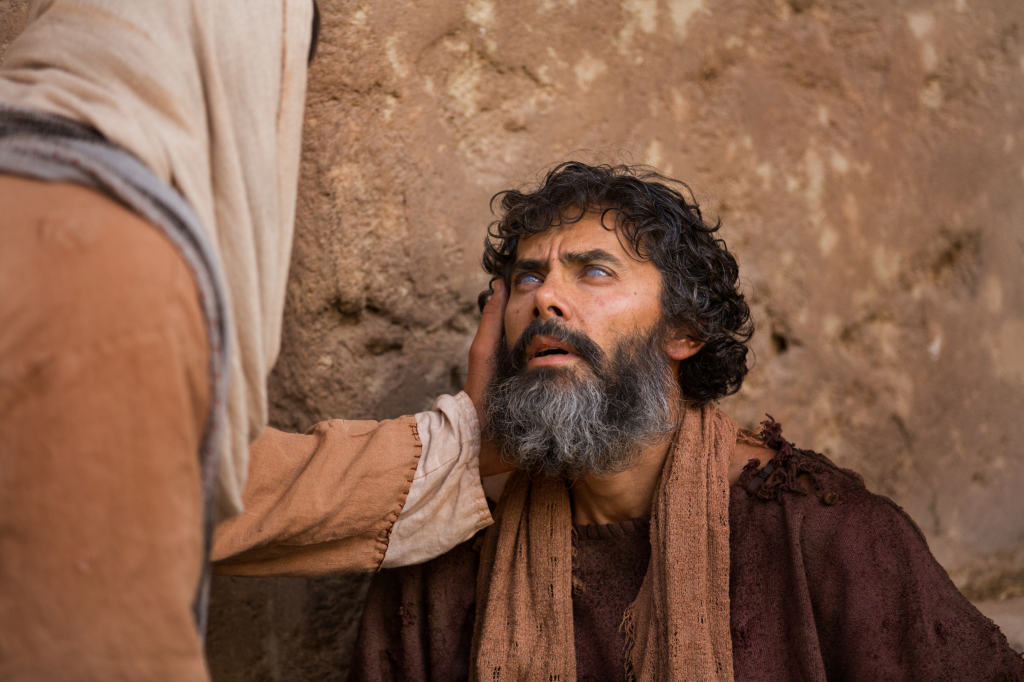
 

Blind From Birth

John 9:1-7

As he was walking along, he saw a man blind from birth.

“Master,” his disciples asked him, “why was this man born blind? Was it a result of his own sins or those of his parents?”

“Neither,” Jesus answered. “But to demonstrate the power of God. All of us must quickly carry out the tasks assigned us by the one who sent me, for there is little time left before the night falls and all work comes to an end. But while I am still here in the world, I give it my light.”

Then he spat on the ground and made mud from the spittle and smoothed the mud over the blind man’s eyes, and told him, “Go and wash in the Pool of Siloam” (the word Siloam means “Sent”). So the man went where nd washed and came back seeing!

Up to now I’ve tried to approach these posts from the first person viewpoint. Ihoped to understand those who met face-to-face with Jesus. I wanted to grasp what they were seeing through their own eyes. But I intend with this post to revert back to a more traditional approach to this passage.

First, we’re introduced to a man who is blind from birth.

I can’t even imagine what that would be like (just as he probably could imagine having sight). I’ve been told that he probably didn’t have a “dream” life–that requires having seen images (a dog, a tree, a mean person) and this wasn’t available to him. He never saw the color red, or seen a mountain. (He didn’t have the circuitry.)

I suppose we can only imagine what blindness like this would be.

Somehow I’ve come to an idea that this represents fallen men–we’re spiritually blind to the workings and truths of Jesus’ Kingdom. It seems a pretty good explanation of each of us–“blind from birth.”

Secondly, notice the response of the disciples who first met this unfortunate man. They don’t see his needs, rather they want to know the theology behind this. Perhaps that’s how we respond much of the time–we don’t see the needs, we only want to know the reasons. We’re not wise or discerning enough to see what’s going on–in short we’re not equipped to love or show mercy. (We haven’t got the circuitry.)

Perhaps this is how we operate as immature Christians.

We don’t engage the need, but rather we like having great theology over understanding compassion. If we really don’t love needy people, we miss so much. We don’t ever grow up. It’s easy to philosophize–it’s hard to get down and serve and really love others.

It’s funny but Jesus declares Himself to be the light of the world while speaking to the man who is born blind.

Third, we discover the gentle mercy that Jesus has when He meets needy people. Now the Lord does accommodate His followers, but not at the expense of engaging the need of the moment. Jesus is full of compassion–most especially when He meets broken people–and as His followers, we must grasp this.

Good theology is not the primary calling of Jesus’ followers.

As I mature in Christ I’m learning (slowly) that people are His real focus. He has come, not to theologize or philosophize, but to meet needs! Sure the reasons why become clearer, but that really isn’t Jesus’ primary goal. People are, not having impeccable theology.

Classes in systematic theology are good, but soup kitchens are better.

The miracle happens, and Jesus’ love and desire to restore this man is ‘front and center.’ The Lord’s methodology is interesting. Spit and mud, wiped on the blind man’s eyes. In Genesis we discover that God made man out of dirt and dust of the ground. Perhaps what He’s doing here mirrors that work.

And it’s also important to understand that Jesus never performs the exact same healing in the exact same way. For some reason He ‘tailors’ His work to the individuals deepest need. I suppose He doesn’t want us to grab a hold of a formula, as that’s what we want to have.

The story is primarily about a blind man’s healing.

It’s not theology, and it certainly isn’t about what is proper and acceptable. We really must understand this, and we really need to understand the tremendous mercy and power of God to both heal and restore.

Image: MCCC. Text from the “Living Bible,” published by Tyndale House

I’m a Riddle to Myself

They tell me that courage is to do something that frightens you. That it is being strong in the face of pain and suffering. If that’s true (and I suspect that it is) then I haven’t arrived yet. I’m a spiritual “chicken.” I’m no eagle yet.

It seems at times I’ve been ‘gifted’ with cowardice! 😁

I struggle at times with chronic depression, and am physically handicapped. I have lost the use of my right arm and hand. I no longer have any balance and must use a cane. This is due to a brain tumor I had in 2002. I’ve had over a dozen head injuries which only has compounded the ataxia.

I admit I sometimes get angry with God. I also get spiritually confused as I try to walk like Jesus wants me too. My frustration with Him is all foolishness when I think of all He has given me. I pretend at these times, and I do it well I think.

I’m also afflicted with a terrible disease called “Facebookitist.”

I find that this blog I write sometimes covers up a multitude of my own sins. You see and read what I want you to see. I polish up things to preserve a modicum of spiritual decency. I want you to see me as faithful and triumphant. A real disciple, (but alas, that’s often a bit of a stretch).

Brennan Manning

I once was confronted by a younger believer, “I don’t know you, brother, you’re like two different people.” And honestly I’m sure he was right. I am, and it disturbs and saddens me.

And what is the truth often scares me. I’m often a spiritual coward who tries to speak the things that are real and true. (A clown trying very hard to play “Hamlet.”) I occasionally realize I will write something that’s spiritually false, and that scares me. “Kyrie Eleison.” God have mercy on me, a sinner.

I think all I want is God’s stamp of approval. “Well done, good and faithful servant.”

And perhaps yours as well?

I realize that I end up wanting truth which is no small thing. Many lies must be stripped away and that seems to take time. It’s like scraping away layers of varnish on a table you’re working on. I’m pretty much coated with sin. I desperately need the truth to survive.

All I really know is that I love Jesus, and I seek to be filled with His Spirit. I keep coming, over and over, to Him. He holds on to me.

     C.S. Lewis

Jesus comes not for the super-spiritual but for the wobbly and the weak-kneed who know they don’t have it all together, and who are not too proud to accept the handout of amazing grace.”

Brennan Manning

Crooked Kisses

kiss-596093_960_720

“The Son of Man has come eating and drinking, and you say, ‘Look at him! A glutton and a drunkard, a friend of tax collectors and sinners!’”

Luke 7:34

God, in some profound way accommodates Himself to your ‘sickness.’ He will never turn away from you.

We discover that Jesus has a beautiful quality–He becomes quite tender and gentle around any spiritual disease. He gravitates to the broken and sinful. His love for sinners is a fact we must consider over and over. It’s absolutely critical that we recognize this.

And if we can only understand this, it’ll change us forever.

In his book Mortal Lessons (Touchstone Books, 1987) physician Richard Selzer describes a scene in a hospital room after he had performed surgery on a young woman’s face:

“I stand by the bed where the young woman lies. . . her face, postoperative . . . her mouth twisted in palsy . . . clownish. A tiny twig of the facial nerve, one of the muscles of her mouth, has been severed. She will be that way from now on. I had followed with religious fervor the curve of her flesh, I promise you that. Nevertheless, to remove the tumor in her cheek, I had cut this little nerve.”

Her young husband is in the room. He stands on the opposite side of the bed, and together they seem to be in a world all their own in the evening lamplight . . . isolated from me . . private.”

“Who are they? I ask myself . . .

“He and this wry mouth I have made, who gaze at and touch each other so generously. The young woman speaks. “Will my mouth always be like this?” she asks. “Yes,” I say, “it will. It is because the nerve was cut.” She nods and is silent. But the young man smiles. “I like it,” he says, “it’s kind of cute.”

All at once, I know who he is.”

“I understand, and have to lower my gaze.”

“One is not bold in an encounter with the divine. Unmindful, he bends to kiss her crooked mouth, and I am so close I can see how he twists his own lips to accommodate to hers. . . to show her that their kiss still works.”

This is your Savior. He has always been there for you. He is seeking a kiss of spiritual intimacy.

But if you think somehow you are getting to be a great kisser, or you think maybe you’re looking desirable, I feel sorry for you. For it’s He who wraps himself around our hurts, our brokenness, and our ugly and our ever-present sin. He loves the unlovable. He kisses those who shouldn’t be kissed.

I guess I’m starting to know who I am.

I need Jesus so much to love me like I really am: brokenness, memories, wounds, sins, addictions, lies, death, fear….all of it. (Take all it, Lord Jesus.) If I don’t present this broken, messed-up person to Jesus, my faith is dishonest, and my understanding of it will become a way of continuing the ruse and pretense of being “good.”

God truly loves the unlovely. I am learning this. Slowly. Far too slowly.

He is passionate about those who have been disfigured by sin. And for those playing “make-believe” and are trying to find some sort of ‘spiritual Botox’ are not being truthful. Only by clinging to Him can find real healing and true acceptance.

For some reason, and I don’t really understand quite why, but He delights in kissing lips that are crooked.

I’m glad because that is really who I am.

     Henry Ward Beecher