Righteousness: His, Yours? (or Ours?)

“All of us are dirty with sin.
All the right things we have done are like filthy pieces of cloth.
All of us are like dead leaves,
and our sins, like the wind, have carried us away. “ 

Isaiah 64:6, NCV

________________

I have this reoccurring nightmare. I jump out of a plane.  I deploy my parachute, and it opens.  But it is completely full of holes!  Yikes!  I wake up before I splat. And then I think in a spiritual sense— what a relief it is to have a holiness that is given, or imputed.  If somehow you could turn off the spigot of the holiness he gives, and then run on your own merits; how far would you go?

Among good Christian people, there is an occupational hazard of sorts, and that is to “advance” in our thinking to that place where we are doing fine on our own.  We very much appreciated Jesus’ help– but now, at this moment, I must figure it out by myself.  This line of thinking, is called “self-righteousness.”

“Many have passed the rocks of gross sins – who have suffered shipwreck upon the sands of self-righteousness.” 

William Secker:’The Consistent Christian,’ 1660

We begin to travel in our sense of ourselves, away from a desperate, clinging to a trust in his mercy that is moving to a place of a confident, strutting awareness of having put ourselves back together again.  This is the ‘evil ones’ work– to steer you into self-righteousness.  Once you get there, he can just release you and let you ‘stew in your own juices,’ while he rules over your soul.

Becoming self-righteous should scare us to death.  It will damn our souls just as quick as adultery, or murder.  It is evil, and it sedates us to the place where it can work, unhindered and unchallenged.  I’ve read that some predators inject first an anesthetic to soothe their prey. This enables them to take their time, as they slaughter them.

I have had several bouts with self-righteousness.  (And I bet I’ll have several more.)  It is sin that will give you a wonderful back massage, just before it reaches for the knife that will cut your throat.  Somehow, we are lulled into this and my! I’m such a good person (even after such a dark and evil start.)

“Self-righteousness is the largest idol of the human heart – the idol which man loves most and God hates most. Dearly beloved, you will always be going back to this idol. You are always trying to be something in yourself, to gain God’s favour by thinking little of your sin, or by looking to your repentance, tears, prayers ; or by looking to your religious exercises, your frames, etc; or by looking to your graces, the Spirit’s work in your heart.”  

–Robert Murray McCheyne

 Jesus was, and is, and will be all my “righteousness.” 

We must cling to these hand-holds of grace.  The waves are substantial, and we most certainly would be swept out to sea.  But we grab and hold on to him.  And he holds on to us!  The fantasy of having enough of my own created righteousness to please God is simply a crock.  Jesus was, and is, and will be all my “righteousness.”  I have nothing– nothing else.

 bry-signat (1)

cropped-christiangraffiti1.jpg

Killing My Sin, Before It Kills Me

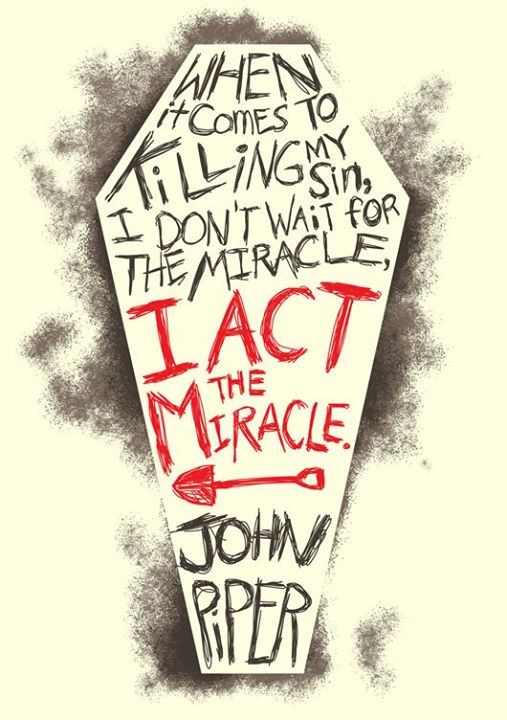
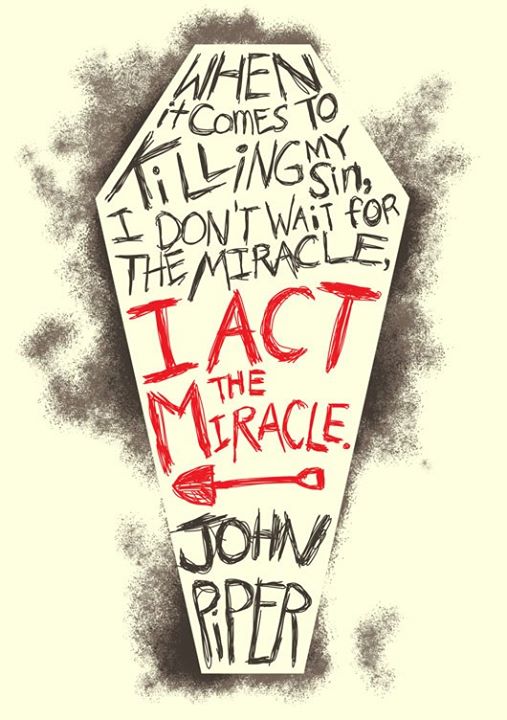
killing-sin-act

We are for the most part anyway, eager to please God. We are Jesus’ people with the occasional brush with sin. But hey, who doesn’t? But that attitude must be questioned.

“My little children, these things I write to you, so that you may not sin.”

1 John 2:1

John hopes that his readers would make a choice— not to commit sin. After all, what soldier goes into battle with the intent of getting just a little wounded? Often we will sin just because it seems so inevitable, and we feel we can’t help ourselves. (But the reality is that we can.)

But the Holy Spirit now lives inside. Cooperation with Him is needed. Often we will work ourselves into a ‘no win scenario’ where we believe that sin rules. We can’t beat it, so we stop trying. That is common, and sad.

‘Passivity’ is defined as not participating readily or actively; inactive. When we are passive spiritually, we disengage ourselves from any effort of living holy and pure lives. Not being ‘hot’, but content to be lukewarm. At this point sin becomes, reluctantly, tolerated. “After all, I’m a sinner, what else can I do?”

Mentally ill people are often passive. We are told that we have an uncontrolled illness which dictates that we act ‘irresponsible.’ Our depression often escalates and we feel victimized by it. My experience has taught me that there are three kinds of depression:

  • organic depression, or the ‘biochemistry’ of the disease,
  • guilty depression, the kind that feels bad because of what we’ve done (or didn’t do),
  • reactionary depression, the type we feel when experiencing a loss, a loved one, or a job

Depression will almost always fall in these three categories. And passivity plays a part in all three. We  frequently feel victimized and ‘acted upon.’ When it comes to our discipleship we don’t act, we react. We are utterly convinced of the Bible— God’s truth, but we are so sporadic we can’t seem to get it to work for any length of time.

Yes, we are believers. And yes, we have issues. We’re waiting for a miracle, and hope we get a breakthrough soon.

At the base point of our lives, quite often, there is a passive attitude. Passivity aggravates our depression or mental illness. It deepens, spreading through our lives like a contagious illness. Our discipleship sputters and stalls. We no longer act on God’s Word, but we find ourselves fabricating a faith that makes allowances for our situation.

But we must ‘act the miracle.’ Everything God gives… everything… must be received by a convinced faith. We must be persuaded to give up our flawed ideas, and believe God for the real thing. I opened up this with 1 John 2:1. But there’s much more to this verse:

“My little children, these things I write to you, so that you may not sin.  And if anyone sins, we have an Advocate with the Father, Jesus Christ the righteous.”

I don’t want you to sin. Avoid sin. But even if you do— we have someone who will plead our case before God. He stands and argues our plight. He loves us that much.


bry-signat (2)

cropped-christiangraffiti1.jpg


A Finder’s Fee of Joy

New Testament 3 Production Still Photography Tax collectors and other notorious sinners often came to listen to Jesus teach. This made the Pharisees and teachers of religious law complain that he was associating with such sinful people—even eating with them!” (Luke 15:1)

“If a man has a hundred sheep and one of them gets lost, what will he do? ” (v. 4)

“Or suppose a woman has ten silver coins and loses one.” (v. 8)

“For this son of mine was dead and has now returned to life. He was lost, but now he is found.’ So the party began.” (v. 24)

flourish10

The lost sheep, the lost coin, and the ‘lost son’ tell us that this is a time for recovery. This is a unique period for the Church. It is a season of special grace that allows us to seek and find things that are valuable to us. It is a time of finding out things about ourselves as well.

What is precious to you? With the woman, it was a lost coin (probably a part of her dowry) and she made a substantial effort to get it back. With the shepherd, what was valuable was a lost sheep, and he would take a calculated risk to find it, and rejoin the flock. And the father lost his son, and he had to wait for him to return to his senses.

These three parables were directed to the different issues that effected the “notorious sinners.” But they also spoke to the pharisees who were present. Both groups understood and there were plenty of implications for everyone.

It’s a funny thing, Jesus never minced words. No one could be neutral around him. That is still the case today. I think God is seeking His lost children. This is what He is up to, this is His passion. Understanding this salient fact should enlighten us,

  1. to His will,
  2. to know His passion and love, (His pleasure in finding what was lost)
  3. and the true purpose of His Church.

As the Parable of the Prodigal Son develops, we see the pharisees equated to the ‘grouchy’ older brother. He begrudges his newly returned brother, and he really can’t see what is happening all around him. The idea of grace eludes him. Perhaps that is far more common than we think. Whenever ‘religion’ exerts control over a person or group, duty is almost always elevated over joy.

The Church is only as relevant as when it’s seeking out the lost.

The Church is meant to extend to the lost ‘sons’ of Adam, and the ‘daughters’ of Eve. This is God’s passion, and we must find out what He wants us to do to share His heart. It’s almost as if He wants to give us a chance to taste His joy.

aabryplain


Praying Authentically

front-prayer

Prayer often can be just a nice religious duty, that makes us feel warm and fuzzy. But such prayer the does not suit a disciple who is tired of religion, and is seeking authenticity. There are few models who can be our guides.

That one of the reasons why we need elders in our fellowships; they have been through so much, they can anchor us to all that is real. As elderd they probably had lessons in prayer.

We often will theologically play on the periphery, and cleverly deceive others and ourselves.  My own heart gets pretty creative as I display a self-righteousness. (I should win an Academy Award as ‘best actor.’) But Jesus insists on us becoming real. You might say that real is the prayer that touches his heart.

When you talk with Jesus, do you really talk to Him? Do you have a real awareness that you are really talking with Him?

Is it the real you that fellowships with the ‘real’ God?

________________________________

The following is an excerpt from A Diary of Private Prayer, by the Scottish theologian, John Baillie, 1886-1960:

Eternal Father of my soul, let my first thought today be of You, let my first impulse be to worship You, let my first speech be Your name, let my first action be to kneel before You in prayer.

For Your perfect wisdom and perfect goodness:

For the love with which You love mankind:

For the love with which You love me:

For the great and mysterious opportunity of my life:

For the indwelling of your Spirit in my heart:

For the sevenfold gifts of your Spirit:

I praise and worship You, O Lord.

Yet let me not, when this morning prayer is said, think my worship ended and spend the day in forgetfulness of You. Rather from these moments of quietness let light go forth, and joy, and power, that will remain with me through all the hours of the day;

Keeping me chaste in thought:

Keeping me temperate and truthful in speech:

Keeping me faithful and diligent in my work:

Keeping me humble in my estimation of myself:

Keeping me honorable and generous in my dealings with others:

Keeping me loyal to every hallowed memory of the past:

Keeping me mindful of my eternal destiny as a child of Yours.

Through Jesus Christ my Lord, Amen.

(Taken from Richard Foster’s Devotional Classics, pp. 126-127.)

aabryscript