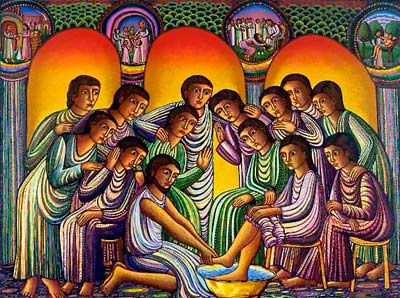
Go Lower Yet

footwashing

“Now that I, your Lord and Teacher, have washed your feet, you also should wash one another’s feet.”

John 13:14

Some Christians reading this part of scripture, have concluded that foot washing should be part of the Churches customary routine.  Their case is compelling, and they may be right in their interpretation.  There is as much support for this as with other things, and Lord knows we could use the humility by getting on your knees with a basin and towel before a brother. 

It probably would relieve issues between saints. It may even heal Church splits. (Oh my!)

Jesus pronounced that His act of service was to be imitated by everyone who would follow.  He further would assert that His example would be emulated by every believer that followed after Him.  Our service to our brother, or sister is to help them become clean Christians. 

We have this ministry of the basin and towel to remove the dirt and filth that comes from walking in this world.  Of course, we cannot remove sins.  But we can serve as Jesus would and intervene with His power.

Cleansing people that we meet will be a challenge. 

It will call us to strip our lives down to a minimum, and to get lower.  We need to get so low that we’re on the floor.  This requires much grace and discipline.  We must weed out every pretense and pride–especially the kind that says, “Look at me serving; am I not wonderful?  I am a true disciple now.”  We are to shake off thoughts like that. 

We are to love others, and perhaps be honestly brutal on ourselves. (Not in a morbid way, just less of ‘yourself.’)

While in my first year of Bible college, I developed a bitter dislike for a classmate.  He had been a lead guitarist; he was handsome and popular, and he oozed pride from every pore (at least I could see it).  I actually took it on myself to be God’s hand in humbling him.  I became antagonistic and scorned him every chance I could.

Within days, my prayer life shut down and the heavens became brass.  One day I was praying and the Holy Spirit graciously zapped me.  I became aware of my sin toward my brother, and I repented. There was a real definite leading, to find a basin and a towel, and then to wash his feet.

God reconciled us, as I knelt at his feet in that dorm room.  From that point on we became very good friends.

We must go lower still.   Water always finds the lowest point, were it pools and gathers into the place of healing others. Perhaps the Holy Spirit will not lead us ‘deeper’ until we start practicing true humility.

When we lower ourselves even deeper we find His presence waiting for us.  But we must cleanse our own hands first, and His blood must work its ministry on me. It’s then I can proceed to clean the filth off of their feet.  If I am not clean myself I will only perpetuate the dirt on to my brother with my dirty hands.

We must scrub our way into the heart of our sister or brother with a basin, some soap and a towel. 

The challenge for us will be a super-challenge.  Christlikeness will always demand this humble grace.  When we think about being like Jesus we must make sure we are following the Jesus in the Bible.  The Jesus who washed dirty feet as a slave.

But let’s not have any foolish nonsense of a discipleship that doesn’t kneel before our brothers in humility.


 

Under Quarantine

quarantine

Quarantines are a real possibility, even to this day. A quarantine is imposed when a disease is contagious enough that it would harm a society: Measles, Smallpox, and the recent COVID-19 are just a few physical diseases where isolation must be imposed.

It can be severe— an epidemic, with desperate consequences if not adhered to; in some rare cases, the use of deadly force has been authorized to maintain a quarantine until the disease is no longer communicable.

This may surprise you, but there are examples of ‘quarantines’ in the Bible.

The term ‘unclean’ was used for ‘leprosy.’ Those afflicted had to isolate themselves; they had to ‘announce’ their presence when in contact with society. Lepers lived in groups away from the general populace, as a result of their disease.

In Paul’s epistle to the Corinthians, he addresses another kind of ‘quarantine.’ The situation was dire; the church had advocated a Christian living with his father’s wife.

“I have already passed judgment on this man in the name of the Lord Jesus. You must call a meeting of the church. I will be present with you in spirit, and so will the power of our Lord Jesus. Then you must throw this man out and hand him over to Satan so that his sinful nature will be destroyed and he himself will be saved on the day the Lord returns.”

1 Corinthians 5:3-5, NLT

Understanding the Principle of Usefulness

Now in a large house, there are not only gold and silver vessels, but also vessels of wood and of earthenware, and some to honor and some to dishonor.”

2 Timothy 2:20, NASB

Found in God’s pantry are lots of pots and pans of various uses.  Paul writes Timothy about the ‘large house’ which is the Church inclusive. Look around Timothy, there are gold ones, and there are silver ones. They have a noble purpose fitting for such a great house. These are the ones the guests will use; they befit the significance of the Lord himself. These vessels have great value for they are made of precious metals.

There are vessels of different categories. These are the ones made of wood, and of clay. These are part of the household, make no mistake about it. But their use is one of function, they’re utilized in common and ignoble ways. (A clay ‘bed-pan’ perhaps?!)

21 “Therefore, if anyone cleanses himself from these things, he will be a vessel for honor, sanctified, useful to the Master, prepared for every good work.”

2 Timothy 2:21

Paul, the author of the New Testament doctrine of grace emphasizes the place of personal holiness. We are to ‘cleanse’ ourselves to become a vessel of honor. There is good news here:

  • All are vessels in the Father’s house. Each of us belongs to Him. He alone determines their use.
  • Things are not yet in their final state. Changes in status can be experienced. In God’s economy, clay pots can become ‘golden.’ Silver can become ‘wood.’

Some sin is contagious.

It affects believers, and the Church becomes compromised by what we’ve done. And then sometimes we are quarantined by the Holy Spirit–until the contagion passes. This spiritual disease must not be permitted.

I have experienced this several times in my own discipleship. These are not pleasant times, but there is no condemnation. I’m still His servant, His love for me stays outrageously constant. He has never turned away a sinning child who repents of their sin.

“Yes, I am His servant, but I must wait out in the hall. I haven’t been faithful. So I sit in His waiting room, waiting for His call. This is for my good. And my Father knows what is best.” 

OMG! He Just Walked Through the Wall

Luke 24:36-43

Sometimes in a story, you get a vivid sense of what is really happening.  Luke’s account ignites that in me.  With the flair of the dramatic– Jesus, freshly resurrected from the dead, bursts into the room and he scares the bejeezus out of everyone. 

I guess it was one of those times when you just had to be there in order to really get it.

“Frightened” and “terrified”–it takes two words to describe this unearthly experience. 

Not only that, but they got real freaky, after all, He had to be a ghost!  I can only imagine their fear at that moment. I think everyone present bolted to the door.  But wait for a second!  “The door is still locked?! OMG, what has just happened?”

We see Jesus [I think he was lovingly amused] point out that he was still a human being–look at me!  Think for a second, have you ever tried to get a pet dog, who is so scared he’s peeing on the floor, to come to you?  I see the disciples kind of half crawling, stooped, and very unsure about this. 

They slowly encircle Jesus and as they come, I have to believe He’s laughing. He has returned from the dead. And they have no idea!

He is laughing from the pure joy of one who has endured the worst of a very real hell.

Jesus has come out on the other side, intact and fully real. I suspect Jesus is reveling at the moment, and he is among friends whom he loves and vice versa.  He is alive, he has done the impossible, and I can only imagine everyone is laughing and crying at the same time!

I believe each of us has walls. 

These borders give us security and protection. We feel we have to have them, or else. They protect us. The disciples feel like there’s security in numbers and safety in their walls that protect them. I can relate.

But Jesus insists on penetrating our walls.  

Suddenly we come face-to-face with the dead one who’s now alive. The crucified man now lives! Everything has changed.

It is the resurrection power–the most powerful force in the universe, more intense than the sun, or a nuclear reactor. It’s funny, when Moses prostrated himself before the Lord’s glory, he changed.  Not only that, but he had to take precautions to cover his face when he returned to camp. These disciples however have just seen the glory of God first-hand.

As broken believers, we must be prepared for any eventuality.  Jesus can and will burst into our homes, and into our very lives.  Can you hear him laugh? Can you see His joy?

When he comes, nothing really is the same again. He loves his disciples too much to leave them in a dark stuffy room. The resurrected Jesus is coming for you!

Walking in the Darkness

  • We are afflicted in every way, but not crushed
  • perplexed, but not driven to despair
  • persecuted, but not forsaken
  • struck down, but not destroyed;

2 Corinthians 4:8-9, ESV

The issues we face can be formidable. Our relationships and our circumstances can bring daunting obstacles to joyful Christlike living. We live out at times from unpleasant realities and less than ideal situations. We are broken believers who follow Jesus through our deadly minefields.

Struggling with mental illness is just as much a challenge as with any other handicap. The young man struggling with bipolar disorder or someone else who faces a clinical depression, may seem to be tangled up in something quite brutal and very hopeless. “Will I ever find normal again?

I know that struggle and at times it has ripped me apart. But I suppose the grinding hopelessness is the worst part of that.

I want to encourage you in this. The issues we face on a daily basis are hard. And we don’t minimize their complexity or diminish their bitterness. They can be awful. But the Holy Spirit is with you in the midst of your issues. That’s a promise.

There is a wisdom emanating from the fire. It’s only waiting for discovery. The flames can not destroy us when God shows up.

I believe that the constant presence of difficulty produces a faith and tenderness that can’t be just prayed for.

The most kind and gentle people are those who themselves have been afflicted.

Please understand we have a real challenge. We have to walk through the trials or tests, not around them. We see a mountain, and God gives us a shovel. But He also gives us the strength we need.

But I’ve discovered a tenuous joy in these issues— more precisely, a joy because of them. Our illness is not meant to destroy us. That is not why God has allowed you to be afflicted.

I definitely did not choose this path I’m on.

Think about Jesus’ great love for people with hard issues:

Luke 7:21

Jesus has special spot for the afflicted, we see him repeated touching them. He drew them like a magnet draws iron. And he is the same today in our time. It is comforting to know that he cares for us and that we are understood. Let him draw you into his caring presence.

Our disabilities do not trouble him. Yes, I know the issues are formidable. But your obedience in them is an exquisitely special commodity to Jesus. I believe He values the shaking faith of broken people far more than the happy shiny people with no pain or scars.

Faith is precious in his sight and holds its value for all eternity.

Understanding this should be a cause for joy for the broken believer. Having the lightness of heart, right in the middle of our disability, often transforms these issues into a lighter burden. We are  beaten but not totaled. Incredibly challenged but not completely devastated. The apostle wrote this in his letter to the Corinthians, and it gives us hope.

I have learned that if I can bless a difficult thing it will bless me.

If we curse it and it will curse us. If you bless a situation, it has no power to hurt you, and even if it is troublesome for a time, it will gradually fade out, but only you can only sincerely bless it.  

There’s a deep joy waiting for those who choose to do this.

I guarantee it!