Are You Too Righteous?

“Do not be excessively righteous and do not be overly wise. Why should you ruin yourself?”

Ecclesiastes 7:16

I’m thinking out loud about something, so I should alert everyone.  Anyway, I’m thinking about “scruples”.  The dictionary defines scruples as an uneasy feeling arising from conscience or principle that tends to hinder action.”

The malady developed in the middle ages.  Among the saints who were not yet labeled saints, there developed a particular syndrome of hypersensitivity toward sin and holiness.  You might say that they got stuck in the proverbial “hamster wheel” and couldn’t get off.  Run, run, run and they developed an irrational fear of somehow missing God.  Many a zealous saint has turned obsessive and superstitious. Suicide would happen.

Wikipedia says this about “scruples”– –an obsessive concern with one’s own sins and compulsive performance of religious devotion.”   It is essentially the doubt and fear that you will do or say something that is not right.  It locks you up inside to the point you can’t do anything.  Scruples can be one of the occupational hazards of the devout believer.

Ecclesiastes postulates the idea of being overly devout.  “Do not be excessively righteous and do not be overly wise. Why should you ruin yourself?” (Eccl. 7:16) This verse, suggests that one can be excessive, or, too good.  That might rankle some, as it did me.  How can you be too righteous?

Luther once said, “Be a sinner and sin strongly, but more strongly have faith and rejoice in Christ.” That intrigues me. I once heard a sermon entitled, “Does Your Christianity Include You?” (I can remember the title, but not the message.)

I guess we sometimes develop a sense of wanting to please God to the extent of denying our humanity. 

At least that’s where my own battles with scrupulosity originate.  I am thinking that “Pharaseeism” is kind of like its cousin; they are closely related. I think we start to have issues when we start to become obsessive about our holiness and our discipleship.  If a little is really good, then a lot is even better; this is our rationale, but it doesn’t work that way.

There are several examples in the Word.  I think of Jephthah and his over-the-top vow to the Lord.  In Judges 11, Jephthah vowed to God that if he were victorious in battle, he would give to God whoever came through the doors of his house upon his return from battle. In verse 34-35  we read that his only child a daughter came out first upon his return from battle. Jephthah was crushed.

This wasn’t necessary, or even required, but if we look at his life it seems that he had an impulse to overcompensate.  He was blown away by his daughter’s appearance when he returned home.  Saul was another, with Jonathan and the honey.  Just something to think about.

“If there be anything that can render the soul calm, dissipate its scruples and dispel its fears, sweeten its sufferings by the anointing of love, impart strength to all its actions, and spread abroad the joy of the Holy Spirit in its countenance and words, it is this simple and childlike repose in the arms of God. “

S.D. Gordon

ybic, Bryan

 

cropped-christiangraffiti1-2

On a Wing and a Prayer


B-29

6 “And I am certain that God, who began the good work within you, will continue his work until it is finally finished on the day when Christ Jesus returns.”

Philippians 1:6

When I saw this photo of a B-29 it seemed perfect to open up this post. Sometimes we return from combat ‘on a wing and a prayer’

I have been ill for a long time.  My hepatitis has been aggravated the last three months.  The Bipolar depression has been a bit better, but it seems to linger like an unwelcome guest.  Recovery from the effects from my brain tumor has stalled.  And I suppose I could go on, but I won’t.

I’m mindful that I was aware of hypochondriacs before this recent spate with a medical issues.  I was pretty much annoyed by these complainers, they seemed to always be talking about themselves.  Their self-absorption with problems and complaints was an irritant for me.

Until it happens to you.  Lots of times there is a domino effect, with illness following illness.  The doctors call this “kindling.”  There can be an overwhelming co-occurrence.  Things can move down hill fairly fast.  And many conditions can overlap. Things cascade into another crisis. But there can be a right way to handle things.

“The moment an ill can be patiently handled, it is disarmed of its poison, though not of its pain.”

Henry Ward Beecher

Maintaining a spiritual discipleship is an obvious challenge.  Having something even resembling a living faith is pretty hard.  Three things have helped me.  These three doesn’t mean that there aren’t others, its just these are the boiled-down essentials.

1) Prayer–

Things will often turn from bitter to sweet in just a moment. I think of Jesus turning plain, basic water into a delicious and succulent wine.  When He shows up, everything changes– I change.  I need him, His presence isn’t an option.

2)  The Word–

Sometimes a just a phrase, a perceived inflection on the words.  Simple verses, rolling through my heart and thinking create hope, and recharges me through one more day. I realize that these are our promises, for me to call my own.  My enemy who hates me, is afraid when I start reading it. I need to read the Word.

3)  Serving Others–

I can easily paralyze myself with the awful venom of selfishness.  Self-absorbed faith will kill me.  Actually, “brokenbelievers.com” has been a way for me to recover. (I’m sitting here writing from the cozy confines of my loft in Alaska— on a beat-up old laptop.)  It has been a necessary thing.

Each of the three listed above work better when you mix and match them.  Take prayer and combine with the Word and they will strengthen each other.  Sort of a synergy happens, and things will come together for you, for one more day.  And that is just how it seems to work. It’s a pretty good start, anyway.

1brobry-sig4

cropped-christiangraffiti1 (1)

Exam Time: Psalm 138

“God, examine me and know my heart;
       test me and know my anxious thoughts.
 24 See if there is any bad thing in me.
       Lead me on the road to everlasting life.”

Psalm 138:23-24,  NCV


“Examine me |  Test me | See me | Lead me.”  When we think about an examination, we are never happy or relaxed about it.  In our thinking an examination could mean the exposure of weakness.  And that is exactly what we want to avoid.  Funny though, the psalmist puts himself under the microscope.  He invites full disclosure, he anticipates God’s x-ray machine.  He wants it.

But his life isn’t perfect or complete.  There are fears, and anxieties laying deep inside his heart.  Many times this would divide us, and split us from Him.  Anxiety will often become a strong wall, that would grow into an issue of some significance.  The psalmist moves into God’s presence.  So much in him had to be extracted.  Understanding that the Father is incredibly aware of us is only the first step.

Examine me |  Test me | See me | Lead me.  Four words that we must get to know.  The Christian life “pivots” on these four words. The four brought together, get dynamically linked into our hearts.  These four concepts will become quite critical as we come closer to Him.  There is a synergy, when the elements of discipleship are mixed together.  For example, if we extract “the examine me” part of this equation, we will not be able to conclude the situations we face very effectively.

I once made a couple loaves of bread where I mistakenly substituted sugar instead of flour.  I was frustrated because the lump of dough, was not responding.  So what did I do?  I added more “flour” which was really powered sugar, from the unmarked canister.  Later, what I buried in the backyard was a big lump of something that would never, ever work.   Not even if I wished it very hard.

Discipleship must always be intimacy at its a basic level. 

That takes God examining my life, full disclosure of everything.  We need to be intimate, by being astonishingly open to Him.  The things we share will be confidential.  And it will also be essential. “May it be the real me who encounters the real You.”

bry-signat (1)

cropped-christiangraffiti1.jpg


The Melancholy of Edvard Munch

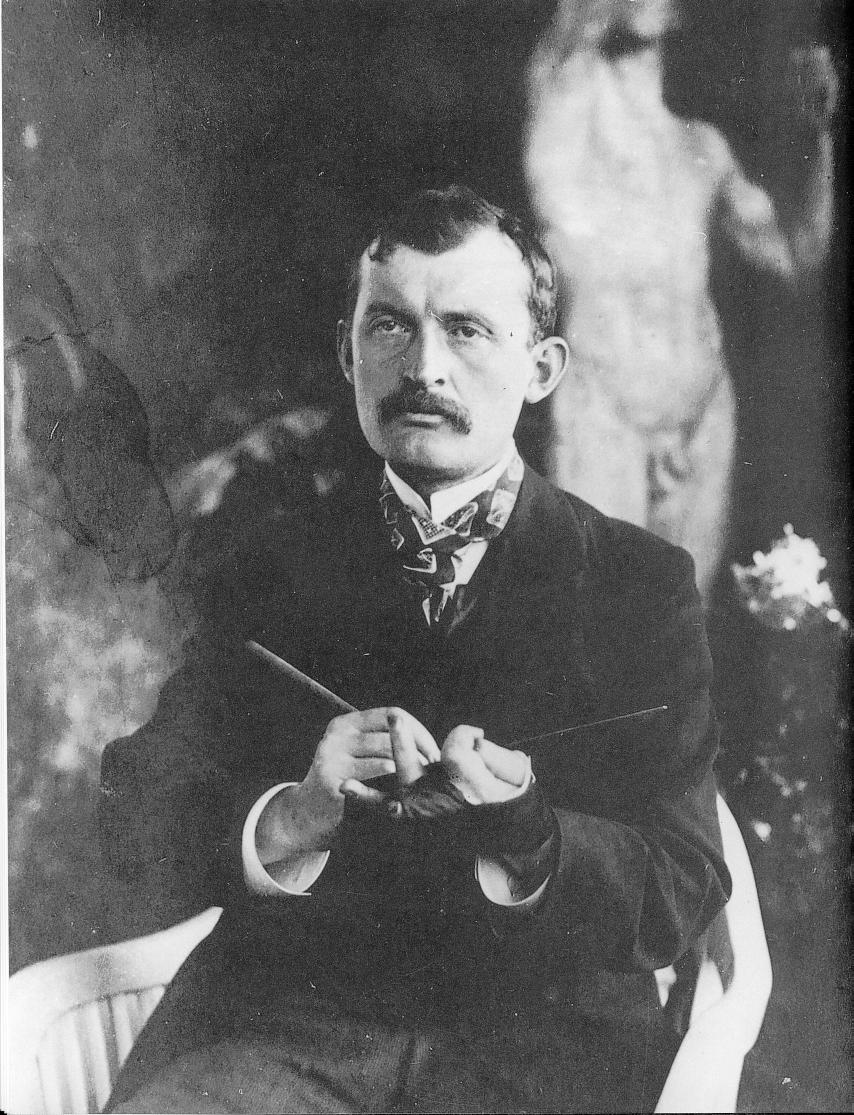
munchDecember 2, 1863 – January 23, 1944, he was a Norwegian painter. He is regarded as a Symbolist and a forerunner of expressionism. He focused on themes of fear, anxiety, melancholy, and death. He did not believe in heaven, or other Christian themes or doctrines, as far as I know.

My intention is to reintroduce you to an artist that I highly esteem.  The challenge I suppose is to understand the issues that Munch discovers in his work. He clearly taps into the ‘angst’ of the modern man, and what he does perpetuates a mindset for our generation.

Obviously these paintings are just an introduction, and I understand that they are selective. I have refrained from any kind of interpretation, other than laying down a general principle–  to Munch, color is everything.

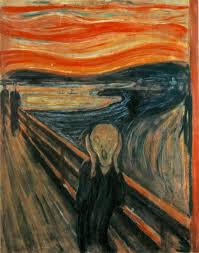
Munch was probably not a cheery person. He essentially was driven by anxiety through his whole life. It seems that he could be very ambitious. His classic work was “The Scream” which he made several versions to sell. He used different mediums to do this– tempera, lithograph and pastel. Interestingly, “The Scream” is a favorite target for art thefts. It captures the minds of every modern thinker.

Within our culture, “The Scream” is iconic. Warhol, Gary Larson, Dr. Who and even “The Simpsons” have cashed in on a parody of it.

Quotes

“I painted the picture, and in the colors the rhythm of the music quivers. I painted the colors I saw.”

“Painting picture by picture, I followed the impressions my eye took in at heightened moments. I painted only memories, adding nothing, no details that I did not see. Hence the simplicity of the paintings, their emptiness.”

“For as long as I can remember I have suffered from a deep feeling of anxiety which I have tried to express in my art.”

“Disease, insanity, and death were the angels that attended my cradle, and since then have followed me throughout my life.”

munch-thescream
The Scream, 1893
Munch’s best known painting ^


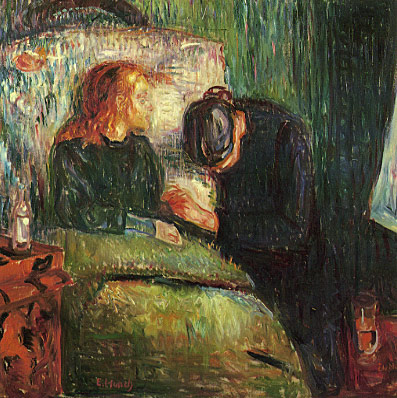
The Sick Child (1885)
Melancholy, 1894
Melancholy, 1894
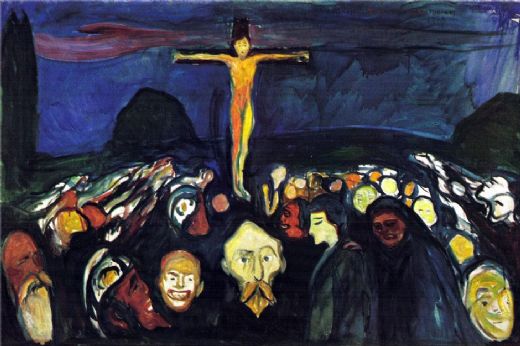
Golgotha, 1900
Golgotha