Little Sin, Little Love— Much Sin, Much Love


She was forgiven many, many sins, and so she is very, very grateful. If the forgiveness is minimal, the gratitude is minimal.”

Luke 7:47, Message

I have been a disciple of Jesus for over 40 years.  But it seems that I really haven’t been a desperate lover of Jesus until recently.

I have seen a lot of stuff, so I made a quick list–

  • the charismatic movement
  • the Imperials
  • New Wine Magazine
  • “I Found It”
  • Larry Lea‘s Prayer Program
  • the PTL Club
  • the Shack
  • preaching on the streets of San Francisco
  • Jesus’ festivals, Festival of the Son
  • Promise Keepers
  • Anita Bryant
  • the Living Bible, youth edition
  • YWAM teams, the Candle– SF
  • Four Spiritual Laws
  • ’88 Reasons Why
  • “Honk if You Love Jesus”
  • preaching on death row
  • Don Francisco
  • carrying the cross, Arthur Blessit
  • the Hiding Place
  • Watchman Nee
  • Outdoor baptisms in city parks

I’ve been exposed to a lot of winds blowing through, and moving on.  You learn to separate the chaff from the grain.  Much of my life has been spent winnowing out to get to the good stuff.  God, through his word describes a coming “trial by fire” over each person’s works.  Romans 14:12 says,

“Yes, each of us will give a personal account to God.” 

One time I walked as a backslidden Christian. I remember once waking up from a drunken stupor with my t-shirt soaked in blood. That blood was someone elses.  I sobered up really quick.  I had this shadowy awareness of beating someone almost to death.  I still catch myself wondering what exactly happened.  There is so much stuff that will be revealed, and I have done many despicable things.

The judgment seat of Christ, therefore, involves believers giving an account of their lives to Christ. The judgment seat of Christ does not determine salvation; that was determined by Christ’s sacrifice on our behalf and our faith in Him. All of our sins are forgiven, and we will never be condemned for them.

We should not look at the judgment seat of Christ not as condemnation but as love, but rather as the Lord speaking into our lives. Yes, as the Bible says, we will have to give an account of ourselves. Part of this is surely answering for the sins we committed.   

But the One who will judge me is also my Savior. That comforts me.

The Greek word for the judgement of Christians is “bema seat.” It was where the judge sat during athletic contests.  Think of the high chair on which a court official sits during a tennis match.  

The issue will not be our salvation, but our faithfulness.    

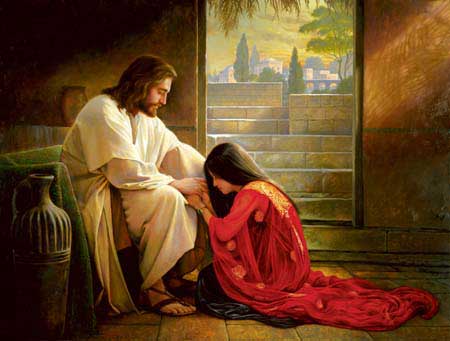
Loving Jesus must become your critical objective for the rest of your days, 1 Peter 4:8, “Love covers a multitude of sins.”  We also read of the sinful woman who washed Jesus feet, “therefore I tell you, her sins, which are many, are forgiven—for she loved much. But he who is forgiven little, loves little.” (Luke 7:47)

Dear one, practice loving him– starting today.  Many are the doers, few be the lovers.  The demanding weight of evangelism and world missions has quadrupled in the last 10 years.  Now is our time!  We love much!  Time is getting very short.


Straining at Your Oars

“He saw the disciples straining at the oars because the wind was against them.”

Mark 6:48

It’s good to know that Jesus sees our labor.  He truly understands all that concerns us, and he understands every issue that concerns us.  Attentive and keenly aware He comes to our boat.  It’s quite common for us to think that he isn’t aware, and we may feel that He’ll pass us by without a word.

Jesus watches over us all the time. 

He knows all about our battles, the fight we have with our flesh, the difficulty we have with the challenging people in our lives. I often struggle to steer my boat. Jesus knows when and why I labor like I do.  And He doesn’t condemn me.

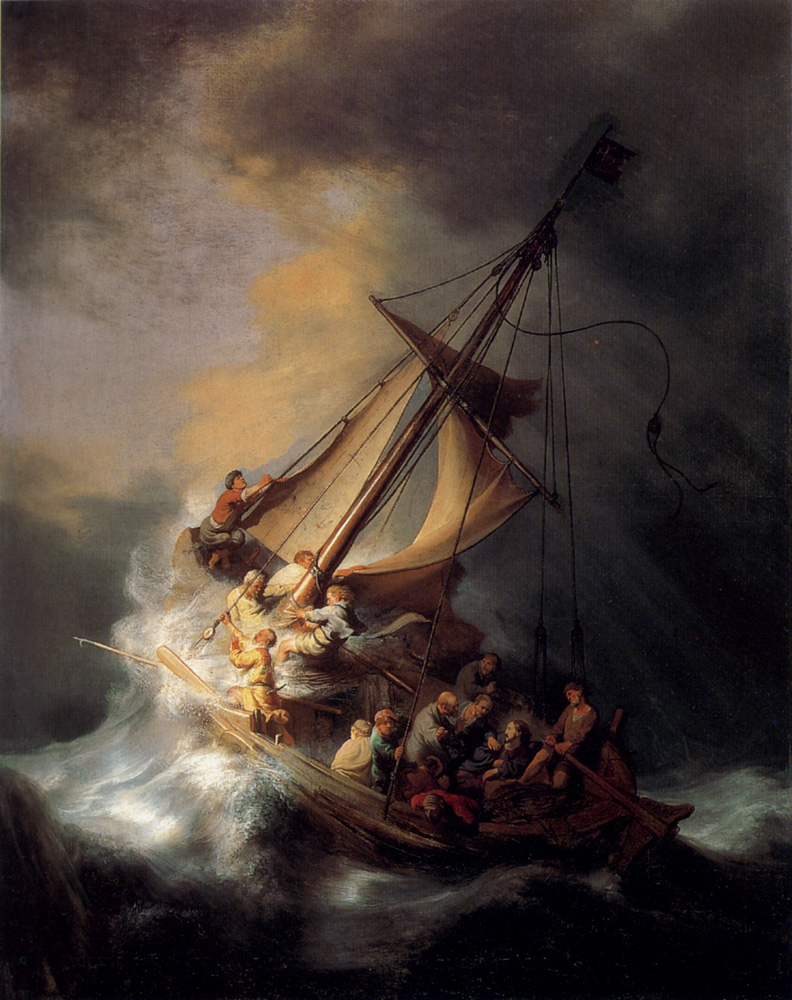
The disciples were straining hard to keep the boat afloat. 

Every oar was being used and every man had his seat.  They must work together.  Some were frantically bailing, and a couple gripped the tiller. A lot of effort was being expended but nothing was working.  The wind continued to push harder against them. 

This is really quite perplexing.  If you remember, they’re simply trying to obey the command of Jesus to cross the sea. They were being obedient, and yet they were starting to sink.

Why do things have to be so difficult?

I’m intrigued by believers who expect sunshine, blue sky, and red roses just because they are doing God’s will.  They don’t seem to think through the issues of conflict and challenge, weakness and humility. That’s not how it’s suppose to work.

“It is necessary to go through many hardships to enter the kingdom of God.”

Acts 14:22

Doing the will of God will often mean that there will be a headwind directly at us.
 

The seas will become impossible, and we may even be driven back.  But special comfort comes when we realize we’re being watched.  Jesus is doing constant surveillance on us, and He sees our toil on the oars. And then He comes to us, walking on the water.

Even in our storm, our hearts should trust and rejoice.

“Lo, I am with you always, even to the end of the age”

Matthew 28:20

How to Die Well

“Even though I walk through the valley of the shadow of death,
   I will fear no evil,
for you are with me;
   your rod and your staff,
 they comfort me.”

Psalm 23:4, ESV

“Precious in the sight of the Lord is the death of his saints.”

Psalm 116:15, ESV


“Death is like my car. It takes me where I want to go.” 

Pastor John Piper

Our generation simply doesn’t know how to die well.  There are so many conflicting messages and attitudes which have steered us away from the reality of dying.  Much of it is the natural development of unbelief.  Our pop culture develops this and gives it momentum.  We are trying to convince ourselves that “death is impossible, my life will not end.’  But we’re escaping into a delusion.  We are running from what is real.

There is a Latin phrase,  Ars moriendi  (“The Art of Dying”) which the Church practiced in past generations.  In past time, Christians would be buried as close as possible to the Church building.  Many would be interred within the very walls of the Church.  The understanding was that the dead were part of the congregation.  That there was only a thin veil that stood between the living and the dead.  The dead didn’t just vanish.  They are with us.

My generation is confused.  We have forced death to wear a mask.  We insist on a significant camouflage to hide the reality of sickness and death.  No one really ever talks about it, and so no instructions are given on how to die well. So we don’t, we die poorly–in ICUs and LTCs, completely sedated, separated and unable to process it or help our families process it.  There can be no solid connection between the living and the dying. And to be very honest, this is not working.

For many, the fear of dying is intense and paralyzing.  Death brings us a terror that twists us; we don’t know how to respond to it.  Additionally there seems that there is no one available to direct us.  Death is a spooky taboo that no one really explains.  The implication is that we are simply to avoid death, ‘it may not come for you’.  But that is not what is real.

“Death avoidance” pretends to lift us above the issue, where we can imagine that we will stay separated somehow from its obscenity and ugliness.  Funerals are nothing more then an aberration.  We have become ‘teflonized’, these things just slide on and off.  We just refuse to calculate, or accept what is happening.  We have ‘molded’ our fear into a more desirable shape.  We simply cannot function in the steady gaze of what is real.  We just shut down and refuse to function. We simply pretend.

Its time for the Church to step up and guide us to our next step.  Our pastors and elders have got to prepare us to die well.  It is a part of being a disciple.  It is discipleship, and dying is inclusive.  We need somebody to prepare us for the inevitable and the certainty that is approaching us.  I need someone that will help me face my own death.

You know what?  No one escapes.  And the reality of that drives some of us mad, or addicted, or psychotic.  The idea of filling a casket up for forever is incomprehensible.  We cannot live with this sick idea of dying.  It disturbs us on the deepest level possible.  It is completely evil.

Psalm 23 has been pure comfort and healing for generations.  And it is an excellent starting point for us.  Verse 4 develops the idea of traversing death.  The writer has incredible insight of passing through death.  This verse alone is worth “billions of dollars in gold”.  Psalm 23 has made me a very wealthy man.  His Word has become my rich treasure.


The Blessings of an Illness

The Bible is a book of miraculous healing.

Jesus Christ performed many of them. He taught His disciples, and those who would follow, to heal the sick and afflicted. This is a real part of the Gospel, and it’s the definite work of his Kingdom.

I’ve personally seen legs lengthened and fevers ‘broken’ on several occasions. Obviously it changes life for the sick person, certainly! But it can also boost the faith of those who witness these miracles. I truly believe the Holy Spirit still works these wonders today. We must let him do these things. That isn’t an option.

Somehow though, there is the ‘understanding’ that in order to be healed you must have sufficient faith. Those who are not healed are the people who have a weak faith, they’re missing out somehow on a miracle because their faith didn’t measure up. I wonder though, how much faith was needed to wash in the pool of Siloam in John 5? But really, all that is needed is a mustard seed (Matthew 17:20).

Faith is an active component to many who were healed in Scripture. Jesus said to the blind man, “Receive your sight; your faith has healed you” (Luke 18:42). It happened!

Yet we read of many believers in Hebrews 11 who endured sickness and ill-treatment. We read of vicious brutality and persecution of these “people with faith.”

Not everyone who is sick will receive a physical healing.

For believers today who suffer physically or mentally, we may question our faith. (Especially when the healing evangelist comes to town). After 2-3 tries we settle back on our “deficient’ faith feeling a bit miserable. I honestly don’t think that’s what the Lord wants.

It seems to me that the real issue is not so much a weak faith, but holding on to your faith when you are not healed.

I hear talk about having faith to be healed–but what about the faith that’s needed to be sick?

Why do we suffer from illness? I suspect that for many believers sickness is really there to bring glory to God. Holding onto faith in the midst of pain often encourages those who witness it. I believe that was Paul’s experience (2 Cor. 12:7-10).

Oh dear one, continue to seek healing, (James 5:14).

The Spirit does these things today. But if you’re left in your illness, trust in Him still. All your ways end up in His nail-scarred hands of our Lord Jesus. But remember, when he greets you in heaven, you will know him by the scars.

“The moment an ill can be patiently handled, it is disarmed of its poison, though not of its pain.”

–Henry Ward Beecher