“But Jesus spoke to them at once. “Don’t be afraid,” he said. “Take courage. I am here!”
Matthew 14:27, NLT
In this moment of history there are more Christians discouraged than ever. We seem to doubt the very precious promises found in the Bible. Our very best now seems to be the worst we could ever wish for. Discouraged, we seriously consider packing it all in.
But their is another step. Something more advanced. That is diversion. A strange sort of deflection into complete disaster. Most of us would never dream of renouncing our faith in Jesus Christ, but if we are sufficiently discouraged we will end up there without much thought. We are being diverted into total loss.
Discouragement is not the final goal, but diversion could well be. Once we lose sight of our true calling and present nature we untrack and derail. We’ve rejected the rails, and don’t want to travel the tracks anymore. Our diversion leads to disaster.
A gift of encouragement helps another to stay on track. An encourager will stand and shout for you to stay in the faith. They are only a few to be found, for they are a rare species. But many exercise the gift without the distinct call. (More power to them). We need people who can truly encourage the saints to run well.
Dear saint, if you feel called to encourage others here are three things you must try to do:
Separate and dedicate. Become someone who knows how to move our of your own past and to live now staring at the future. “Leave and cleave” is a good word for you.
Master the promises of God. Read them, and master them. Put them on your heart so that the Spirit can put them on your tongue.
“Pray like your house is on fire!” When prayer meets encouraging words it will turbocharge your ministry. It will also protect others from the foolish things we all say. Trite and simple things that will confuse them. Avoid doing this.
Please become an encouragementto those fighting a hard battle.
Prepare to be educated far beyond your present capabilities. An encourager will always have a “job.” The Kingdom has openings for all those who want to encourage God’s people.
The story of Elisha and his young man is saturated with the ministry of encouragement.
“When the servant of the man of God got up early the next morning and went outside, there were troops, horses, and chariots everywhere. “Oh, sir, what will we do now?” the young man cried to Elisha.”
16 “Don’t be afraid!” Elisha told him. “For there are more on our side than on theirs!” 17 Then Elisha prayed, “O Lord, open his eyes and let him see!” The Lord opened the young man’s eyes, and when he looked up, he saw that the hillside around Elisha was filled with horses and chariots of fire.”
2 Kings 6:16, 17
“I would go to the deeps a hundred times to cheer a downcast spirit. It is good for me to have been afflicted, that I might know how to speak a word in season to one that is weary.”
“Come, let’s worship him and bow down. Let’s kneel before the Lord who made us.”
Ps. 95:6, NCV
We come directly to Him, with so many deep and ugly flaws. We step toward Him, having lost every confidence, but yet there is an assurance that we have arrived at something far beyond ourselves.
Mental illness destroys confidence. In our most lucid and aware moments, we discover that we are completely disarranged. We stumble and fumble through many things which are easy for others. But they are intensely difficult for us. My distinct paranoia has ruined many possible relationships. I end up fouling many possible friendships to my loss.
We gravitate toward this place where we can only bow. There are so many, far too many loose ends. So much is unsure and I’m totally unready for this. And yet, we have a nagging thought that we just might shatter these issues that hold us. And maybe even break into a profound awareness of Light. Sometimes we can only bow without saying a word.
We must readily admit that we can only bow.
Nothing can be brought in, or considered as a provision or an enhancement to our credit. All of us are beggars and losers in His sight. We simply can’t generate anything that just might make us acceptable in His eyes. The only thing acceptable is the blood of Jesus on the cross.
Everyone who truly kneels is brought to this place. We are undone, completely. In the light of His deep grace, we have been dismantled and rendered inoperative. We must step out of our ruins, and leave them in a pile. Sweet grace will save us, in fact, it is the only thing that can.
“We believe that we are all saved the same way, by the undeserved grace of the Lord Jesus.” Acts 15:11
There isn’t really a place for the individual in our walk of discipleship. This is a most exceptional truth. You might say that our society here in the U.S. is expressed in the ‘Marlboro Man’ who rides alone. “High Noon,” (my favorite Western) is based on a solitary man who stands when other won’t. The message of individualism saturates this movie. Like Gary Cooper, I think I have to face the bad guys alone.
But I think we need to understand that we are connected to other believers. In fact, I believe that the Holy Spirit works quite distinctly in ‘generations.’ Whether we like it or not, each of us is connected to our generation. We are responsible for our own time and place. I’m a child of the Sixties, it’s what makes me tick.
Stellar individuals like Charles Spurgeon and D.L. Moody spoke directly to their generation. They were voices in the late 1800s. They connected to their particular milieu, but were surrounded by many praying believers. Their ministries and sermons, were founded upon the prayers of many saints. Their ministries were an extension of many people. They were surrounded by other believers.
We are connected with others who are also connected. We are organically related and that needs to be understood. It’s funny about that, we are called a “body.” This is a difficult concept for us to understand. But we need to know that you are not so much solitary, but woven into the life of others. The Church is plural and it happens when believers join together.
We need to understand that the Christian life is not solitary.
If this makes you curious, check out the word “together” in New Testament. We can reflect on this, and think out what that really means. Just a few scriptures:
“From whom the whole body, joined and held together by every joint with which it is equipped, when each part is working properly, makes the body grow so that it builds itself up in love.”
Ephesians 4:16, ESV
“For, in the first place, when you come together as a church, I hear that there are divisions among you. And I believe it in part.”
1 Corinthians 11:17-19
“Not neglecting to meet together, as is the habit of some, but encouraging one another, and all the more as you see the Day drawing near.”
Hebrews 10:24-26,
And there is at least a dozen or so more. The idea– ‘together,’ is only a start, and we need to understand that the Christian life is not solitary. The Father melts our independence, and then molds us with each other to make us into something new. Whether we like it or not, we are “together.”
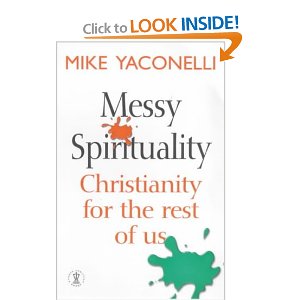
“Messy Spirituality:” A Book Excerpt by Mike Yaconelli
“For as long as I can remember, I have wanted to be a godly person. Yet when I look at the yesterdays of my life, what I see, mostly, is a broken, irregular path littered with mistakes and failure. I have had temporary successes and isolated moments of closeness to God, but I long for the continuing presence of Jesus.
Most of the moments of my life seem hopelessly tangled in a web of obligations and distractions. I want to be a good person. I don’t want to fail. I want to learn from my mistakes, rid myself of distractions, and run into the arms of Jesus. Most of the time, however, I feel like I am running away from Jesus into the arms of my own clutteredness. I want desperately to know God better. I want to be consistent. Right now the only consistency in my life is my inconsistency. Who I want to be and who I am are not very close together. I am not doing well at the ‘living-a-consistent-life’ thing.
I don’t want to be St. John of the Cross or Billy Graham. I just want to be remembered as a person who loved God, who served others more than he served himself, who was trying to grow in maturity and stability. I want to have more victories than defeats, yet here I am, almost 60, and I fail on a regular basis.
If I were to die today, I would be nervous about what people would say at my funeral. I would be happy if they said things like “He was a nice guy” or “He was occasionally decent” or “Mike wasn’t as bad as a lot of people. ”Unfortunately, eulogies are delivered by people who know the deceased. I know what the consensus would be.“Mike was a mess.”
You might say Christianity has a tradition of messy spirituality. Messy prophets, messy kings, messy disciples, messy apostles. From God’s people getting in one mess after another in the Old Testament to most of the New Testament’s being written to straighten out messes in the church, the Bible presents a glorious story of a very messy faith. Sounds like you and I are in good company.
A few years ago, I was introduced to a group of uncouth Christians who call themselves “the Notorious Sinners.” These are men from all walks of life who meet once a year to openly share their messy spirituality with each other. The title ‘Notorious Sinners’ refers to the scandalous category of forgiven sinners whose reputations and ongoing flaws didn’t seem to keep Jesus away.
In fact, Jesus had a habit of collecting disreputables; he called them disciples. He still does. I like people who openly admit their ‘notoriousness’—people who unabashedly confess they are hopelessly flawed and hopelessly forgiven. Graciously, these men invited me to be a part of their group. The ‘Notorious Sinners’ meet yearly at spiritual-retreat centers, where from the moment we arrive, we find ourselves in trouble with the centers’ leadership.
We don’t act like most contemplatives who come to spiritual-retreat centers— reserved, quiet, silently seeking the voice of God. We’re a different kind of contemplative— earthy, boisterous, noisy, and rowdy, tromping around our souls, seeking God, hanging out with a rambunctious Jesus who is looking for a good time in our hearts.
A number of us smoke cigars, about half are recovering alcoholics, and a couple of the men could embarrass a sailor with their language. Two of the ‘Notorious Sinners’ show up on their Harleys, complete with leather pants and leather jackets. I admit I run with a rough crowd—Christians whose discipleship is blatantly real and carelessly passionate, characterized by a brazen godliness. Unafraid to admit their flaws, unintimidated by Christians who deny their own messiness, these guys sometimes look like pagans and other times look like Jesus.
They are spiritual troublemakers, really, which is why they look like Jesus (who was always causing trouble himself ). They are full of mischief, laughter, and boisterous behavior, which is why they look like pagans. Truly messy disciples. The ‘Notorious Sinners’ are definitely a bizarre mix of the good, the bad, and the ugly, living a spirituality which defies simple definitions.
Oh, and they are some of the most spiritual men I know.”
___________________________
Messy Spirituality [Book] by Michael Yaconelli, Karla Yaconelli in Books
By Michael Yaconelli, Mike Yaconelli, Karla Yaconelli – Zondervan (2007) – Paperback -192 pages-ISBN 0310277302
I Guess I’m Not a Very Good Christian . . . Do you feel like: I don’t pray enough I don’t read my Bible enough I don’t share my faith enough I don’t love God enough I’m not committed enough I’m not spiritual enough Then this book is for you.
Messy Spirituality was written for the silent majority of us who have been convinced that we just don’t do Christianity right. We spend most of our lives worried about what we don’t do instead of what we have done, focused on our imperfections instead of God’s fondness for the imperfect. Why?
Because we’ve been bombarded with books, tapes, talks, seminars, and movies convincing us that real Christianity is all about perfection. Michael Yaconelli dares to suggest that imperfection, infiniteness, and messiness are, in fact, the earmarks of true Christianity; that real Christianity is messy, erratic, lopsided . . . and gloriously liberating.
What if genuine faith begins with admitting we will never have our act completely together? Maybe messy disciples are exactly the kind of imperfect people Jesus came to earth for and whose company he actually enjoyed–and still enjoys.
If you want to find Jesus today, look for him in the midst of burned-out believers, moral misfits, religious incompetents . . . men and women whose lives are, well, messy.
Messy Spirituality is a strong antidote for the spiritual perfectionism in us all. Here are truths that can cut you loose from the tyranny of ought-to’s and open your eyes to the deep spirituality of being loved, shortcomings and all, by the God who meets you and transforms you in the midst of a messy and unpredictable life.










 Broken Believers