Dismayed by My Own Fallenness

“As the Scriptures say,

“No one is righteous—
    not even one.
11 No one is truly wise;
    no one is seeking God.
12 All have turned away;
    all have become useless.
No one does good,
    not a single one.”

Romans 3:10-12

Scripture never, ever flatters the human ego.  It acts on us directly, “dividing the spirit from the soul.”  I find no glowing review of our “noble” humanity. The opposite is true.

At our deepest core, the Bible teaches that we are depraved—separated from truth and goodness.  In theology this is called, “original sin.”  (I don’t think there is really anything original about it.) There is also a concept called “contrition.”   It means, “having sorrow or sadness over sin involving making steps to amend your ways.”  Notice the definition instills a sense of action.  Perhaps the idea of penitence need a new emphasis?

Does your discipleship include the reality of you?

There are broad, generalized teachings that are woven into the Word— the iniquity and fallenness of men.  It consistently talks a seemless truth, without fail. ( That’s one of the reasons why I know the Bible is true.)  Yet the Father has made provision for our falseness and weakness, he sweeps nothing under a cosmic rug.  You might say the Scripture completely understands us, as us.  Our illusions and deceptions, blatant or subtle, do not confuse or mislead him.

Our discipleship must be “walked out” in brokenness. That is the only way it will work.

We have absolutely nothing to boast about.  I cannot point to this blog— or having been a missionary, a teacher and a pastor as my “good things.”  Today, I sat and became very aware of my inner wickedness. But because He directly intervenes in my life, I will not die in my sins like I deserve.

I am sad.  You see, I am fallen, a complete failure.  It’s easier to find water in the Sahara Desert than to find goodness in my heart.  As a matter of fact, I’ve taken evil to a new level.  I excel, and then I keep practicing it trying to squeeze out more and more power— pride— pleasure.

Those who mourn their contagiously evil hearts (Matthew 5:3-4) are the ones who God can comfort.  Our sadness over our sin (and the sin of the world)—is evidence of the Spirit’s action over our depravity. Look for it, and rest in the Spirit’s work.

“Original sin is in us, like the beard. We are shaved today and look clean, and have a smooth chin; tomorrow our beard has grown again, nor does it cease growing while we remain on earth. In like manner original sin cannot be extirpated [completely destroyed]  from us; it springs up in us as long as we live. Nevertheless we are bound to resist it to our utmost strength, and to cut it down unceasingly.” 

 ~Martin Luther

bry-signat (1)cropped-christiangraffiti1.jpg

Some Things Must Be ‘Prayed In’ [Intercession]

Apostle-Paul

16 “I pray that from his glorious, unlimited resources he will empower you with inner strength through his Spirit. 17 Then Christ will make his home in your hearts as you trust in him. Your roots will grow down into God’s love and keep you strong. 18 And may you have the power to understand, as all God’s people should,

  • how wide,
  • how long,
  • how high,
  • and how deep his love is. 

19 May you experience the love of Christ, though it is too great to understand fully. Then you will be made complete with all the fullness of life and power that comes from God.”

Ephesians 3:16-19, NLT (My bullet points)

Paul has a ‘rocking’ prayer life. The church of Ephesus would have swelled on the spot with such an amazing prayer. I have to believe that sometimes preaching and worship isn’t enough. There is a need for intercessory prayer instead.

Prayer interjects what preaching can’t. Good worship is critical, but there are needful things that are only drilled in by prayer. Paul knows this, and even though he is quite far away, he can disciple that church at a distance– through prayer. Prayer is Paul’s way of touching the church, even across the ocean!

Paul's cell at Mamertine
Paul’s cell at Mamertine

Most of our Bible heroes had seasons of  intercession.

Abraham for instance, stood and begged God for Lot’s life. Moses beseeched on behalf of Israel. Of course, Samuel and David would stand on Israel’s behalf. These are men who regarded intercessory prayer as a critical part of their walk. They ‘stood in the gap’ so others might live.

In Paul’s prayer for the Ephesians, it seems he wants to solidify some essential things within them. The prayer is marvelous. He has a confidence that he is making a difference in the spiritual lives of the church, even if he is chained to a guard in Rome. Ministry doesn’t have to be restricted by distance.

There are powerful truths in this part of Ephesians, and will penetrate the hearts of the hearers. With Paul confined and unable to visit the church, he must revive the heart of an intercessor. I hope you find someone to pray for.

”Jesus Christ carries on intercession for us in heaven; the Holy Ghost carries on intercession in us on earth; and we the saints have to carry on intercession for all men.”

–Oswald Chambers

aabryscript


cropped-cropped-christiangraffiti1.jpg


The Difference the Holy Spirit Makes

Chesterton-disciple

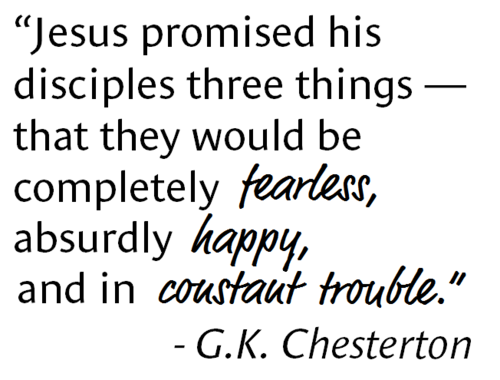
I like this quote. The early Church was all of these things: Fearless, happy, and very much in trouble. Luke wrote of the nascent exploits of this group of people in the Book of Acts, and while some believers will debate different aspects of theology, none can diminish the reality. These were human beings irrevocably touched by the Holy Spirit.

Some have even suggested that the title of the book be changed to “the Acts of the Holy Spirit.” (Instead of “Acts of the Apostles”).

When the fire of the Holy Spirit meets the dry tinder of the heart, it explodes into a conflagration that can’t be contained. It boils over and touches everyone around it. The disciples became fearless. Their boldness could not be diminished or diluted. They were so courageous (and contagious) that they preached to both kings and beggars.

They were “happy.” Once they had surrendered their personal ‘agendas’ they became immune to the negative issues of life. They soared with the eagles of contentment and joy. They no longer lived in the ‘mud’ of human life. They were ‘Teflon’ to that which can be so sticky. Happiness is the deep evidence of a personal contact with God’s own spirit.

But they ‘were in constant trouble.’ There may never been a people so maligned and persecuted. The apostle Paul faced daily obstacles. As the de facto leader of the church, he absorbed a lot of hatred and wrath that was focused on the early Church. Everywhere he went this darkness would descend, and each time God met him.

I suppose that we might ask ourselves, is this our experience? Am I fearless, and happy? Am I in ‘constant trouble” for the sake of the Gospel? (Do the police have my ‘mug shot?’)

Honest reflection is in order I think. We should really determine if we have the very same spirit that the early Church possessed. Whether or not, we should amend our relationship with the Spirit of God, and seek to be more tractable to His work. We start by believing the truth about our hearts and lives. The Truth is stronger than the lies.

This post was not intended to condemn. If you have read that into these words, I ask forgiveness. But reading this over, I will retract nothing. But I still ask that you ‘spiritually check’ each thought. Is it biblical, and does it glorify the Lord Jesus?

“I have told you all this so that you may have peace in me. Here on earth you will have many trials and sorrows. But take heart, because I have overcome the world.”

John 16:33, NLT


aabryscript


cropped-christiangraffiti1-3

Feeding the Dogs, [Choosing Holiness]

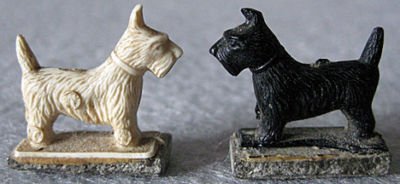
A toy I grew up with, they were magnetized pushing against each other.

There is a story of a Native American elder who once described his own inner struggles to understand the Bible and Christianity.

Inside of me there are two dogs. One is black, and the other is white. The black dog is mean and tries to talk me into making the wrong choices. The white dog is good and encourages me to make the right choices. The black dog fights the white dog all day.” When asked by the friend which dog wins, the elder reflected for a moment and replied;

“The one I feed the most.”

White Dog: As a believing Christian, there is a part of us that is Christ-spirited, compassionate, trusting, open, abundant and focused on helping others. We pray and are being filled with the Holy Spirit.

Black Dog: The other part is our flesh. We can be proud, evil, self-centered, greedy, manipulative, sullen, promiscuous, drunken, and only wants to he served by others.

“An analogy is made between the good white dog, our new nature in Christ, and the bad black dog, our old fallen nature. While we cannot eliminate the old nature, we can choose to feed the white dog.”

(From “The Holy Spirit: Activating God’s Power in our Life,” by Billy Graham 1978.)
 

howlingwolf3-300x281The main key for us to remember is that these two parts are in constant struggle.

Two Scriptures to help: One– “If you use your lives to do the wrong things your sinful selves want, you will die spiritually. But if you use the Spirit’s help to stop doing the wrong things you do with your body, you will have true life.”   Rom. 8:13, NCV

Two– “Our sinful selves want what is against the Spirit, and the Spirit wants what is against our sinful selves. The two are against each other, so you cannot do just what you please.”   Gal. 5:17

In thinking this through this analogy might help.  I’m inclined to think that holiness is not so much like an “on and off” switch.  But I think it’s more like a “dimmer” switch is turned to brighten or darken a room.  I actually think there are times when we should make a deliberate decision for God.  And yet other times we just need to turn up the dimmer from 30% to 80%. Maybe all the way?

I’m just thinking out loud here.

 bry-signat

flourish31