Good Medicine

medicine

“A joyful heart is good medicine,
    but a crushed spirit dries up the bones.”

Proverbs 17:22, ESV

We have from ‘King Solomon’s mines’ a truth regarding joy. Whether we acknowledge its truth, or not, we find its effects on us to be binding. “A joyful heart” is like medicine for our souls. There are many issues that afflict us, many things that trouble us. I find within myself a veritable zoo. But there is a sure and ready relief.

“Worry, fear, distrust, care-all are poisonous! joy is balm and healing, and if you will but rejoice, God will give power. He has commanded you to be glad and rejoice, and He never fails to sustain His children in keeping His commandments. Rejoice in the Lord always, He says. This means no matter how sad, how tempted, how sick, how suffering you are, rejoice in the Lord just where you are-and begin this moment. The joy of the Lord is the strength of our body, The gladness of Jesus, the balm for our pain, His life and His fullness, our fountain of healing, His joy, our elixir for body and brain.”

A.B. Simpson


For those among us who struggle so, we find a  treatment plan that will work. There is an active ingredient within a joyful heart that heals and protects our souls. Real joy— applied frequently to our aching souls— provides something quite  like medicine to someone quite ill. I’m no snake oil salesman. Nor am I into herbs and vitamins. (I suppose I could be a little more aware.) But I know that this principle is true.

“A crushed spirit dries up the bones.” We know first-hand that this is true. There is a ‘crushing’ wound that can breakdown our spirits and bodies. We are simply overwhelmed by life and we experience a crumbling and mashing of our personalities. We are as sick in our ‘bones’ as we might be physically. Now there is a huge difference between a physical illness and a spiritual one, but the factual principles are the same. The pain is different, but is it not similar?

A joyful heart is the pharmaceutical of choice for treating diseases of the personality and spirit. Sometimes we are unwell because we ignore the prescription.  “The joy of the Lord is your strength.”  (Nehemiah 8:10) Joy in the deepest part of us is almost always:

  1. transforming,
  2. God-honoring, and
  3. contagious.

If this is true, then we do well to ‘give it a whirl.’

“The joyless Christian reveals himself by having negative thoughts and talk about others, in a lack of concern for others welfare, and a failure to intercede on others behalf. Joyless believers are self-centered, selfish, proud, and often vengeful and their self-centeredness inevitably manifests itself in prayerlessness.”

John MacArthur

bry-signat (1)

cropped-christiangraffiti1.jpg


Listening In

road_emmaus-2

“That same day two of Jesus’ followers were walking to the village of Emmaus, seven miles from Jerusalem. 14 As they walked along they were talking about everything that had happened. 15 As they talked and discussed these things, Jesus himself suddenly came and began walking with them.”

Luke 24:13-14, NLT

“Then those who feared the Lord spoke with each other, and the Lord listened to what they said. In his presence, a scroll of remembrance was written to record the names of those who feared him and always thought about the honor of his name.”

Malachi 3:16

These verses compliment each other. The disciples were walking and talking, each situation creating a supernatural moment. We can involve the Holy Spirit of God listening to us conversing with each other; it seems He wants to be involved when we talk about Jesus with each other. In Malachi, we see a “scroll of remembrance” being written. And in Luke’s account, the resurrected Jesus shows up himself.

The disciples are not named in either account. It seems God enjoys reaching out to ‘no-namers’— the obscure and the anonymous. I suppose this might mean that we are all equally important or significant. But the Lord himself decides that. What we do and say really does matter in the ‘heavens.’ If and when we speak  of Him, it is noted and sometimes even focused upon by God. We are being, in a sense, ‘recorded.’

The mundane becomes special when He is the topic of conversation.

There are few casual words when He is the subject of discussion. When we speak of him truly, we should realize we are being recorded. In a sense, there is someone listening to what we say. And it matters.

Malachi tells us of ‘the fear of the Lord.’ I suppose this phrase means that we have an esteem or reverence of God’s place in our lives. But fear can also mean ‘awe’ at His presence. When we speak of Him perhaps we should tremble a bit, knowing that our Creator and Judge is incredibly present.

I suppose that this kind of ‘monitoring’ should make us hyper-aware of his presence. We can do nothing without his awareness. But we love anonymity, and the false idea we are not heard. Perhaps we believe that we are not significant enough to warrant such detection. But we are. What we say is being recorded in heaven.

I want to leave you with this idea.

bry-signat (1)

cropped-christiangraffiti1.jpg

The Melancholy of Edvard Munch

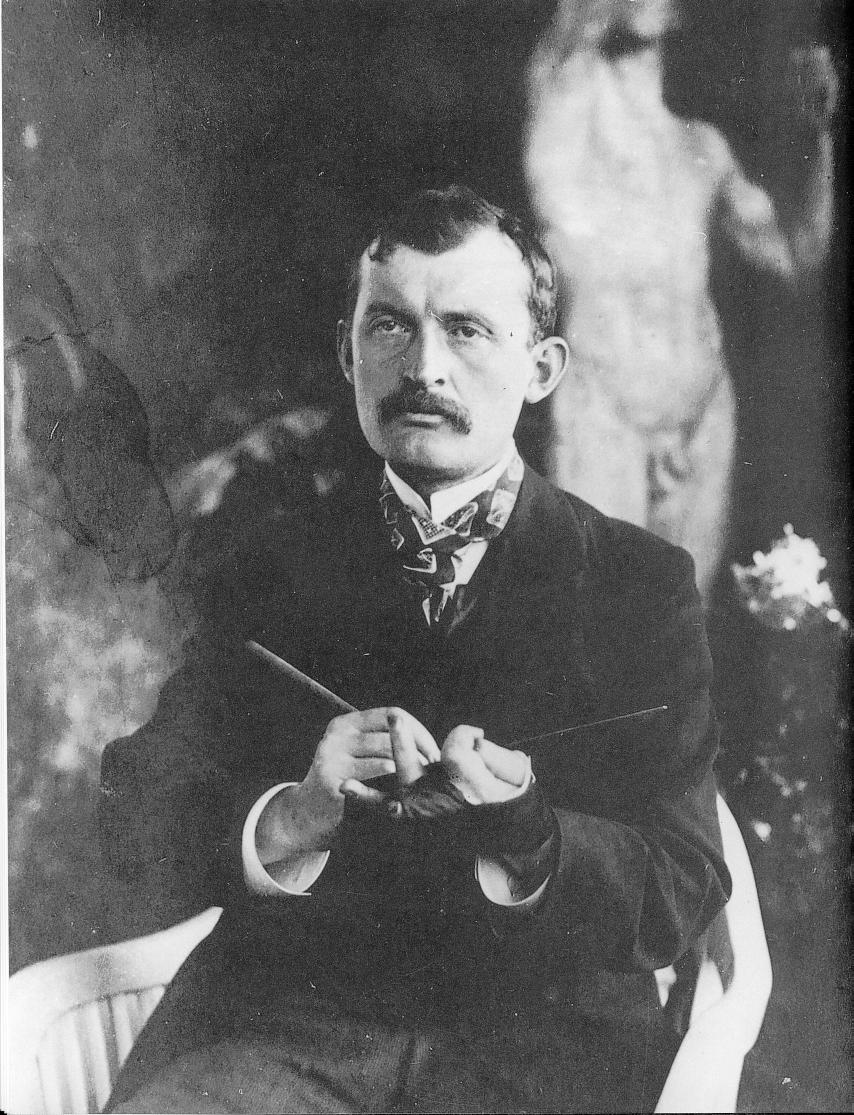
munchDecember 2, 1863 – January 23, 1944, he was a Norwegian painter. He is regarded as a Symbolist and a forerunner of expressionism. He focused on themes of fear, anxiety, melancholy, and death. He did not believe in heaven, or other Christian themes or doctrines, as far as I know.

My intention is to reintroduce you to an artist that I highly esteem.  The challenge I suppose is to understand the issues that Munch discovers in his work. He clearly taps into the ‘angst’ of the modern man, and what he does perpetuates a mindset for our generation.

Obviously these paintings are just an introduction, and I understand that they are selective. I have refrained from any kind of interpretation, other than laying down a general principle–  to Munch, color is everything.

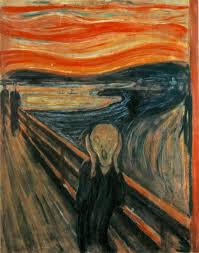
Munch was probably not a cheery person. He essentially was driven by anxiety through his whole life. It seems that he could be very ambitious. His classic work was “The Scream” which he made several versions to sell. He used different mediums to do this– tempera, lithograph and pastel. Interestingly, “The Scream” is a favorite target for art thefts. It captures the minds of every modern thinker.

Within our culture, “The Scream” is iconic. Warhol, Gary Larson, Dr. Who and even “The Simpsons” have cashed in on a parody of it.

Quotes

“I painted the picture, and in the colors the rhythm of the music quivers. I painted the colors I saw.”

“Painting picture by picture, I followed the impressions my eye took in at heightened moments. I painted only memories, adding nothing, no details that I did not see. Hence the simplicity of the paintings, their emptiness.”

“For as long as I can remember I have suffered from a deep feeling of anxiety which I have tried to express in my art.”

“Disease, insanity, and death were the angels that attended my cradle, and since then have followed me throughout my life.”

munch-thescream
The Scream, 1893
Munch’s best known painting ^


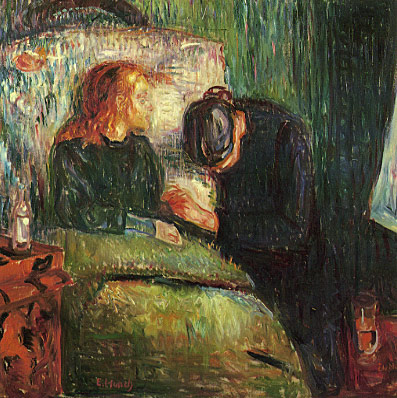
The Sick Child (1885)
Melancholy, 1894
Melancholy, 1894
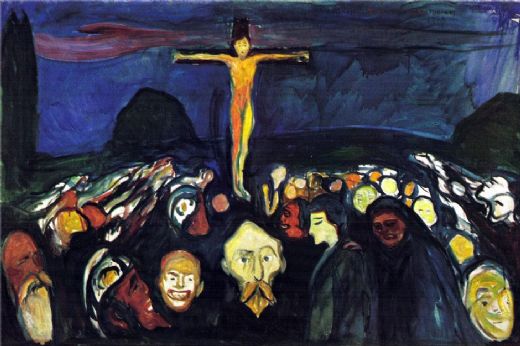
Golgotha, 1900
Golgotha

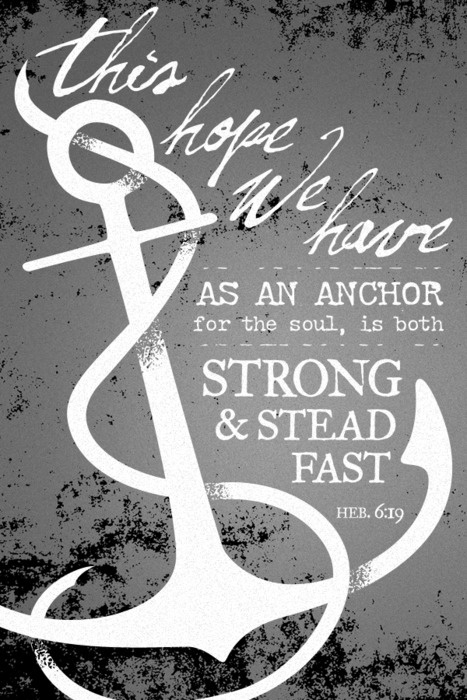
Anchored to Him

anchored-hope

“Therefore, we who have fled to him for refuge can have great confidence as we hold to the hope that lies before us. 19 This hope is a strong and trustworthy anchor for our souls. It leads us through the curtain into God’s inner sanctuary.”

Hebrews 6:18-19, NLT

“Every thing that is done in the world is done by hope.”  ~Martin Luther

“To live without hope is to cease to live.”  ~Fyodor Dostoevsky

flourish14

We must never give up our hope. In some sense we must guard our tether that reaches into heaven. The writer of Hebrews develops this idea into an exhortation. We are linked by hope as an “anchor for our souls.”

Many years ago I signed on as a deckhand fishing ‘long line’ for halibut in the Gulf of Alaska. We had to fish for 24 hours straight, we couldn’t put the long line into the water until midnight, and then we went all out until midnight the next day. It was brutal and cold work.

The ship’s anchor was vital. We ‘holed up’ in a sheltered cove were we spent a day resting up near Kodiak Island. I was as green as they come; I dreamed that we would make a fortune the next day. I suppose I was a bit deluded.

Anchors come in a dozen shapes and sizes: some are for muddy bottoms, others for sand or rock. The anchor is the only tether or connection to the ocean floor. It allows the ship to be fixed in one spot temporarily. The open sea is always churning and tides and currents are almost always running; the wind is always a factor.

wave1Waves can get rather dangerous. There can be sense of riding a roll-coaster. I have been at the wheel when water broke over the cabin. I knew real fear. (Watch the movie, “The Perfect Storm.”)

Our own hope is a ‘strong’ and reliable anchor for our souls. Let’s face reality. The storms we are traversing through can be formidable. Sometimes, we honestly wonder if we are going to make it. Having a mental or physical illness gives more credence to the power of the wind and waves.

But we have an anchor; it holds and tethers us to that which is solid and eternal. Our hope is in Jesus; he is both eternal and tender, and ever-present for us. Our anchor holds.

aabryscript


flourish15