A Jubilate Discipleship: Psalm 95

Montage-Jubilate

A Psalms Study

“Come, let’s sing for joy to the Lord.
    Let’s shout praises to the Rock who saves us.
Let’s come to him with thanksgiving.
    Let’s sing songs to him,
because the Lord is the great God,
    the great King over all gods.
The deepest places on earth are his,
    and the highest mountains belong to him.
The sea is his because he made it,
    and he created the land with his own hands.

Come, let’s worship him and bow down.
    Let’s kneel before the Lord who made us,
because he is our God
    and we are the people he takes care of,
    the sheep that he tends.

Today listen to what he says:

Psalm 95:1-7, NCV

Such joy: it just bubbles through the words. This is a psalm saturated with excitement. These first seven verses are ‘carbonated joy.’ They pronounce an excitement of a living God that excels in every way. These are simple words made to escort us into a true worship, unlike any other. We might use the word, “jubilant” when hearing this psalm. And we wouldn’t be far off.

“The Lord is the great God,” and He is the King of any ‘so-called’ gods. Everything concerning the earth is His doing– for He created it, with His own hands! And our creating God is also our Shepherd, tending and caring for us as His very own flock.

These verses extol our God, to the point of exuberance. It channels us to the point of worship upon our knees, with the realization of the greatness of God. But this Psalm continues for four more verses.

Today listen to what he says:
“Do not be stubborn, as your ancestors were at Meribah,
    as they were that day at Massah in the desert.
There your ancestors tested me
    and tried me even though they saw what I did.
10 I was angry with those people for forty years.
    I said, ‘They are not loyal to me
    and have not understood my ways.’
11 I was angry and made a promise,
    ‘They will never enter my rest.’”

Psalm 95:7-11

There are two parts to Psalm 95. The first is of jubilant worship. But the second part emphasizes a solid obedience. The phrase, “Today listen to what he says:’ welds these two sections together.

Worship must always lead to obedience. You can do ‘cartwheels’ on Sunday morning, as long as you follow Him on Monday.

The issue is an history lesson that goes back to Israel’s days of Moses and the days following the Exodus. Because they were so hard and stubborn, they would wander for forty years in the desert. Their continued ‘stubbornness’ not only closed off the Promised Land, but also closed off their relationship with God— a relationship that would’ve been ‘jubilant’ and  profound (at the same time). They missed out on verses 1-6 and settled on verses 8-11. How tragically sad.

There is a thread that works through scripture called “the rest of God.” The book of Hebrews uses in 12x usually as a warning:“Now, since God has left us the promise that we may enter his rest, let us be very careful so none of you will fail to enter.” (Heb. 4:1).

 “Let us try as hard as we can to enter God’s rest so that no one will fail by following the example of those who refused to obey.”

Heb.4:11

To be in God’s rest is to be in harmony with Him. It is a mixture of confident faith mixed with a careful obedience. When you combine these two, you have the recipe for joy.

I believe this rest is the believer’s place of joy, peace and confident faith. It obeys because it really wants to. It is Psalm 95:1-7 in action. It is for the jubilant Christian.

bry-signat (1)

cropped-christiangraffiti1.jpg

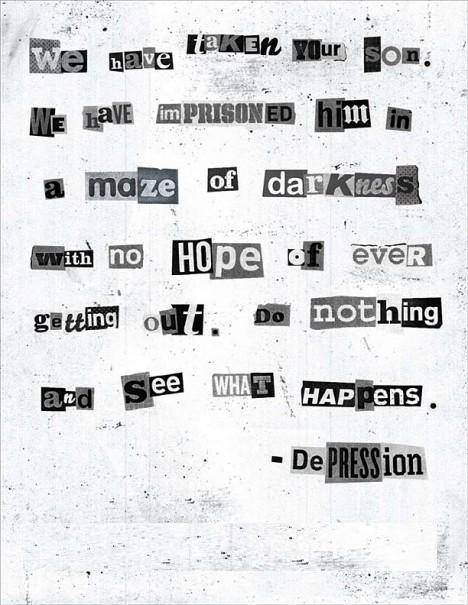
The Ransom Note

depression-note

“We collapse in the dust,
    lying face down in the dirt.
26 Rise up! Help us!
    Ransom us because of your unfailing love.”

Psalm 44:25-26, NLT

“For even the Son of Man came not to be served but to serve others and to give his life as a ransom for many.”

Mark 10:45

“God chose him as your ransom long before the world began, but he has now revealed him to you in these last days.”

1 Peter 1:20

I think that God has more or less ransacked the human language in His effort to get through to us the critical nature of what exactly has been done just for us. When it comes to our salvation and what that means to the universe, the word, “ransom” is used.

The connection for us, as we consider the implications, has mainly a connection with the crime of “kidnapping.” This is when someone is captured by other men, and held in captivity until certain terms are met. When the kidnapper feels his needs are fully met, then the hostage is released.

In the Bible sense, we should work through several verses. There are at least three Hebrew words. In the N.T. Greek just a single word to explain “ransom” is seen. And yet we can say, each word is linked back to the idea of being “helpless.” And helpless is far more than a definition, rather it is a description of a “state of being.”

We come to understand that helplessness is the natural state of human beings. We each have been captured, taken away and are being held, until terms are met for our release. I suppose that some see this helplessness easier than others. (And I’m sure a few will never acknowledge it at all). But nevertheless, it is real and it describes every single person that has ever lived.

Being completely helpless is hardly a situation we would ever choose. Having ransom demands being made to set us free is mostly awkward. And it’s an affront. Perhaps, we feel we are worth more? But the issues here are eternal, and currency concepts are never the consideration.

But there is a present need, to purchase back those who are being held as captives. The absolute clear position is that the Lord Jesus Christ, died in our place. Choosing to die for us, he was essentially tortured before his cruel death. In this decision, he himself paid my ransom. In doing this, I was set free and fully able to return home.

There are many who have been free. But there is a thing called “the Stockholm Syndrome.” This refers to those in captivity who somehow “connect” with their kidnappers through a prolonged captivity. This is to the point where they begin to act less than the victims, and more like the captor. It is confusing. They seem to go out of their way to act “pro-kidnapper”. This can get very disturbing.

We must look to our children, and closest family and our friends. They are toiling for Satan, the captor of our souls (past-tense). Many different tactics are being used– depression, addictions, lust, greed, anger, gluttony, pride, guilt and many other deceitful things. They are being held, until faith (the key) “springs” them out of their prison.

Thank you Jesus, for coming to free us. Thank you for forgiving us. We have been released, and now walk away free. You died, so we might live. We desperately want to see the others we love set free.

*

ybic, Bryan


cropped-christiangraffiti1 (3)

*

A Different Kind of Christian

discipleship-copy
A decidedly different believer

“The Lord God has given Me the tongue of disciples,
That I may know how to sustain the weary one with a word.
He awakens Me morning by morning,
He awakens My ear to listen as a disciple.”

Isaiah 50:4, NASB

Here substantial truths get revealed. Discipleship is a rare commodity, we need to both be discipled, and then to disciple others. They are meant to work together, we will never arrive at one place, without the other. Here are some principles we must consider.

First, “God has given Me,” expresses a gift. It also shows God’s heart to us. He is aware of our struggles and inadequacies. He truly knows what we need. This is by grace– first to last.

Second, “the tongue of disciples.” Only by being discipled can we speak “disciplish” with others. What we get from the Father is often meant for others, sometimes even if we need to hear it for ourselves. This is critical, and takes humility.

“Only a disciple can make a disciple.”  ~A.W. Tozer

Third, “how to sustain the weary,” is carrying a word that supernaturally encourages those whom we touch. Our words from God have amazing powers of restoration and reconciliation. However, we need to be convinced of this enough to do it.

Fourth, “He awakens My ear to listen.” The Father tutors us, “in mid-stride” and we are given the right words to speak. I never want to presume to speak from God, but I can have an assurance that my words will be multiplied for the needy. To listen is to be awoken from our sleep.

This verse was spoken to define the scope of Jesus’ own ministry. I use it today to describe our own. Being a disciple of Jesus will give us ample opportunity to minister to others, as the need is humongous. Since we follow Him we can do these things ourselves, fueled by the Holy Spirit.

“No matter how high the powers of reason, no matter how deep the intellect, no one can discover God’s secret messages without paying the cost of true discipleship.” 

~Winkie Pratney

aabryplain

cropped-christiangraffiti1-2

The Depression Epidemic

Why we’re more down than ever—and the crucial role churches play in healing.

Dan G. Blazer | originally posted 3/06/2009 at Christianity Today

crossredThe church is God’s hospital. It has always been full of people on the mend. Jesus himself made a point of inviting the lame, the blind, and the possessed to be healed and to accompany him in his ministry, an invitation often spurned by those who thought they were fine as is. We should not be surprised, then, that the depressed populate not only secular hospitals and clinics, but our churches as well. Yet depression remains both familiar and mysterious to pastors and lay church leaders, not to mention to those who share a pew with depressed persons.

Virtually everyone has experienced a “down” day, often for no clear reason. We might say we “woke up on the wrong side of the bed,” are “out of sorts,” or just “in a funk.” Such polite references are commonplace in America. Yet as familiar as melancholic periods are to us, the depths of a severe depression remain a mystery. We may grasp in part the distress of King David:

David
King David putting pain in his Psalms

“Be merciful to me, O Lord, for I am in distress; my eyes grow weak with sorrow, my soul and my body with grief. My life is consumed by anguish and my years by groaning; my strength fails because of my affliction, and my bones grow weak”

(Ps. 31:9-10).

But most of us have no idea what David meant when he further lamented, “I am forgotten by them as though I were dead” (v.12). Severe depression is often beyond description. And when such deep and painful feelings cannot be explained, they cut to the heart of one’s spiritual being.

Humans are intricately complex creatures. When things go wrong in us, they do so in myriad and nuanced ways. If churches want to effectively minister to the whole of fallen humanity, they must reckon with this complexity. Depression indicates that something is amiss. But what? And what should churches be doing about it?

For the remainder of this article:  http://www.christianitytoday.com/ct/2009/march/15.22.html


cropped-christiangraffiti1 (3)