Admitting I Need Jesus

When I was in the sixth grade, a friend invited me to her church. My parents didn’t go to church, but said I could go with Clarissa if I wanted to. Before long, I was spending at least three days a week with my church friends. I learned who Jesus was and that if I believed in Him I would be saved.

I believed, though I didn’t fully understand my need for a Savior.

It would be many years and much wayward living later before I would realize the importance of the Apostle Paul’s words to the church in Rome. “For I am not ashamed of the gospel, for it is the power of God for salvation to everyone who believes, to the Jew first and also to the Greek. For in it the righteousness of God is revealed from faith to faith; as it is written, ‘But the righteous man shall live by faith.’” (Romans 1:16–17 NASB).

It’s easy to think “of course I’m not ashamed of the gospel.” Why would anyone be ashamed of the good news that Jesus died for our sins so that we might be reconciled to Him?

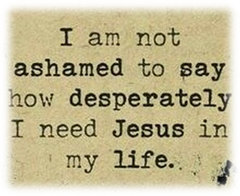
But at its core, faith in the gospel requires the believer to say “I can’t do this myself.”

Well, let me tell you a little secret that believers and nonbelievers often forget. We humans, with all our self-importance, like to think we’re the kings and queens of the universe. We strut around like peacocks, patting ourselves on the back for our so-called brilliance. And you know what? We even pass that audacity onto our poor children, encouraging them to be little independent dynamos. But hey, who needs divine intervention when we’ve got our fabulous human ego, right? wink

I remember a time when my son was in high school and because of a snow day his class schedule was changed. As a result, he took the wrong books. He called to ask me to bring the right books to the school office on my way to work, which I happily agreed to do. When I got to the office to drop them off, the school secretary chided me for bailing him out. “These kids need to learn to be responsible or suffer the consequences,” she said.

I’ve thought of that encounter often, being thankful that Jesus didn’t say the same to the Father when the plan of salvation was put into place. What if Jesus had said, “You know Dad, these humans need to be more responsible or suffer the consequences.” We’d all be doomed.

And so, although it requires me to admit I can’t do it alone, I choose to live by faith in the One who gives me His righteousness.

For the broken believer (which is all of us, if we’re honest), it is all the more important to be okay with something less than full independence. We were created to be dependent on God and on one another. We were created to live in community and relationship with others.

Note: A version of this article was originally published in the January 2020 issue of The Christian Journal, a publication I highly recommend, and not just because they publish some of my writing.

Go Lower Yet

footwashing

“Now that I, your Lord and Teacher, have washed your feet, you also should wash one another’s feet.”

John 13:14

Some Christians reading this part of scripture, have concluded that foot washing should be part of the Churches customary routine.  Their case is compelling, and they may be right in their interpretation.  There is as much support for this as with other things, and Lord knows we could use the humility by getting on your knees with a basin and towel before a brother. 

It probably would relieve issues between saints. It may even heal Church splits. (Oh my!)

Jesus pronounced that His act of service was to be imitated by everyone who would follow.  He further would assert that His example would be emulated by every believer that followed after Him.  Our service to our brother, or sister is to help them become clean Christians. 

We have this ministry of the basin and towel to remove the dirt and filth that comes from walking in this world.  Of course, we cannot remove sins.  But we can serve as Jesus would and intervene with His power.

Cleansing people that we meet will be a challenge. 

It will call us to strip our lives down to a minimum, and to get lower.  We need to get so low that we’re on the floor.  This requires much grace and discipline.  We must weed out every pretense and pride–especially the kind that says, “Look at me serving; am I not wonderful?  I am a true disciple now.”  We are to shake off thoughts like that. 

We are to love others, and perhaps be honestly brutal on ourselves. (Not in a morbid way, just less of ‘yourself.’)

While in my first year of Bible college, I developed a bitter dislike for a classmate.  He had been a lead guitarist; he was handsome and popular, and he oozed pride from every pore (at least I could see it).  I actually took it on myself to be God’s hand in humbling him.  I became antagonistic and scorned him every chance I could.

Within days, my prayer life shut down and the heavens became brass.  One day I was praying and the Holy Spirit graciously zapped me.  I became aware of my sin toward my brother, and I repented. There was a real definite leading, to find a basin and a towel, and then to wash his feet.

God reconciled us, as I knelt at his feet in that dorm room.  From that point on we became very good friends.

We must go lower still.   Water always finds the lowest point, were it pools and gathers into the place of healing others. Perhaps the Holy Spirit will not lead us ‘deeper’ until we start practicing true humility.

When we lower ourselves even deeper we find His presence waiting for us.  But we must cleanse our own hands first, and His blood must work its ministry on me. It’s then I can proceed to clean the filth off of their feet.  If I am not clean myself I will only perpetuate the dirt on to my brother with my dirty hands.

We must scrub our way into the heart of our sister or brother with a basin, some soap and a towel. 

The challenge for us will be a super-challenge.  Christlikeness will always demand this humble grace.  When we think about being like Jesus we must make sure we are following the Jesus in the Bible.  The Jesus who washed dirty feet as a slave.

But let’s not have any foolish nonsense of a discipleship that doesn’t kneel before our brothers in humility.


Under Quarantine

quarantine

Quarantines are a real possibility, even to this day. A quarantine is imposed when a disease is contagious enough that it would harm a society: Measles, Smallpox, and the recent COVID-19 are just a few physical diseases where isolation must be imposed.

It can be severe— an epidemic, with desperate consequences if not adhered to; in some rare cases, the use of deadly force has been authorized to maintain a quarantine until the disease is no longer communicable.

This may surprise you, but there are examples of ‘quarantines’ in the Bible.

The term ‘unclean’ was used for ‘leprosy.’ Those afflicted had to isolate themselves; they had to ‘announce’ their presence when in contact with society. Lepers lived in groups away from the general populace, as a result of their disease.

In Paul’s epistle to the Corinthians, he addresses another kind of ‘quarantine.’ The situation was dire; the church had advocated a Christian living with his father’s wife.

“I have already passed judgment on this man in the name of the Lord Jesus. You must call a meeting of the church. I will be present with you in spirit, and so will the power of our Lord Jesus. Then you must throw this man out and hand him over to Satan so that his sinful nature will be destroyed and he himself will be saved on the day the Lord returns.”

1 Corinthians 5:3-5, NLT

Understanding the Principle of Usefulness

Now in a large house, there are not only gold and silver vessels, but also vessels of wood and of earthenware, and some to honor and some to dishonor.”

2 Timothy 2:20, NASB

Found in God’s pantry are lots of pots and pans of various uses.  Paul writes Timothy about the ‘large house’ which is the Church inclusive. Look around Timothy, there are gold ones, and there are silver ones. They have a noble purpose fitting for such a great house. These are the ones the guests will use; they befit the significance of the Lord himself. These vessels have great value for they are made of precious metals.

There are vessels of different categories. These are the ones made of wood, and of clay. These are part of the household, make no mistake about it. But their use is one of function, they’re utilized in common and ignoble ways. (A clay ‘bed-pan’ perhaps?!)

21 “Therefore, if anyone cleanses himself from these things, he will be a vessel for honor, sanctified, useful to the Master, prepared for every good work.”

2 Timothy 2:21

Paul, the author of the New Testament doctrine of grace emphasizes the place of personal holiness. We are to ‘cleanse’ ourselves to become a vessel of honor. There is good news here:

  • All are vessels in the Father’s house. Each of us belongs to Him. He alone determines their use.
  • Things are not yet in their final state. Changes in status can be experienced. In God’s economy, clay pots can become ‘golden.’ Silver can become ‘wood.’

Some sin is contagious.

It affects believers, and the Church becomes compromised by what we’ve done. And then sometimes we are quarantined by the Holy Spirit–until the contagion passes. This spiritual disease must not be permitted.

I have experienced this several times in my own discipleship. These are not pleasant times, but there is no condemnation. I’m still His servant, His love for me stays outrageously constant. He has never turned away a sinning child who repents of their sin.

“Yes, I am His servant, but I must wait out in the hall. I haven’t been faithful. So I sit in His waiting room, waiting for His call. This is for my good. And my Father knows what is best.” 

How to Die Well

“Even though I walk through the valley of the shadow of death,
   I will fear no evil,
for you are with me;
   your rod and your staff,
 they comfort me.”

Psalm 23:4, ESV

“Precious in the sight of the Lord is the death of his saints.”

Psalm 116:15, ESV


“Death is like my car. It takes me where I want to go.” 

Pastor John Piper

Our generation simply doesn’t know how to die well.  There are so many conflicting messages and attitudes which have steered us away from the reality of dying.  Much of it is the natural development of unbelief.  Our pop culture develops this and gives it momentum.  We are trying to convince ourselves that “death is impossible, my life will not end.’  But we’re escaping into a delusion.  We are running from what is real.

There is a Latin phrase,  Ars moriendi  (“The Art of Dying”) which the Church practiced in past generations.  In past time, Christians would be buried as close as possible to the Church building.  Many would be interred within the very walls of the Church.  The understanding was that the dead were part of the congregation.  That there was only a thin veil that stood between the living and the dead.  The dead didn’t just vanish.  They are with us.

My generation is confused.  We have forced death to wear a mask.  We insist on a significant camouflage to hide the reality of sickness and death.  No one really ever talks about it, and so no instructions are given on how to die well. So we don’t, we die poorly–in ICUs and LTCs, completely sedated, separated and unable to process it or help our families process it.  There can be no solid connection between the living and the dying. And to be very honest, this is not working.

For many, the fear of dying is intense and paralyzing.  Death brings us a terror that twists us; we don’t know how to respond to it.  Additionally there seems that there is no one available to direct us.  Death is a spooky taboo that no one really explains.  The implication is that we are simply to avoid death, ‘it may not come for you’.  But that is not what is real.

“Death avoidance” pretends to lift us above the issue, where we can imagine that we will stay separated somehow from its obscenity and ugliness.  Funerals are nothing more then an aberration.  We have become ‘teflonized’, these things just slide on and off.  We just refuse to calculate, or accept what is happening.  We have ‘molded’ our fear into a more desirable shape.  We simply cannot function in the steady gaze of what is real.  We just shut down and refuse to function. We simply pretend.

Its time for the Church to step up and guide us to our next step.  Our pastors and elders have got to prepare us to die well.  It is a part of being a disciple.  It is discipleship, and dying is inclusive.  We need somebody to prepare us for the inevitable and the certainty that is approaching us.  I need someone that will help me face my own death.

You know what?  No one escapes.  And the reality of that drives some of us mad, or addicted, or psychotic.  The idea of filling a casket up for forever is incomprehensible.  We cannot live with this sick idea of dying.  It disturbs us on the deepest level possible.  It is completely evil.

Psalm 23 has been pure comfort and healing for generations.  And it is an excellent starting point for us.  Verse 4 develops the idea of traversing death.  The writer has incredible insight of passing through death.  This verse alone is worth “billions of dollars in gold”.  Psalm 23 has made me a very wealthy man.  His Word has become my rich treasure.