Christianity without discipleship is always Christianity without Christ. –Dietrich Bonhoeffer
Take the words of Jesus and let them become the Supreme Court of the Gospel to you. –John G. Lake
Some wish to hear the word of God, others wish to receive it.–Anonymous
Understanding is the reward of obedience. Obedience is the key to every door. –George MacDonald
In the spiritual life only one thing produces genuine joy and that is obedience. –Richard Foster
The level of our obedience is most often determined by the behavior standard of other Christians around us. –Jerry Bridges
Many Christians have what we might call a “cultural holiness”. They adapt to the character and behavior pattern of Christians around them. As the Christian culture around them is more or less holy, so these Christians are more or less holy. But God has not called us to be like those around us. He has called us to be like himself. Holiness is nothing less than conformity to the character of God. –Jerry Bridges
Holiness has never been the driving force of the majority. It is, however, mandatory for anyone who wants to enter the kingdom. –Elisabeth Elliot
The dullness that overshadows a passive person is increased by the mounting number of times one doesn’t respond to the promptings of God. –Greg Manalli
Whatsoever one would understand what he hears must hasten to put into practice what he has heard. –Gregory the Great
I know the power obedience has of making things easy which seem impossible. –Teresa of Avila
Let this be thy whole endeavor, this thy prayer, this thy desire,–that thou mayest be stripped of all selfishness, and with entire simplicity follow Jesus only. –Thomas à Kempis
No man has the mind of Christ, except him who makes it his business to obey him.—George MacDonald
One can believe in the divinity of Jesus Christ and feel no personal loyalty to Him at all – indeed, pay no attention whatever to His commandments and His will for one’s life. –Catherine Marshall
I defy you to read the life of any saint that has ever adorned the life of the Church without seeing at once that the greatest characteristic in the life of that saint was discipline and order. Invariably it is the universal characteristic of all the outstanding men and women of God.—Unknown
The strength of a man’s virtue should not be measured by his special exertions, but by his habitual acts.–Blaise Pascal
He who is faithful in little will be faithful in much. –Jesus Christ
If Christ does not reign over the mundane events in our lives, He does not reign at all. –Paul Tripp
Self-respect is the root of discipline: The sense of dignity grows with the ability to say no to oneself. –Abraham Joshua Heschel
Maturity doesn’t come with age; it comes with acceptance of responsibility. –Ed Cole
To be converted to faith in Jesus Christ is to return to the worship of the true God, and to dethrone all rivals to his authority. –Graham Kendrick
We must assess our thoughts and beliefs and reckon whether they are moving us closer to conformity to Christ or farther away from it. –John Ortberg
Jesus tapped me on the shoulder and said, Bob, why are you resisting me? I said, I’m not resisting you! He said, You gonna follow me? I said, I’ve never thought about that before! He said, When you’re not following me, you’re resisting me. –Bob Dylan
There is no peace in the border lands. The halfway Christian is a torment to himself and of no benefit to others. –Earnest Worker
The characteristic of holiness, which is the outcome of the indwelling of God, is blazing truthfulness with regard to God’s word and an amazing tenderness in personal dealings. –Oswald Chambers
Christianity does not consist in any partial amendment of our lives, any particular moral virtues, but in an entire change of our natural temper, a life wholly devoted to God. –William Law
Those who teach by their doctrine must teach by their life, or else they pull down with one hand what they build up with the other. –Matthew Henry
…Christ did not appoint professors, but followers. If Christianity … is not reduplicated in the life of the person expounding it, then he does not expound Christianity, for Christianity is a message about living and can only be expounded by being realized in men’s lives. –Soren Kierkegaard
A holy life has a voice. It speaks when the tongue is silent, and is either a constant attraction or a perpetual reproof. –Hinton
Preaching is to much avail, but practice is far more effective. A godly life is the strongest argument you can offer the skeptic. –Hosea Ballou
No one can sum up all God is able to accomplish through one solitary life, wholly yielded, adjusted, and obedient to Him. –D.L.Moody
I surrendered unto Him all there was of me; everything! Then for the first time I realized what it meant to have real power. –Kathryn Kuhlman
I dare not say with Paul that I am the slave of Christ, but my highest aspiration and desire is to be the slave of Christ. –George MacDonald
Nothing is really lost by a life of sacrifice; everything is lost by failure to obey God’s call. –Henry P Liddon
Nothing disciplines the inordinate desires of the flesh like service, and nothing transforms the desires of the flesh like serving in hiddenness. The flesh whines against service but it screams against hidden service. It strains and pulls for honor and recognition. –Richard Foster
Today, even amongst Christians, there can be found much of that spirit that wants to give as little as possible to the Lord, and yet to get as much as possible from Him. The prevailing thought today is of being used, as though that were the one thing that mattered. That my little rubber band should be stretched to the very limit seems all important. But this is not the Lord’s mind. The Lord wants us to be used, yes; but what He is after is that we pour all we have, ourselves, to Him, and if that be all, that is enough. –Watchman Nee
The decision to grow always involves a choice between risk and comfort. This means that to be a follower of Jesus you must renounce comfort as the ultimate value of your life. –John Ortberg
The Christian ideal has not been found tried and found wanting, it has been found difficult and left untried. — GK Chesterton
If thou art willing to suffer no adversity, how wilt thou be the friend of Christ? –Thomas à Kempis
There is no success without sacrifice. If you succeed without sacrifice it is because someone has suffered before you. If you sacrifice without success it is because someone will succeed after. –Rick Joyner
The Bible parable says that while men slept, the enemy sowed tares among the wheat. A boy who rises at 4:30 to deliver papers is considered a go-getter, but to urge our young people to rise at 5:30 to pray is considered fanaticism. We must once again wear the harness of discipline. There is no other way. –Leonard Ravenhill
To be rooted is perhaps the most important and least recognized need of the human soul. –Simone Weil
Knowing that we are fulfilling God’s purpose is the only thing that really gives rest to the restless human heart. –Chuck Colson
The invitation is not, “Give Me thine head.” The invitation is, “My Son, give Me thine heart.” –John G. Lake
At the back of it there lies the central citadel of obstinacy: I will not give up my right to myself–the thing God intends you to give up if ever you are going to be a disciple of Jesus Christ.–Oswald Chambers
Whatever God’s dream about man may be, it seems certain it cannot come true unless man cooperates. –Stella Terrill Mann
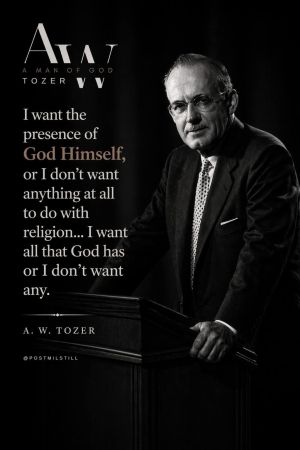
Let no one imagine that he will lose anything of human dignity by this voluntary sell-out of his all to his God. He does not by this degrade himself as a man; rather he finds his right place of high honor as one made in the image of his Creator. His deep disgrace lay in his moral derangement, his unnatural usurpation of the place of God. His honor will be proved by restoring again that stolen throne. In exalting God over all, he finds his own highest honor upheld. –A.W Tozer
It is the Father’s life, and the Father’s life alone, that ever lives the Christian life. It is the Father’s life, and Father’s life alone, which will live the Christian life in you. Embrace a formula or a list in order to “live the Christian life,” and you are doomed to frustration. –Gene Edwards
If you have not chosen the Kingdom of God first, it will in the end make no difference what you have chosen instead. –William Law
Until you have given up your self to Him you will not have a real self… –C.S. Lewis
It is only by a total death to self we can be lost in God. –Jeanne Guyon
All we have—ourselves–to Him, and if that be all, that is enough. –Watchman Nee
*******