Our Life in Babylon

Living-in-babylon-Logo

Christians are now smack-dab in “Babylon.” We must live our lives under the auspices of this hostile world-system, and yet stay faithful to our Lord. We must manage ourselves with the same grace as Daniel or Esther.

In Jeremiah 29 there contains an important historical letter that the prophet Jeremiah wrote to those taken into captivity. In it we can absorb much of what is needful for the moment. For people caught in Babylon it becomes a vital document, advising them of what they should now do.

This list comes straight out of Jeremiah 29.

  • First, prepare for the long haul. Be good citizens of your new land, (vv.5-6.)
  • Second, pray for the peace of the nation you’re captive in. (v.7.)
  • Third, don’t be fooled by it’s culture, Discern what is true and what is false. Babylon is full of false gods and worship.
  • Fourth, remember that God has given you “a future and a hope” (v. 11.)
  • Lastly, extend that same discernment to the spiritual understanding of your own past.

These five should be enough to navigate faithfully through hard times in Babylon. We must admit that we’re only “pilgrims and strangers” here. Our citizenship is in heaven where it is secure. By faith we understand this.

As broken believers we are supervised by the Holy Spirit, even in this difficult place, Our souls are shepherded by God, even in Babylon. Our “captivity” is only temporary– it is not a permanent one.

“And you will seek Me and find Me, when you search for Me with all your heart.”

Jeremiah 29:13, NKJV

“By the rivers of Babylon, There we sat down, yea, we wept When we remembered Zion.”

Psalm 137:1

“She who is in Babylon, elect together with you, greets you; and so does Mark my son.”

1 Peter 5:13

‘Alas, alas, that great city Babylon, that mighty city! For in one hour your judgment has come.’

Revelation 18:10

ybic, Bryan


cropped-christiangraffiti1-2

“Depression Deceptions,” by James Winsor

“Pilgrim’s Progress” by Bunyan

Bryan’s Note: On many occasions I encounter a blog that communicates so well that I think about doing a re-post.  Today is one of those days. So, here is Pastor Winsor’s exceptional article on depression.  I hope that his perspective will bless you and give you a deeper understanding of this mental illness.


Depression Deceptions by Rev. James Winsor
Lots of people these days suffer from depression. Many of them are Christians. If you suffer from depression, I hope the following information helps you. If you don’t suffer from depression, then maybe this will assist you in understanding and helping those who do. Here is a list of three Depression Deceptions to avoid.


Deception #1: If you’re depressed, you’re not a strong Christian. 

On August 2, 1527, Martin Luther wrote these words in a letter to a close friend: “l have been thrown more than a whole week into death and tossed back and forth in hell.. .I have lost Christ totally and have been shaken by the floods and storms of desperation and of blasphemy against God.”Even strong, mature Christians like Martin Luther can suffer from depression. Depression is not a sign of unbelief or weak faith. It’s a sign of spiritual battle, and battles are for healthy soldiers.

This is a sin-sick world. You’d be crazy not to be depressed sometimes!

Deception #2: No one would understand. 

Holy Scripture tells Christians to “bear one another’s burdens and so fulfill the law of Christ” (Galatians 6:2). We’re told to “mourn with those who mourn” (Romans 12:15). God doesn’t want you to carry your depression alone. God makes sure there are Christians around who understand.

You don’t have to be alone in your depression. Not all Christians will understand it, but some will. You just have to take a few risks until you find the ones who have experienced depression themselves and will understand what you’re going through. Your fellowship with those Christians will be tight. You may even end up being glad the depression brought the two of you together.

Deception #3: Depression is a Useless Detour in the Christian Life.

God has a purpose for the depression that falls on His children. In an Old Testament passage we’re told that “an evil spirit from the Lord tormented King Saul” (1 Samuel 16:14). God had anointed David to be Saul’s replacement as king. God wanted to save Saul’s eternal soul, but He also wanted to replace him as king. So God sent David as a music therapist for Saul. “Whenever the spirit from God came upon Saul, David would take his harp and play. Then relief would come to Saul; he would feel better, and the evil spirit would leave him” (1 Samuel 16:23).

God gave Saul a problem and sent David as the solution. Saul might have done the obvious thing – thank God for David and support him! But instead Saul tried to kill David because he was jealous of him. Saul missed the opportunity his depression offered him. He rejected both his depression and David as gifts from God.

St. Paul, on the other hand, had a similar experience of evil sent from God for a good purpose. He responded the right way and received the suffering as a gift from God. Paul wrote, “There was given me a thorn in my flesh, a messenger of Satan, to torment me. Three times I pleaded with the Lord to take it away from me. But he said to me, ‘My grace is sufficient for you, for my power is made perfect in weakness.’ Therefore, I will boast all the more gladly about my weaknesses, so that Christ’s power may rest on me.. .When I am weak, then I am strong.” (2 Corinthians 12:7-10).

God presented Paul with a problem. Then He presented him with the solution, grace in Christ. Paul learned to be thankful for his weaknesses because his weaknesses made him need Christ.

Depression does that to and for you. It leaves you with nothing to hang onto, but Jesus. When you’re depressed, you can’t find anything inside to place hope in. All that exists is darkness and emptiness. You come to find your hope in something outside of you: Christ and His cross and pardon.

That’s not a detour from the Christian life. That is the Christian life, God has you right where He wants you.

I was really depressed one day. I told a pastor friend of mine, “Sometimes I don’t know whether I’m saved. All I know is that I have a Savior.” God had me right where He wanted me. I could actually rejoice in my weakness. Suddenly all I had was Christ. And, in a way, you don’t have Christ until Christ is all you have.

“Carry each other’s burdens, and in this way you will fulfill the law of Christ.” 

Galatians 6:2

“Rejoice with those who rejoice; mourn with those who mourn.” 

Romans 12:15

NOTE: If you can’t seem to shake your feelings of sadness and depression after a few weeks, seek out help right away. Talk to your parents, a counselor, or your doctor to help you deal with these overwhelming emotions.


The Rev. James Winsor is pastor at Risen Christ Lutheran Church in Arvada, Colorado.

 

cropped-christiangraffiti1 (2)


Taken from the Spring 2002 edition of Higher Things magazine. You can write Higher Things at P.O. Box 58011, Pleasant Prairie, WI 53158-8011.

 www.issuesetc.org

Related articles

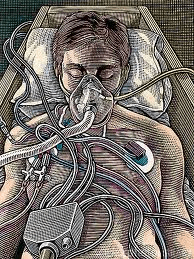
On Life Support

 untitled (2)And I will give them singleness of heart and put a new spirit within them. I will take away their stony, stubborn heart and give them a tender, responsive heart, 20 so they will obey my decrees and regulations. Then they will truly be my people, and I will be their God. 21 But as for those who long for vile images and detestable idols, I will repay them fully for their sins. I, the Sovereign Lord, have spoken!”

Ezekiel 11:19-21, NLT

This is one of those complex portions of God’s scripture where several ideas overlap. In our English translation, we read compound sentences and knotty syntax. But the thoughts are God’s, and therefore significant. Without these truths though, I believe that we can quickly slip into a ‘comatose’ condition.

First we must consider who is involved.

  1. God [speaking through the prophet] declares His intentions.
  2. His repentant people [Israel] are acted upon.
  3. But there is a third bunch, those unrepentant ones who have decided within themselves that they will stick with their idols.

God is very decisive by this point. The prophetic ministry was supposed to work, many prophets and teachers have been sent out. But with very limited success. If we pick one out, it would have to be Hosea; his ministry was dramatic– but ultimately fruitless. The only real successful prophet was Jonah– preaching to Ninevah, ironically a pagan people. But God’s own people are living in flagrant sin. They remain untouched. They’ve chosen to remain in their sinful condition.

A solid and clear promise has been given. An interior work has been promised by God, if they can only show a minute sense of life. The nation is on “life support.” The prophets attend to the needs before them. They are very far from the virile and robust nation– they are in the ICU and are showing only scanty signs of life.

This promise is that a special work will be done inside. They will become both tender and responsive again. A new receptivity and awareness will come into being. The ability to obey will ignite within. We call this “revival.” Revivalists throughout history have carried this to every generation.

As I scan over my Christian life of more than 30 years, I simply see my own “cycles” of sin and revival. I wish I could have been more consistent. But I cling to the faithfulness of God. He stays true even when I’m not. He has promised me. I’ll take Him at His word.

And I am certain that God, who began the good work within you, will continue his work until it is finally finished on the day when Christ Jesus returns.”

Philippians 1:6, NLT

God will do what He can, His efforts are heroic. He fully intends to change us— if we’re only willing.

“A revival is nothing else than a new beginning of obedience to God.” 

Charles Finney

1brobry-sig4

cropped-christiangraffiti1 (1)

)

Tricycle Theology, Psalm 106:1-5

tricycle
Johnny’s new trike

A Psalm Study

Psalm 106:1-5, New Living Translation (NLT)

Praise the Lord!

Give thanks to the Lord, for he is good!
    His faithful love endures forever.
Who can list the glorious miracles of the Lord?
    Who can ever praise him enough?
There is joy for those who deal justly with others
    and always do what is right.

Remember me, Lord, when you show favor to your people;
    come near and rescue me.
Let me share in the prosperity of your chosen ones.
    Let me rejoice in the joy of your people;
    let me praise you with those who are your heritage.

These five verses cap a “Psalm of Rebellion,” tragically found in part two of this psalm (vv. 6-46.)  This work dates to ‘post-exile’ times, and Daniel is believed to have written it. Nehemiah himself quotes from it as he intercedes for the nation upon Israel’s return from captivity.

But these five verses are very different from the rest of the Psalm. They ably serve as a positive introduction to some pretty depressing stuff. I like these first five, they carry a refreshing quality about them. I read them and I’m happy I did.

V. 1, Thanksgiving is to be a normal part of the believer’s life. Imagine little Johnny. He is celebrating his sixth birthday today. His uncle has brought over a gift—a bright red tricycle, with ribbons out of the handlebars! Johnny is estatic, he can’t believe it. Mom steps in and says to him, “What do you say, Johnny?” Johnny thinks. “Thank you, Uncle Ed. This is what I’ve wanted my whole life.”

If the truth be told, Johnny’s response to his uncle’s perfect gift is much like the believer’s response to God. “What do you say, Johnny?” Johnny’s mom would say— and that is what the little guy did. We are to also give thanks. To do is an easy thing, and perhaps does more for us than our Father in heaven.

V.2, “Who can ever praise him enough?” Excessive displays of affection are ‘nothing to roll your eyes at.’ Some wag defined a fanatic as “someone who loves Jesus more than you do.”

V. 3, is an observation by Daniel about the joy available to us if we will only work-out our issues of obedience. This verse might seem out of place, but I assure you its not. It fits in well with vv. 6-46.

V. 4, Remember me, Lord,” contains the desire to be included in the grace that will follow. We should let our heavenly Father know that we want to be part of what He is doing.

V. 5, “Let me” is repeated three times. This phrase is critical to the believer’s walk; it is a statement of submission combined with desire. The writer is asking ‘permission’ from God to become part of the aspects of His kingdom. Matthew 7 gives us the principle that God is looking for. So ask.

8 “For everyone who asks, receives. Everyone who seeks, finds. And to everyone who knocks, the door will be opened.”

Matthew 7:8

bry-signat (1)

cropped-christiangraffiti1.jpg