Man on Fire

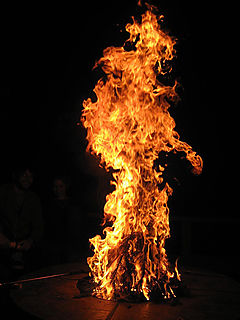
man-on-fireOne morning in January 1984 I set myself on fire. I was in my cabin up on the ridge and I was trying to build a fire. Alaska can be a cold place. I had also started a coffee pot and because it was so cold I opened up the oven door a couple of inches to get some heat.


The oven started getting the place warm, and I gratefully backed up my butt to it. That is when it happened. My sweater ignited from the front burner. At first I didn’t realize that I was on fire, but when the flames started spreading over my head I panicked.

I couldn’t put it out! I dropped to the floor and tried to roll. All that seemed to do is embed that burning sweater into my back, and set the carpet on fire. I ran to the bathroom with the idea of getting under the shower. Somehow I knew that was my only hope.

Needless to say I ended up in the local hospital with second and third degree burns on most of my back. It took months to recover and I still have the scars. It was something that changed my life.

Ironically, I had been thinking of a verse in Hebrews just the night before. I wondered what it meant.

He makes his angels spirits, and his servants flames of fire.”

Hebrews 1:7

 As I healed I prayed for understanding. Why did the Lord allow this to me? I was in my third year at a Bible college and had given my life over for the Gospel. Why did this happen to me?

I’ve never gotten a complete answer from the Lord, but it did confirm my call into the ministry. It also made me aware of the precariousness of our lives. It taught me to appreciate life.

The doctor told me that if I had run outside instead of staying inside I could have died. God preserved me for His own purposes. We have no way of knowing “our time.”

“And we know that in all things God works for the good of those who love him, who have been called according to his purpose.”

Romans 8:28

bry-signat-1

cropped-christiangraffiti1 (2)

April Fool’s Day: An Accident Report

This is a bricklayer’s accident report that was printed in the newsletter of the English equivalent of the Workers’ Compensation Board.

Dear Sirs,

I am writing in response to your request for additional information in Block #3 of the accident reporting form. I put “Poor Planning” as the cause of my accident. You asked for a fuller explanation and I trust the following details will be sufficient.

I am a bricklayer by trade. On the day of the accident, I was working alone on the roof of a new six-story building. When I completed my work, I found I had some bricks left over which when weighed later were found to weigh 240 lbs. Rather than carry the bricks down by hand, I decided to lower them in a barrel by using a pulley which was attached to the side of the building at the sixth floor.

Securing the rope at ground level, I went up to the roof, swung the barrel out and loaded the bricks into it. Then I went down and untied the rope, holding it tightly to insure a slow descent of the 240 lbs of bricks. You will note on the accident reporting form that my weight is 165 lbs. Due to my surprise at being jerked off the ground so suddenly, I lost my presence of mind and forgot to let go of the rope. Needless to say, I proceeded at a rapid rate up the side of the building.

In the vicinity of the third floor, I met the barrel which was now proceeding downward at an equally impressive speed. This explains the fractured skull, minor abrasions and the broken collarbone, as listed in Section 3, accident reporting form. Slowed only slightly, I continued my rapid ascent, not stopping until the fingers of my right hand were two knuckles deep into the pulley which I mentioned in Paragraph 2 of this correspondence. Fortunately by this time I had regained my presence of mind and was able to hold tightly to the rope, in spite of the excruciating pain I was now beginning to experience.

At approximately the same time, however, the barrel of bricks hit the ground and the bottom fell out of the barrel. Now devoid of the weight of the bricks, the barrel weighed approximately 50 lbs. I refer you again to my weight. As you might imagine, I began a rapid descent down the side of the building. In the vicinity of the third floor, I met the barrel coming up. This accounts for the two fractured ankles, broken tooth and severe lacerations of my legs and lower body.

Here my luck began to change slightly. The encounter with the barrel seemed to slow me enough to lessen my injuries when I fell into the pile of bricks and fortunately only three vertebrae were cracked.

I am sorry to report, however, as I lay there on the pile of bricks, in pain, unable to move and watching the empty barrel six stories above me, I again lost my composure and presence of mind and let go of the rope. And I lay there watching the empty barrel begin its journey back onto me.

1brobry-sig4

cropped-christiangraffiti1 (1)

Disciples Who Can Stay Afloat

22 “Immediately Jesus told his followers to get into the boat and go ahead of him across the lake. He stayed there to send the people home.23 After he had sent them away, he went by himself up into the hills to pray. It was late, and Jesus was there alone.24 By this time, the boat was already far away from land. It was being hit by waves, because the wind was blowing against it. 25 Between three and six o’clock in the morning, Jesus came to them, walking on the water.26 When his followers saw him walking on the water, they were afraid. They said, “It’s a ghost!” and cried out in fear.

27 But Jesus quickly spoke to them, “Have courage! It is I. Do not be afraid.”28 Peter said, “Lord, if it is really you, then command me to come to you on the water.” 29 Jesus said, “Come.” And Peter left the boat and walked on the water to Jesus. 30 But when Peter saw the wind and the waves, he became afraid and began to sink. He shouted, “Lord, save me!”

31 Immediately Jesus reached out his hand and caught Peter. Jesus said, “Your faith is small. Why did you doubt?” 32 After they got into the boat, the wind became calm.33 Then those who were in the boat worshiped Jesus and said, “Truly you are the Son of God!”

Matthew 14:22-33, New Century Version

flourish15

When I am in the storm, when the waves are breaking into my boat, my faith is shaky, and I feel abandoned, I turn to Matthew 14.

Jesus sees his disciples in mortal danger.  The overloaded boat has been caught in a ferocious storm.  It is 3 a.m., and the darkness just makes their situation that more desperate. The idea of imminent drowning has passed through their thoughts. They are terribly afraid.

Suddenly Jesus comes near, he is walking on the water!  Their fear turns to stark terror, they want to bolt but there is no place to go.  They are thinking that Jesus is a ghost, and that he is coming to escort them to the grave.  So Jesus calls out through the raging storm, “It is just me.  Do not fear!  Have courage.”

Brash Peter (bless him, Lord) yells to Jesus, “If it is you, really you, let me come to you, on the water!”  The word ‘if’ is very telling, and it explains much. Peter is soon on the edge of frantic hysteria when he begins to sink while walking to Jesus.

If it was me, I would have let Peter drown.  (What an object lesson to teach the 11 sitting in the boat.  “See what happens when you have weak faith, you drown!”)

But Jesus is not teaching here, He is loving.  He grabs Peter and pulls him out.  I find it interesting that the rock on whom Jesus is to build his Church upon sinks like a stone. Peter shows his faith for a brief shining moment, and when he falters and sinks, Jesus catches him.

aabryscript

Whim-Whams

getty_rm_photo_of_woman_seen_through_eyeglasses_of_another

“In our family “whim-wham” is code, a defanged reference to any number of moods and psychological disorders, be they depressive, manic, or schizoaffective. Back in the 1970s and ’80s – when they were all straight depression – we called them “dark nights of the soul.” St. John of the Cross’s phrase ennobled our sickness, spiritualized it. We cut God out of it after the manic breaks started in 1986, the year my dad, brother, and I were all committed. Call it manic depression or by its new, polite name, bipolar disorder. Whichever you wish. We stick to our folklore and call it the whim-whams.”

— David LovelaceScattershot: My Bipolar Family

flourish2

Speaking in code is often our way of communicating to those who are curious. We seldom tell anyone we have bipolar disorder outright. Some of us tried, and failed; we fall back to “I’m just a little blue today,” or the classic, “I’m just woke up on the wrong side of the bed.” We really can be somewhat disingenuous.

All too often these are half-truths that deflect the sticky issues of a mental breakdown. We seek to salvage some kind of dignity, or evade the inevitable stigma that would certainly come if we told the truth. We choose to evade, but at a cost.

I struggle with the stigma of both bipolar disorder and epilepsy. I’m still uncomfortable when others seem uncomfortable with me. So, I have developed a general rule:

Bryan’s Rule #14, “Never reveal your illness, except to qualified people.”

I suppose this adds a layer of personal security. The occasions I have violated this rule have resulted in awkward pauses and odd looks. Afterwards, the relationship changed. It was as if I suddenly sprouted a second head, or something.

As Christian believers, I know we are supposed to walk in the truth. But exactly how truthful am I supposed to be? I’ve always had an iconoclastic streak, and I love stretching the social boundaries of others. Bipolar disorder has been an illness made-to-order for people like me.

Bryan’s Rule #15, “Openness can be a true step toward my healing.”

But it take truth to change. We really need to be honest by bringing things into the light. Obscuring the truth keeps us isolated and distant from others. Will speaking forthrightly about my bipolar disorder be a challenge? Of course. But necessary if I want to heal and cope.

I’m not advocating making a big sign and parading down Main Street. Just to be a bit more honest with others, and ultimately with ourselves. Let’s be comfortable with our own personal “whim-whams.”

aabryscript