Flaws in Our Spiritual ‘DNA’

DNA by medoo-khfaga
DNA by medoo-khfaga

“What do you mean, ‘What’s the matter?’” Micah replied. “You’ve taken away all the gods I have made, and my priest, and I have nothing left!”

Judges 18:24

“Man’s nature, so to speak, is a perpetual factory of idols.” ― John Calvin

flourish14

Here in Judges 18, we see the folly of a false religion. It is a crude and simple idolatry, and the foolishness of it is lost on these men. Micah had installed his very own personal priest, and had carved some idols to enhance his spiritual status. We see in Micah, the silly and shortsightedness of the idolater. He engages in some ‘unauthorized’ theology, that allows him this liberty.

But the ill-advised idolatry seems not only silly, but bizarrely primitive. It’s kind of a ‘do it yourself’ custom religion.  Micah had a spiritual need, and met it with hiring his own priest. However, the roving tribe of Dan, with an armed force of 600 men, have decided to take the entire ensemble to be their own. It now seems foolishness has led Dan astray.

The bickering between Micah and these warriors would be imprudent if pushed. Micah has just lost his religion by brute force. The ‘priest’ and all the accouterments are now forcibly taken from him. I suppose this is the painful folly of his ‘homemade’ religion. He watches as the riders take it all away.

What an empty spiritual condition! But religious people often seek out idols to help them deal with life. An idol can be anything that takes God’s place in a person’s life. But the results are sad. A counterfeit faith of any kind is profoundly sad. The modern version has become much more sophisticated, but the end result is the same. It would seem  that idolatry is etched in our DNA.

“Those who worship false gods [idols] turn their backs on all God’s mercies” (Jonah 2:8).

The only way to protect yourself in a time of spiritual anarchy is to come to the true and living God. Insist on your needs be met by Him. We really must shun anything that could take His place. Our idolatry is different today, but God has never changed.


aabryscript

Whim-Whams

getty_rm_photo_of_woman_seen_through_eyeglasses_of_another

“In our family “whim-wham” is code, a defanged reference to any number of moods and psychological disorders, be they depressive, manic, or schizoaffective. Back in the 1970s and ’80s – when they were all straight depression – we called them “dark nights of the soul.” St. John of the Cross’s phrase ennobled our sickness, spiritualized it. We cut God out of it after the manic breaks started in 1986, the year my dad, brother, and I were all committed. Call it manic depression or by its new, polite name, bipolar disorder. Whichever you wish. We stick to our folklore and call it the whim-whams.”

— David LovelaceScattershot: My Bipolar Family

flourish2

Speaking in code is often our way of communicating to those who are curious. We seldom tell anyone we have bipolar disorder outright. Some of us tried, and failed; we fall back to “I’m just a little blue today,” or the classic, “I’m just woke up on the wrong side of the bed.” We really can be somewhat disingenuous.

All too often these are half-truths that deflect the sticky issues of a mental breakdown. We seek to salvage some kind of dignity, or evade the inevitable stigma that would certainly come if we told the truth. We choose to evade, but at a cost.

I struggle with the stigma of both bipolar disorder and epilepsy. I’m still uncomfortable when others seem uncomfortable with me. So, I have developed a general rule:

Bryan’s Rule #14, “Never reveal your illness, except to qualified people.”

I suppose this adds a layer of personal security. The occasions I have violated this rule have resulted in awkward pauses and odd looks. Afterwards, the relationship changed. It was as if I suddenly sprouted a second head, or something.

As Christian believers, I know we are supposed to walk in the truth. But exactly how truthful am I supposed to be? I’ve always had an iconoclastic streak, and I love stretching the social boundaries of others. Bipolar disorder has been an illness made-to-order for people like me.

Bryan’s Rule #15, “Openness can be a true step toward my healing.”

But it take truth to change. We really need to be honest by bringing things into the light. Obscuring the truth keeps us isolated and distant from others. Will speaking forthrightly about my bipolar disorder be a challenge? Of course. But necessary if I want to heal and cope.

I’m not advocating making a big sign and parading down Main Street. Just to be a bit more honest with others, and ultimately with ourselves. Let’s be comfortable with our own personal “whim-whams.”

aabryscript


*Dis–joint-ed Ideas* Out of Matthew 25:1-13

Ten-virgins-parable
 
KJV—————————->
 
Then shall the kingdom of heaven be likened unto ten virgins, which took their lamps, and went forth to meet the bridegroom.

2 And five of them were wise, and five were foolish.

3 They that were foolish took their lamps, and took no oil with them:

4 But the wise took oil in their vessels with their lamps.

5 While the bridegroom tarried, they all slumbered and slept.

6 And at midnight there was a cry made, Behold, the bridegroom cometh; go ye out to meet him.

7 Then all those virgins arose, and trimmed their lamps.

8 And the foolish said unto the wise, Give us of your oil; for our lamps are gone out.

9 But the wise answered, saying, Not so; lest there be not enough for us and you: but go ye rather to them that sell, and buy for yourselves.

10 And while they went to buy, the bridegroom came; and they that were ready went in with him to the marriage: and the door was shut.

11 Afterward came also the other virgins, saying, Lord, Lord, open to us.

12 But he answered and said, Verily I say unto you, I know you not.

13 Watch therefore, for ye know neither the day nor the hour wherein the Son of man cometh.

King James Version


NLT—————————>
 
“Then the Kingdom of Heaven will be like ten bridesmaids who took their lamps and went to meet the bridegroom. 2 Five of them were foolish, and five were wise. 3 The five who were foolish didn’t take enough olive oil for their lamps, 4 but the other five were wise enough to take along extra oil. 5 When the bridegroom was delayed, they all became drowsy and fell asleep.

6 “At midnight they were roused by the shout, ‘Look, the bridegroom is coming! Come out and meet him!’

7 “All the bridesmaids got up and prepared their lamps. 8 Then the five foolish ones asked the others, ‘Please give us some of your oil because our lamps are going out.’

9 “But the others replied, ‘We don’t have enough for all of us. Go to a shop and buy some for yourselves.’

10 “But while they were gone to buy oil, the bridegroom came. Then those who were ready went in with him to the marriage feast, and the door was locked. 11 Later, when the other five bridesmaids returned, they stood outside, calling, ‘Lord! Lord! Open the door for us!’

12 “But he called back, ‘Believe me, I don’t know you!’

13 “So you, too, must keep watch! For you do not know the day or hour of my return.

 New Living Translation

In recent years I have heard nothing relevant from Matthew 25. Zilch. Why? I honestly don’t know.

The language he uses in this chapter is not only important– but also quite evocative. Even winsome, like the resplendently gorgeous flowers you just have to pick from your neighbors flowerbed. They are the solar plexus kind of trouncingly beautiful.

goldilocks_tarrantWhichever version you like best must carry the authority of the original speaker– his imprimatur if you will– to be real, and valid and even significant. Now Jesus Christ is not speaking out some “weirdy nursery tale” to comfort us. This isn’t “Goldilocks and the Three Bears.” Not even close.

This group of parables, spoke from the mouth and mind of the Lord Jesus Christ (the Creator and Savior and Lord) is meant to connect with us. Try running out in a empty field, with a steel fence post in a the middle of a fierce, lightning storm– you’ll get connected with– real quick! Now back on the farm, you know that you take the needed shelter in a bad storm. One of my great-Aunties was electrocuted in a cast iron bed while sleeping (this led to the conversion of my Uncle Art, who became a prolific evangelist.)

The words of Jesus are not meant to be ignored, or even trifled with. Maybe minimized or entertained or even played with. His words are meant to sizzle, or “crisp us up.” Either way we dare not disregard, or demean them. If we even try, we will end up as very foolish virgins. gotoil

It must be duly noted that 50% missed it completely. But to their credit they really tried to make it work, having the awareness to try to “fix” things, and become available. But the painful part of these 13 verses was the stark-mad fear of not being able to “catch up.”

idea-light-icoBut run this through your “hopper.” MAYBE, I am missing something here? (It wouldn’t be the first time.) Let me know, ok?


*
kyrie eleison, Bryan

(Lord, have mercy)

*

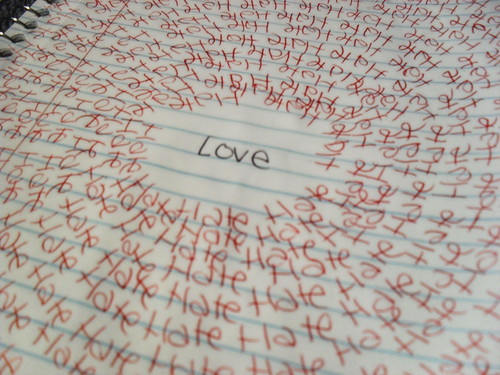
Looking at the Flip Side of Love


The other day Pastor Bryan posted an article titled “Making Some Sense of a Deep and Kind Love: 1 Corinthians 13.” It reminded me of a poem I recently wrote on my own blog, Linda Kruschke’s Blog. So I decided to offer it up here for your consideration.

This poem was born as I was pondering 1 Corinthians 13, and it occurred to me that I might gain a better understanding of what love really is if I looked at it from the opposite side. Taking each description of love in this wonderful passage of scripture, I turned it on its head and saw what hate is. Afterall, hate is the opposite of love.

So here is my poem illustrating what the opposite of 1 Corinthians 13 looks like. (I don’t want to spoil anything, but the final line is my favorite.)

Hate Is . . .

Hate is impatient,
toe tapping, eye-rolling,
in a hurry for instant gratification

Hate is mean,
treating others unkindly,
bullying, and insulting

Hate is envious,
not happy for others’ prosperity,
wanting what others have,
and for them not to have it

Hate is boastful,
puffed up, pointing to self-accomplishments,
not recognizing contributions of others

Hate is not humble,
but is arrogant, filled with hubris
proudly thinking oneself better than all,
pretentious and vain, always vain

Hate is rude,
abusive and insulting, vulgar,
disrespectful, and never caring for others

Hate is self-seeking,
it’s-all-about-me attitude,
selfish and egotistical, self-important

Hate is easily angered,
irritated by the slightest mistake,
hot-headed, unwilling to forgive

Hate keeps a record of wrongs,
every little sin catalogued and indexed,
ready as part of its arsenal of hostility

Hate delights in evil,
revels in rebelling against authority,
is pleased to go its own way

Hate despises truth,
closes its ears to teaching,
refuses instruction and correction

Hate attacks,
harms loved ones and strangers alike,
injures all in its way without care

Hate distrusts,
lacks faith in God or anything,
doubts there is anything good

Hate despairs,
has no hope for a future,
lives in misery and sorrow

Hate gives up,
at the smallest obstacle it gives in,
is defeated by the tiniest tribulation

Hate never wins

Always remember that last line. Hate never wins. Satan never wins. And love never fails, ever! God’s love prevail for all of us on the cross.