Rembrandt’s Prodigal Son

Rembrandt-The_return_of_the_prodigal_son
Rembrandt, “The Return of the Prodigal Son,” c. 1661

17 “But when he came to himself, he said, ‘How many of my father’s hired servants have more than enough bread, but I perish here with hunger! 18 I will arise and go to my father, and I will say to him, “Father, I have sinned against heaven and before you. 19 I am no longer worthy to be called your son. Treat me as one of your hired servants.”’ 20 And he arose and came to his father. But while he was still a long way off, his father saw him and felt compassion, and ran and embraced him and kissed him. 21 And the son said to him, ‘Father, I have sinned against heaven and before you. I am no longer worthy to be called your son.’ 22 But the father said to his servants, ‘Bring quickly the best robe, and put it on him, and put a ring on his hand, and shoes on his feet. 23 And bring the fattened calf and kill it, and let us eat and celebrate. 24 For this my son was dead, and is alive again; he was lost, and is found.’ And they began to celebrate.

Luke 15:17-24, ESV

Two hundred and eighty-nine words– these describe the life of every man, woman, and child who has ever lived. These 289 words reveal to us a God who loves far too much, way too easy. Perhaps we sort of expect that he will ‘appropriately’ punish his son– at least put him on probation at least. It only makes sense. But we find that is legalism talking.

“Every saint has a past, and every sinner has a future.” 

Many of us have lived as prodigals, and we have spent our inheritance like ‘drunken sailors.’ We really have nothing at all to show for it. The prodigal, completely destitute, takes the only work he can find. (Imagine a good Jewish boy feeding hogs.)

He is so far gone that he starts inspecting the filthy slop buckets for something to eat.

Many of us will understand his despair. Often there comes to us a crystalline moment of simple awareness. The prodigal, sin-crusted and impoverished, still has a lingering memory of the Father’s house.

The servants there had far more than him right now. Sometimes I wonder if in our captivity, we instinctively want to go home, if only in our minds, to be a servant there.

The Father has dreamed of this precise moment.

The parable says, “He saw him–felt compassion–ran out to him–embraced him–and kissed him.” The Father is a whirlwind of agape love. I’ve read the Parable of the Prodigal Son a hundred times or more. It never loses its punch. I simply want to bring some observations: 

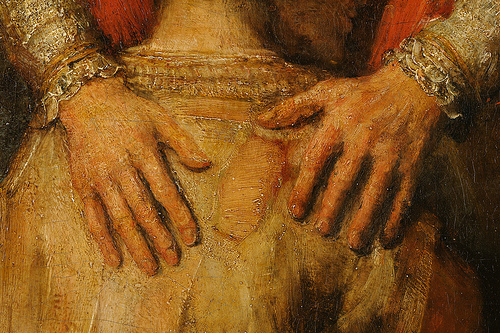
  • We see that his father receives him with a tender gesture. His hands seem to suggest mothering and fathering at once; the left appears larger and more masculine, set on the son’s shoulder, while the right is softer and more receptive in gesture.
  • The son’s head is downy, almost like a newborn’s. We must enter the kingdom like little children. 
  • The Prodigal Son seems to be protected by his father. He snuggles near the Father’s breast. It’s love that holds him there.
  • Consider his sandals. It has taken a long time for him to come home. 
  • Standing at the right is the prodigal son’s older brother, who crosses his hands in stoic judgment; we read in the parable that he objects to the father’s compassion for his brother.
  • We see his mother in the background in the painting, and a seated steward or counselor. One stands in profound joy, the other in sits in stunned perplexity.

But Rembrandt had painted the Prodigal once before, when he was considerably younger. And it is a very good painting. The prodigal is happy and gay; there is absolutely no indication of the consequences of sin.

The Prodigal Son in the Brothel, 1635

He’s a charming young man at the height of his popularity, and we see him at a happy party. He is spending the inheritance of his father.

But Rembrandt chooses at the very end of his life to re-paint it to reflect reality.

This is one of the last paintings he will do, and it is the Prodigal Son–destitute and repenting. I can only imagine; the years have taken a toll and he doesn’t really feel his first painting is enough. He wants to paint what is true.

He now is painting our spiritual condition.

We are given a work that some critics call as the greatest painting ever completed. The painting is now in St. Petersburg, Russia. It is seldom seen by visitors. It is a clear echo of the grace of God for fallen men and women. Like the father in the painting, He’s ready to forgive every sin saturated son and daughter.

The Father’s Prodigal

bry-signat (1)


Misfits

Broken-Fresco-Assisi-Italy-1999-1024x750 (1)
Broken Fresco– Assisi, Italy

Many voices tell me that there must be distinct lines between sinners (like, me) and Church people. These borders keep order and provide security to those on the ‘inside’ of our Faith. This seems more from a reaction to control than actual sin.

But there are so many people with mental illness: Depression, anxiety, bipolar disorder, schizophrenia, addictions, PTSD, and many others. We are truly an afflicted people.

donkey_boat-300x245
Fitting in isn’t always easy

–Joni Eareckson Tada

There needs to be an adjustment to the status quo. Room must be made for the ‘losers’ and the misfits. These are people for whom Christ died. They are special to God.

According to federal  law, buildings must be accessible to the handicapped. Special signs are placed in the parking lots, for special parking and wheelchair ramps need to be installed. This is well and good. But let’s extend this ‘deliberateness’ to those with other needs as well.

“The power of the Church is not a parade of flawless people, but of a flawless Christ who embraces our flaws. The Church is not made up of whole people, rather of the broken people who find wholeness in a Christ who was broken for us.”

–Mike Yaconelli

I encourage you to become proactive when it comes to “opening up” the Church to include ‘the brokenness of the other.’ Even a smile can make the difference to the down-trodden soul.

Love the unlovely,  just like Jesus.

My Scapegoat

“And Aaron shall lay both his hands on the head of the live goat, and confess over it all the iniquities of the people of Israel, and all their transgressions, all their sins. And he shall put them on the head of the goat and send it away into the wilderness by the hand of a man who is in readiness.”

Leviticus 16:21

The ritual was profoundly simple. Every year two goats were brought into the Temple. Goat #1 was sacrificed for the sins of the high priest. Goat #2 was not killed, but became the “scapegoat.” The priest would lay his hands on its head, and the nation’s sins would be transmitted and then carried to the desert.

This ritual finds fulfillment in Jesus Christ, for He absorbs our sin and carries it away.

Scripture is clear on this. Maybe this might help. Back in the 1970s I remember sponges printed with a politician’s advertising his platform/promises. At first the sponge was paper thin. But when you added water it expanded into a full-size sponge.

For some weird reason that communicates what happened at the cross. Jesus received my sin, darkness, and iniquity. He absorbed it all, and I’m free. He is my scapegoat. He carries all of my dark darkness.

“Surely He has borne our griefs (sicknesses, weaknesses, and distresses) and carried our sorrows pains [of punishment], yet we [ignorantly] considered Him stricken, smitten, and afflicted by God [as if with leprosy].”

Isaiah 53:4, Amplified

Front and Center

John 8:3-11

Then the scribes and the Pharisees brought a woman caught in adultery, making her stand in the center. “Teacher,” they said to him, “this woman was caught in the act of committing adultery. In the law Moses commanded us to stone such women. So what do you say?” They asked this to trap him, in order that they might have evidence to accuse him.

Jesus stooped down and started writing on the ground with his finger. When they persisted in questioning him, he stood up and said to them, “The one without sin among you should be the first to throw a stone at her.” Then he stooped down again and continued writing on the ground. When they heard this, they left one by one, starting with the older men. Only he was left, with the woman in the center. 10 When Jesus stood up, he said to her, “Woman, where are they? Has no one condemned you?”

11 “No one, Lord,” she answered.

John 8:3-11

I remember how Jesus defended me. I had been led through the crowds. The temple was filled with people who were there for the festival. It was a time of joy and feasting, but not for me.

Especially not for me.

The temple police escorted me to Jesus. I was now the focus of everyone’s attention. I felt dirty and ashamed. Standing there I could feel the lustful looks from the Pharisees; but there was something else as well, a look from Jesus that I had never seen before. There was compassion there, something quite extraordinary.

I’m ashamed, I committed adultery, I had slept with another man who wasn’t my husband.

I was to be stoned, to have hard rocks thrown at me by “holy” men. The Law had pronounced my guilt, and I knew how I was to be punished. And I deserved it. Yet the man who I slept with was never charged, he escaped and it was I that would be put to death. I didn’t blame him.

My shame was now public knowledge–everyone knew, the Pharisees made sure of that.

They put me front and center. They were going to test Him. They were going to destroy me.

These men who brought me had ulterior motives, they desperately hoped Jesus would stumble. I think they wanted to prove once and all to the crowds that were watching that Jesus really wasn’t the Messiah. They wanted to trap him.

Jesus seemed to understand the implications of this satanic effort.

Only Rome had the power of execution, and yet the Mosaic Law declared that I was to die. I stood waiting, expecting the worst. What else could I do?

It’s funny, but Jesus understood all of this. He seemed to look right through this theological trick, and He responded in a way that really shocked everyone. He never spoke, but bowed low and began to write in the dirt with his finger. Amidst their vicious accusations, they pressed their case.

Jesus bent down again, and he wrote some more.

I never knew what he wrote–but I had to believe it must have been something that revealed the sin in the hidden hearts of the men who were accusing me. In that moment, they quickly dropped the case against me. They all filed out, one by one, in dramatic fashion. I now stood alone with Jesus.

And it was then that Jesus looked directly at me.

I was still afraid, but it was strange, I felt a wave of peace as well. I quietly waited, not knowing what He was going to say to me. I suppose I half expected the worst.

Yes, he did confront me. But He wanted me to acknowledge that those accusing men had left. I saw it and understood. Jesus was asking me to believe that I was now really free. But then he wanted me to understand something that seemed quite crucial.

“Neither do I condemn you,” said Jesus. “Go, and from now on do not sin anymore.”

That dear one was a powerful moment. He set me free with the understanding that He did not condemn me. But my freedom from judgement came with a catch–sort of. I knew then that my sin must be renounced. My freedom came with a price. But knowing I was completely released, meant I was now a free woman.

At that moment I understood completely.

“God pardons like a mother, who kisses the offense into everlasting forgiveness.”

    Henry Ward Beecher

My Facebook page: https://www.facebook.com/bryan.lowe