Blind From Birth

John 9:1-7

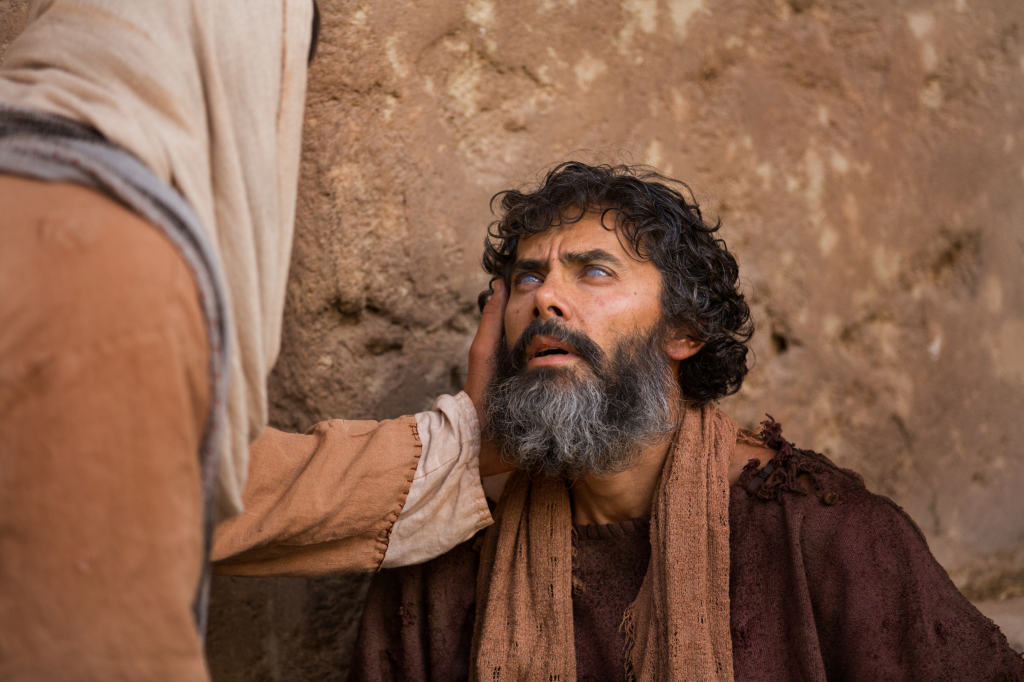
As he was walking along, he saw a man blind from birth.

“Master,” his disciples asked him, “why was this man born blind? Was it a result of his own sins or those of his parents?”

“Neither,” Jesus answered. “But to demonstrate the power of God. All of us must quickly carry out the tasks assigned us by the one who sent me, for there is little time left before the night falls and all work comes to an end. But while I am still here in the world, I give it my light.”

Then he spat on the ground and made mud from the spittle and smoothed the mud over the blind man’s eyes, and told him, “Go and wash in the Pool of Siloam” (the word Siloam means “Sent”). So the man went where nd washed and came back seeing!

Up to now I’ve tried to approach these posts from the first person viewpoint. Ihoped to understand those who met face-to-face with Jesus. I wanted to grasp what they were seeing through their own eyes. But I intend with this post to revert back to a more traditional approach to this passage.

First, we’re introduced to a man who is blind from birth.

I can’t even imagine what that would be like (just as he probably could imagine having sight). I’ve been told that he probably didn’t have a “dream” life–that requires having seen images (a dog, a tree, a mean person) and this wasn’t available to him. He never saw the color red, or seen a mountain. (He didn’t have the circuitry.)

I suppose we can only imagine what blindness like this would be.

Somehow I’ve come to an idea that this represents fallen men–we’re spiritually blind to the workings and truths of Jesus’ Kingdom. It seems a pretty good explanation of each of us–“blind from birth.”

Secondly, notice the response of the disciples who first met this unfortunate man. They don’t see his needs, rather they want to know the theology behind this. Perhaps that’s how we respond much of the time–we don’t see the needs, we only want to know the reasons. We’re not wise or discerning enough to see what’s going on–in short we’re not equipped to love or show mercy. (We haven’t got the circuitry.)

Perhaps this is how we operate as immature Christians.

We don’t engage the need, but rather we like having great theology over understanding compassion. If we really don’t love needy people, we miss so much. We don’t ever grow up. It’s easy to philosophize–it’s hard to get down and serve and really love others.

It’s funny but Jesus declares Himself to be the light of the world while speaking to the man who is born blind.

Third, we discover the gentle mercy that Jesus has when He meets needy people. Now the Lord does accommodate His followers, but not at the expense of engaging the need of the moment. Jesus is full of compassion–most especially when He meets broken people–and as His followers, we must grasp this.

Good theology is not the primary calling of Jesus’ followers.

As I mature in Christ I’m learning (slowly) that people are His real focus. He has come, not to theologize or philosophize, but to meet needs! Sure the reasons why become clearer, but that really isn’t Jesus’ primary goal. People are, not having impeccable theology.

Classes in systematic theology are good, but soup kitchens are better.

The miracle happens, and Jesus’ love and desire to restore this man is ‘front and center.’ The Lord’s methodology is interesting. Spit and mud, wiped on the blind man’s eyes. In Genesis we discover that God made man out of dirt and dust of the ground. Perhaps what He’s doing here mirrors that work.

And it’s also important to understand that Jesus never performs the exact same healing in the exact same way. For some reason He ‘tailors’ His work to the individuals deepest need. I suppose He doesn’t want us to grab a hold of a formula, as that’s what we want to have.

The story is primarily about a blind man’s healing.

It’s not theology, and it certainly isn’t about what is proper and acceptable. We really must understand this, and we really need to understand the tremendous mercy and power of God to both heal and restore.

Image: MCCC. Text from the “Living Bible,” published by Tyndale House

I’m Disappointed in Myself

We read of the “Romans 7” man.

  • For I know that nothing good dwells in me, that is, in my flesh.
  • For I have the desire to do what is right, but not the ability to carry it out. 
  • For I do not do the good I want, but the evil I do not want is what I keep on doing. 

Romans 7:18-19, ESV

When we struggle like this we can safely assume that we’re trying to be holy and accepted by God apart from the grace of God. Our efforts to please Him fall woefully short. This frustration is when we try to keep the Law and neglect to walk in the Spirit.

To be disappointed in your behavior is not grace. To continue living like this becomes deception and hypocrisy. Most of all it creates a vicious wall between your walk and God’s love. A barrier between you and others.

The tension of Romans 7 is real. Every believer will encounters it.

The Scriptures teach us the depravity of man. All we do, even our best efforts and noblest actions are selfish and corrupt. As we understand this we end up realizing that there is a vast gulf between our aspirations and our actions.

“We are all infected and impure with sin.
    When we display our righteous deeds,
    they are nothing but filthy rags.”

Isaiah 64:6

We have a problem when our heart doesn’t match our actions. I’ve worked through the obvious. And yet it gets a little hairy when our ‘little’ sins are visible to others. We feel like hypocrites and we know that our testimony is officially ‘toast.’

“Many have passed the rocks of gross sins – who have suffered shipwreck upon the sands of self-righteousness.”

    William Secker

Romans 7 describes what is wrong with us, it seems we are attempting to please God by our own efforts.

In Romans 7 we read of a man who is constantly disappointed in himself. It can be wrenching to read– partly because it is so real. It describes us too well. At times the Word is like looking into a mirror.

This is what a dear friend said to me recently. I was flabbergasted. I didn’t know how to answer. It was a bit embarrassing, but I couldn’t respond. Later, the Spirit ministered to me while praying about it.

The Lord spoke, “He has no idea how bad you really are. Don’t you dare defend yourself!’

I now realize I should have said this to my friend. You’re absolutely right, I am a bit of a flake. But you only see the veneer, deep down  I’m much worse than you will ever know. I can’t defend my actions, and I desperately need a Savior. Would you pray for me to work this out? I need Jesus”

The daily struggle with sin and personal failure is sometimes more visible than we would like. Even as a believer I can and do sin. That should surprise no one, and yet, it seems I’m the most amazed when sin inevitably breaks out. At times I feel like I specialize in inconsistency.

I wonder when we boldly ‘strut’ into His presence if the angels don’t ‘roll their eyes?’

Whenever we come before God, we should never show up with our list of great things we have recently done for Him. It won’t be accepted. They are at best, filthy rags. They’re not fit for a King’s court. But yet we keep coming, parading our dirty, grimy rags.

We keep forgetting that only Christ’s righteousness is accepted in God’s eyes.

“The greatest enemy to human souls is the self-righteous spirit which makes men look to themselves for salvation.”

Charles Spurgeon


1brobry-sig4

Freezing a Brother

 Bearing with one another and, if one has a complaint against another, forgiving each other; as the Lord has forgiven you, so you also must forgive.”

Colossians 3:13, ESV

Since this blog originates in Alaska, and since winter is upon us, this post seems fitting. It’s cold. And, well, I’ve been thinking about things that have happened to me recently.

We have a sinful tendency to “freeze” people that offend us.

We do it with our words, attitudes, actions. It is called unforgiveness, or stigma, or just plain contempt. It locks another person in a place were they will stay forever, and you won’t ever have to deal with them.

We glaciate others with extraordinary ease.

Someone offends me, or irritates me and I blast them. In my mind I solidify them into one spot, and there they are locked. Sealed away, and out of my thinking. I sometimes call it “discernment.” And then I can avoid those pesky urges to humble myself.

I have been frozen by others, and to be quite honest, I have been the ‘freezer’ as well.

The sad part is that we ourselves are so far from perfect. When we zap someone we will never, ever ‘receive’ from that person. We can even preclude them as outside of the grace of God. (And usually that’s what happens.)

“You offend me, and I will never forget it, and you will never be more than an evil miscreant to me.” My rationale is “life is too short for hassling with jerks like you.” But yet I can’t fully accept that idea. That is not God’s will for me, and I know it.

We end up debasing ourselves by our own unforgiveness.

We restrict others from the Holy Spirit’s transforming ability. In our mind’s eye, the wicked person will never be able to offer up anything of value. We freeze–locking them into a place. And a vast amount comes from an unforgiveness that is ‘fallen,’ and an unbelief in God’s grace and power.

Mr-Freeze-1Furthermore, any use of our ‘freeze gun’ freezes us as well. Unforgiveness turns on us (which we didn’t count on) and the effect is cumulative. We can only absorb so much an we get hard and cold.

One more thing. We do this to whole groups of people. The alcoholics, the mentally ill, other races. This can be called prejudice or stigma. Ask yourself this–have you ever been stigmatized or demonized?  You will usually know it. But we cannot afford to be controlled by our unforgiveness.

There is far too much at stake.

“And whenever you stand praying, if you have anything against anyone, forgive him and let it drop (leave it, let it go), in order that your Father Who is in heaven may also forgive you your [own] failings and shortcomings and let them drop.”

Mark 11:25, Amplified

*bry-signat (1)Related articles:

A Friend of Sinners and the Ungodly

Anthony van Dyck – Christ Healing the Paralytic, 1619

“No matter how low down you are; no matter what your disposition has been; you may be low in your thoughts, words, and actions; you may be selfish; your heart may be overflowing with corruption and wickedness; yet Jesus will have compassion upon you. He will speak comforting words to you; not treat you coldly or spurn you, as perhaps those of earth would, but will speak tender words, and words of love and affection and kindness. Just come at once. He is a faithful friend – a friend that sticketh closer than a brother.”

–D.L. Moody

“The Son of Man has come eating and drinking, and you say, ‘Look at him! A glutton and a drunkard, a friend of tax collectors and sinners!’”

Luke 7:34