Rembrandt’s Prodigal Son

Rembrandt-The_return_of_the_prodigal_son
Rembrandt, “The Return of the Prodigal Son,” c. 1661

17 “But when he came to himself, he said, ‘How many of my father’s hired servants have more than enough bread, but I perish here with hunger! 18 I will arise and go to my father, and I will say to him, “Father, I have sinned against heaven and before you. 19 I am no longer worthy to be called your son. Treat me as one of your hired servants.”’ 20 And he arose and came to his father. But while he was still a long way off, his father saw him and felt compassion, and ran and embraced him and kissed him. 21 And the son said to him, ‘Father, I have sinned against heaven and before you. I am no longer worthy to be called your son.’ 22 But the father said to his servants, ‘Bring quickly the best robe, and put it on him, and put a ring on his hand, and shoes on his feet. 23 And bring the fattened calf and kill it, and let us eat and celebrate. 24 For this my son was dead, and is alive again; he was lost, and is found.’ And they began to celebrate.

Luke 15:17-24, ESV

Two hundred and eighty-nine words– these describe the life of every man, woman, and child who has ever lived. These 289 words reveal to us a God who loves far too much, way too easy. Perhaps we sort of expect that he will ‘appropriately’ punish his son– at least put him on probation at least. It only makes sense. But we find that is legalism talking.

“Every saint has a past, and every sinner has a future.” 

Many of us have lived as prodigals, and we have spent our inheritance like ‘drunken sailors.’ We really have nothing at all to show for it. The prodigal, completely destitute, takes the only work he can find. (Imagine a good Jewish boy feeding hogs.)

He is so far gone that he starts inspecting the filthy slop buckets for something to eat.

Many of us will understand his despair. Often there comes to us a crystalline moment of simple awareness. The prodigal, sin-crusted and impoverished, still has a lingering memory of the Father’s house.

The servants there had far more than him right now. Sometimes I wonder if in our captivity, we instinctively want to go home, if only in our minds, to be a servant there.

The Father has dreamed of this precise moment.

The parable says, “He saw him–felt compassion–ran out to him–embraced him–and kissed him.” The Father is a whirlwind of agape love. I’ve read the Parable of the Prodigal Son a hundred times or more. It never loses its punch. I simply want to bring some observations: 

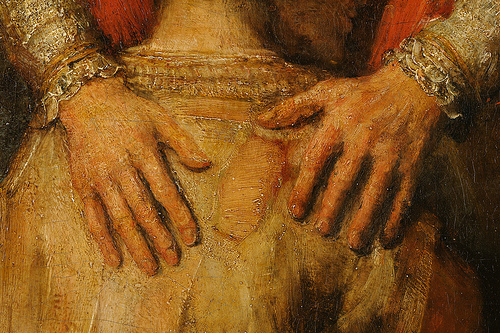
  • We see that his father receives him with a tender gesture. His hands seem to suggest mothering and fathering at once; the left appears larger and more masculine, set on the son’s shoulder, while the right is softer and more receptive in gesture.
  • The son’s head is downy, almost like a newborn’s. We must enter the kingdom like little children. 
  • The Prodigal Son seems to be protected by his father. He snuggles near the Father’s breast. It’s love that holds him there.
  • Consider his sandals. It has taken a long time for him to come home. 
  • Standing at the right is the prodigal son’s older brother, who crosses his hands in stoic judgment; we read in the parable that he objects to the father’s compassion for his brother.
  • We see his mother in the background in the painting, and a seated steward or counselor. One stands in profound joy, the other in sits in stunned perplexity.

But Rembrandt had painted the Prodigal once before, when he was considerably younger. And it is a very good painting. The prodigal is happy and gay; there is absolutely no indication of the consequences of sin.

The Prodigal Son in the Brothel, 1635

He’s a charming young man at the height of his popularity, and we see him at a happy party. He is spending the inheritance of his father.

But Rembrandt chooses at the very end of his life to re-paint it to reflect reality.

This is one of the last paintings he will do, and it is the Prodigal Son–destitute and repenting. I can only imagine; the years have taken a toll and he doesn’t really feel his first painting is enough. He wants to paint what is true.

He now is painting our spiritual condition.

We are given a work that some critics call as the greatest painting ever completed. The painting is now in St. Petersburg, Russia. It is seldom seen by visitors. It is a clear echo of the grace of God for fallen men and women. Like the father in the painting, He’s ready to forgive every sin saturated son and daughter.

The Father’s Prodigal

bry-signat (1)


Hiding Our Wounds

Brennan Manning Quote
“You are the light of the world. A city set on a hill cannot be hidden. 15 Nor do people light a lamp and put it under a basket, but on a stand, and it gives light to all in the house.”

Matthew 5:14-15, ESV

Overall, I think this Manning quote is a great observation. We, the torn and wounded, often try to hide, secluding ourselves in the “Island of Misfit Toys.” (Got to love those 60s Christmas cartoons.) We pretty much accept our lot as damaged merchandise.

Maybe we choose to isolate ourselves more than we want to admit. Could that be what we do? Are we still embarrassed and ashamed by all that we’ve done? That’s quite possible.

This may come as a shock, but the Church doesn’t need any more gifted people.

But it does need broken people who understand ‘the giftedness of the flawed.” When we conceal, we diminish the Church by our absence. We can ostracize ourselves, through a self imposed shame— but the Church will suffer. We need to show them that everyone can be healed, even screwy ‘fruit-cakes’ like us.

I recently had the privilege of speaking to a class of young Bible college students.

My subject was decidedly not on being successful, but on being a failure. Whole courses are geared toward ministerial success– but where are the ones for failure? I think that it just might be even more important, in the long run.

No human effort is going to erase your past.

I have tried and it can’t be done. I have blitzed my brains on drugs and booze, but I still remember the people I’ve hurt. (And I pray for them.) There really isn’t a cure for the evil we have done. I believe in forgiveness. And I hold to the idea that are sins are never to be a subject of  guilty accusation–

“He will again have compassion on us;
    he will tread our iniquities underfoot.
You will cast all our sins
    into the depths of the sea.”

Micah 7:19

Our dark iniquity is put in a very deep place. But there are the memories of an unkind word, or a sad and dark foolishness that we must learn to live with. There will be many regrets, and we face the terrible consequences of our sins, but it’s enough to know that all is under the blood of Jesus.

We are indeed forgiven. Completely.

We are now to live as forgiven sinners, yet precious in God’s eyes. We discover that although the Father has no favorites among His children, but He does have intimates. We are to live the rest of our lives for His glory, exploring that intimacy.

“Leave the broken, irreversible past in God’s hands, and step out into the invincible future with Him.”

  Oswald Chambers

Loving Others (Just Like Jesus Loves Us)


““A new command I give you: Love one another. As I have loved you, so you must love one another. By this everyone will know that you are my disciples, if you love one another.””

– John 13:34-35

What is “love” like?  How do we consistently understand love when we fall short of it all the time?

We understand love by coming to know Jesus.  He not only explains it, but He also exhibits it–He puts it out in the public eye for all to see.  His explanation of what love is will mean a cruel death in order to save us.  When Jesus dies, I am saved.  My salvation has absolutely nothing to do with me– and everything to do with Him, and all that He has done.

Jesus helps us to see others.  He makes a definitive statement, that we are to love others.  We are to use what He has done for me, as an example.  What Jesus did is the pattern, the prototype.  We are to be the photostat or mimeograph.  As believers we are to be captured and drawn into this approach.

We are to find someone, and then, in some sense, ‘die’ for them. That is the way God’s love is.

That very strong word, must in verse 34 cannot escape our attention.  It implies a deep and a very definite commitment to doing that is beyond us.  We ‘must’ connect and receive all that moves through our life.  We love the unlovely, and this is irrational. God says that people are worth crucifixion. We’re the criminals, and the judge has sentenced us. And then He Himself has decided to pay our penalty. This is ‘agape’ love.

We must love accurately. We should love the way He loves us.  We cannot do anything less. 

But the love of Jesus is tracking each wanderer.  He is working to connect with every person on this planet.  No one escapes His view, or His love.  Everyone who belongs to Him, is required to know this.  Our Lord is definitely not going to move if there are still “seekers” still out there.  He leaves no one behind.

Loving others will require a significant broadening of the way we see things.  We purposefully lift up Jesus because He lifted us.  We exalt Him because we have discovered we are so pitiful.  We must be convinced, that His way, is the way of the cross.

We must love more accurately —the same way He loves us.  We cannot do anything less.  For many of us, love is just a concept–a way of feeling ‘warm and fuzzy’ inside.  But it is far more than feeling nice thoughts. It is all about “the extra mile” and we honestly can’t make that trip if we haven’t been willing to die ourselves.

The Prisoner of Jesus

Does being in prison change a person? How would it affect you? I imagine the Apostle Paul’s frustration. He loved to disciple and establish churches. To be confined like this would be quite difficult. What a spiritual trial it would’ve been. Me, personally, I would have definite issues. I made a list. I probably would be:

  • Angry? Depressed?
  • Frustrated? Anxious?
  • Full of self-pity?
  • Isolated, lonely?
  • Frightened?

During his imprisonment, I’m sure that the Apostle Paul had to work through all of these things–I’m certain that Satan tempted him repeatedly. I think the man Paul had dealt with the enemy through all of this (and more besides). Most feel that he would be imprisoned in Rome for at least two years. That’s a long time.

It’s generally agreed that he wrote the four epistles in 60-62 AD. These letters are regarded as written from his prison cell in Rome: Ephesians, Philippians, Colossians, and Philemon. Each of these four is different. (But admittedly, Philemon is the most unalike.)

And yet the scent of the prison can be found in these writings.

Despite the possible response of an incarcerated man, Paul’s writings from the Mamertine Prison are incredibly encouraging–he shows none of the issues of a man locked in a cell–but yet there are hard things he must deal with. Take a second to look at some direct references to his imprisonment.

  • “I appeal to you, instead, on the basis of love. I, Paul, as an elderly man and now also as a prisoner of Christ Jesus,” (Philemon 9.)
  • I am going to Jerusalem, constrained by the Spirit, not knowing what will happen to me there, except that the Holy Spirit testifies to me in every city that imprisonment and afflictions await me. But I do not account my life of any value nor as precious to myself, if only I may finish my course and the ministry I received from the Lord Jesus, to testify to the gospel of the grace of God (Acts 20:22-24).
  • “For this reason I, Paul, a prisoner of Christ Jesus on behalf of you Gentiles,” (Ephesians 3:10).
  • “I, Paul, write this greeting with my own hand. Remember my chains. Grace be with you.” (Col. 4:18).
  • “I want you to know, brothers, that what has happened to me has really served to advance the gospel, so that it has become known throughout the whole imperial guard and to all the rest that my imprisonment is for Christ.” (Philippians 1:12-14).
  • “The following night the Lord stood by him and said, “Take courage, for as you have testified to the facts about me in Jerusalem, so you must testify also in Rome.” (Acts 23:11).

It’s clear to me that Paul used this time to witness through his writings. He never grew bitter, only better. One could suggest that it’s we have been blessed by these epistles. His time in prison was the time he needed to bless us today. Where would we be without these books?

A papyrus fragment from Paul’s epistle to the Ephesians.

How many times was Paul imprisoned? Was he jailed once, twice, or several times? I’ve read different commentaries and they can’t decide. It’s a challenge to put together a solid timeline. There seems to be more evidence for two different confinements. Check out this site if you want to dig deeper.

But no matter what. These writings are God’s gift to us today.

From a dark prison, Paul writes these absolutely incredible letters. I believe Satan wanted to destroy Paul. I also think that this was a tremendous trial for him. He was a spiritual dynamo, wanting to establish and strengthen churches and then being chained to a wall must’ve been a challenge for him. There was so much for him to do.

But we desperately needed these letters!

Perhaps, out of our confusion and challenges, God’s purpose goes far beyond what we think. Sometimes we have no idea what our “imprisonment” is going to do. That encourages me. He turns our hard times into spiritual gold!

Through these letters, we’ve been given so much. These epistles are written from Rome’s dungeon, and yet they continue to shake the world!