This poem is written in the pantoum form and is based on Psalm 116, which is my favorite Psalm. I find that the repetition of lines in this form lends itself well to Christian poetry of lament and praise. I hope you are blessed by this offering.
My Psalm for My Savior
For you, O Lord, have delivered my soul from death The anguish of death and darkness entangled me I called on the name of the Lord: “O Lord, save me!” Praise my God, my Savior who came to my rescue
The anguish of death and darkness entangled me My eyes filled with tears, my feet stumbled under me Praise my God, my Savior who came to my rescue Rescued me from my trouble, sorrow, and darkness deep
My eyes filled with tears, my feet stumbled under me The Lord, my God, heard my cry for love and mercy Rescued me from my trouble, sorrow, and darkness deep Now I know His grace and mercy are mine to keep
The Lord, my God, heard my cry for love and mercy He saw the anguished turmoil of my broken soul Now I know His grace and mercy are mine to keep I will forever praise His glorious name, Jesus
He saw the anguished turmoil of my broken soul I called on the name of the Lord: “O Lord, save me!” I will forever praise His glorious name, Jesus For you, O Lord, have delivered my soul from death
“My memory is nearly gone; but I remember two things; That I am a great sinner, and that Christ is a great Savior.”
Elijah was suicidal. Job wished he had never been born. David understood deep depression. Moses was anxious. Hannah was barren. Jonah was angry. Paul was all alone in a prison cell.
And actually, this is only a brief list. The Bible is loaded with flawed people who stumbled trying to be faithful. God uses imperfect people, because there really isn’t any other kind to be found.
Noah got spectacularly drunk. Abraham lied. Jacob repeatedly deceived others. Rahab was a whore. Samson lusted. David committed adultery and was a murderer. Peter denied Christ.
And there were others.
Why does God favor and love people who are so disturbed? Honestly, none of us measure up. It seems He uses the weak to carry out a plan and a purpose of redeeming others, and establishing a Kingdom. He takes messes and gives them His message.
He is Love– 100% of the time, and He loves you, and He loves me, He loves the world. (John 3:16.)
Messed up people of faith become instruments and vessels of grace to other messed up people. We carry a treasure that is not ours. Sometimes it takes years to see this. I hope you can.
And nothing is ever really wasted. Our mistakes (sins) become useful things to Him. For example, David’s sin would be transformed into Psalm 51 and 32. Yes, his disobedience had consequences, I won’t dispute that, but something wonderful also came when he repented.
Yes, you need to repent. But when sin is destroying you, it does seem logical.
The first two verses of Psalm 51 can bring tears when we finally understand their profound beauty, for they came out of David’s darkness:
Have mercy on me, O God, according to your steadfast love; according to your abundant mercy blot out my transgressions. 2 Wash me thoroughly from my iniquity, and cleanse me from my sin!
Psalm 53:1-2, ESV
For thousands of years people of real faith have come and drawn beauty and grace from this song. David knew his sin was real, and incredible pain emerged from that, but the Psalm did also.
Please do not try to hide or excuse your sin, it always has the most awful consequences.
Broken people can be forgiven, redeemed and used. Sometimes I think God gets special enjoyment out of picking the worst and patiently loving us to wholeness. If you really know Him, and know your flaws, you’re well on your way of usefulness in His kingdom.
“But we have this treasure in jars of clay, to show that the surpassing power belongs to God and not to us.”
Trials are hard, and at times they seem to suffocate us and weaken our walk with God. David shares with us his own difficulty in these six verses.
A Very Brief Commentary of Psalm 13
For the choir director: A psalm of David.
O Lord, how long will you forget me? Forever? How long will you look the other way? 2 How long must I struggle with anguish in my soul, with sorrow in my heart every day? How long will my enemy have the upper hand?
V. 1-2, David believes that he has been forgotten. A phrase is repeated an astounding four times, “How long?” It seems that impatience is a significant issue for him. It makes David ‘human,’ he’s not a marble statue in a museum!
Often when it gets this outrageous, we desperately look around to find anything to fill the gap. Anything.
Something else struck me. Within these two verses, you’ll find five hard questions. Whenever you find a question in the psalms especially, you must stop reading and take a closer look–why is he asking this?
V. 2,“Anguish…sorrow, every day.” Somehow David is alert enough to recognize (and admit) that his life is saturated with real difficulty. It seems it comes and when it comes there’s no relief– it’s a constant, gnawing, challenging pain which can be physical, emotional, spiritual (or all three at once).
Turn and answer me, O Lord my God! Restore the sparkle to my eyes, or I will die. 4 Don’t let my enemies gloat, saying, “We have defeated him!”Don’t let them rejoice at my downfall.
V. 3,“Turn and answer me, O Lord my God! Restore the sparkle to my eyes, or I will die.” (I love this version–“sparkle“). David knew that life could be exceptional, it was meant to gleam and shine. There is much more than just breathing to life. He instead speaks of being restored.
V. 4, Also, he is quite aware that his life is being threatened. The word, “gloat” is an interesting translation. It has the idea of “relishing someone else’s failure.” The dark prince savors your defeat. He has been looking forward to this desperate moment. The enemy rejoices at each of your failures.
But I trust in your unfailing love. I will rejoice because you have rescued me. 6 I will sing to the Lord because he is good to me.
V. 5,“But I trust in your unfailing love. I will rejoice because you have rescued me.” The Lord has covered David with His hand. His life has been saved by a love that never falters, weakens. or hesitates. He knows that no matter what happens, God has rescued him.
Notice how David responds to the great trial of his faith and the wonderful goodness of God:
I trust.
I rejoice.
I sing.
V. 6, Tremendous. When we finally get to this last verse, we see that we have truly traveled with David. And we have learned how to sing, even if we’ve lost everything and we live in constant pain. It doesn’t really matter any more. What a good teacher David is.
Jewelers display their gems on a black background. The darkness intensifies the brightness of the jewels. They become even more beautiful to look at. David is singing and praising the Lord for His nearness.
1-2 What a beautiful home, God-of-the-Angel-Armies! I’ve always longed to live in a place like this, Always dreamed of a room in your house, where I could sing for joy to God-alive!
3-4 Birds find nooks and crannies in your house, sparrows and swallows make nests there. They lay their eggs and raise their young, singing their songs in the place where we worship. God-of-the-Angel-Armies! King! God! How blessed they are to live and sing there!
Psalm 84:1-4, Message
There are some things that leave an indelible mark, and they go very deep down into our souls. For me, one instance I remember staying at Simpson College on Silver Ave. in San Francisco in June 1986. The dorms were empty and I had a whole floor to myself. The campus was gorgeous; the roses were in full bloom.
I found a little “mom and pop” corner market nearby which had an awesome deli. Here I could buy cold cuts, some excellent braunschweiger, and freshly baked sourdough bread. I returned to my room to build my sandwich, and feast.
I remember that the windows were open and there was a beautiful breeze. Food, warm sun, flowers in bloom and the Holy Spirit was about to ‘plow’ into my life. It would be a holy collision.
It was simply a moment that I captured and savored. Everything seemed to coincide, it was magical in the best and holiest sense of the word. It was beautiful, that is all I can say. That time in that dorm room has become a crystalline moment that I will never forget. Right there, it seemed I fell in love, not with a girl, but with a moment in time and place. I knew I was on holy ground.
That nostalgia lays thick on the shoulders of the writer of Psalm 84. He remembers and savors those powerful memories of his visit to the temple. He was given something at that particular moment that would follow him for the rest of his life.
The beauty of that experience was inviolable and true and could never be duplicated. This treasure was his. As he aged he could tell his grandchildren, “I walked with God.” And really mean it.
I personally believe God gives us these holy moments, wrapped in wonder and awe. When the Holy Spirit deeply touches in this way you will never, ever be the same.
The psalmist has the same hunger for God.
These moments in the temple which are so blessed have also ‘ruined’ him. Often special times of God’s presence will result in a ‘sanctified’ dissatisfaction with the present status quo. Brennan Manning once said, “Those who have the disease called Jesus will never be cured.” You can easily apply it to these verses. God’s presence “ruins” us forever.
But when we finally make our way to Jesus, life takes on a special and curious wonder. When the rain finally comes to the barren desert, an explosion of life bursts out. In much the same way, our lives are ‘watered’ by Jesus. Things get very green and lush as we live in the Spirit. All of this is in contrast to our dry and desperate life without His presence.
I want to become hungry for His presence.
I so want to be in the center of wherever He is at. I admit that His grace and love has spoiled me. But the love of Jesus does this. Normal life seems to be nothing more than a boring journey into ‘black & white’, but somehow He turns it all into stunning color.
The psalmist practically begs to be returned to the temple. He wants to be there, more than anything else. It is now his true home. He will not be satisfied with anything less.
I say to the Lord, “You are my Lord. Apart from you, I have nothing good.”






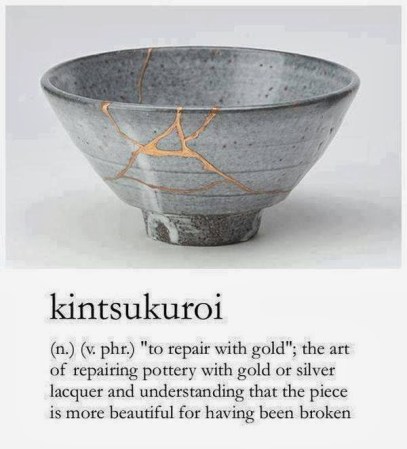



 Broken Believers
