The Plow and Jesus

57 As they were walking along the road, a man said to him, “I will follow you wherever you go.”

58 Jesus replied, “Foxes have dens and birds have nests, but the Son of Man has no place to lay his head.”

59 He said to another man, “Follow me.”

But he replied, “Lord, first let me go and bury my father.”

60 Jesus said to him, “Let the dead bury their own dead, but you go and proclaim the kingdom of God.”

61 Still another said, “I will follow you, Lord; but first let me go back and say goodbye to my family.”

62 Jesus replied, 

“No one who puts a hand to the plow and looks back is fit for service in the kingdom of God.”

Luke 9:57-62, NIV

There’s to be no whitewashing the way of discipleship–there’s no glamour, no special recognition–no acclaim in it to speak of it openly. I guess this is the “real” way of being His follower. The path Jesus has for me demands I give Him my whole heart. Heart enough to turn it all to Him. Heart enough to give Him total commitment.

Jesus seems to make it hard to follow Him. But is it really?

We can see this in His responses to each prospective disciple. His statements to each possible follower seem harsh, difficult, and a bit “unreasonable,” but He doesn’t receive these men unless they do what He says.

Discipleship demands that we give up what we hold dearest.

What happened to these three “would-be” followers? Did they return home dejected and frustrated? To follow in Jesus’ footprints means we give up our personal agendas, and turn our backs on what is closest and dearest. We must renounce everything, and give Him preeminence over all.

These are hard verses with profound implications.

But this passage is given to us for a reason. We dare not minimize what it means to be a disciple. We must grasp the plow with both hands, and we can’t look back. All that we do is a fair response to His mercy, and His kindness. There is incredible joy in all of this.

“Christianity without discipleship is always Christianity without Christ. Unless he obeys, a man cannot believe.”

    Dietrich Bonhoeffer

brokenbelievers.com

Deeply Hurt for a Reason

Pastor A.W. Tozer seems to have gotten a hold on something here. Those who step into discipleship or ministry will inevitably be hurt in some significant way. I wouldn’t say it was a ‘given’, but it seems to be the common path we must take. We must be aware–but often we can’t or won’t understand. This is hard and we’re easily confused.

God really isn’t our problem.

He loves us and saves us and He really wants to bless us. He is all goodness and grace. He has no evil intentions concerning you, and certainly has no desire to see you suffer in a crisis of suffering or trial. Even in times of temptation, He simply views it as a step to strengthen us–He never is out to trip us up.

I really think that the issue is us.

Our old nature–the sinner inside, delights in things like pride and selfishness (even in religious matters). Some of the most difficult people I have ever had to work with were in places of oversight within the Church!  May I suggest something?

Could it be that the problem isn’t that we are too weak, rather, it is because we are too strong?

God’s intention is ‘to bless greatly.’ But my pride and self-will must be left at the door (repeatedly). My old nature cannot truly work in the Kingdom. Only when these issues are dealt with (repeatedly) will humility and brokenness transform us. Quite simply, there is no way around this. God uses broken things. We must be broken as well.

“It takes broken soil to produce a crop, broken clouds to give rain, broken grain to give bread, broken bread to give strength. It is the broken alabaster box that gives forth perfume.”

“It is Peter, weeping bitterly, who returns to greater power than ever.”

Vance Havner

Becoming broken often takes years of trial, temptation, and affliction.

But God is patient. He’s not in any hurry.

You will ‘log-in’ many hours in the desert. Many of His best soldiers have been recruited from that barren place. The Holy Spirit is our best guide through the difficult loneliness and aridity of this place. He will guide you, and comfort you.

I sometimes teach at a local Bible college–I love Song of Solomon and choose to teach it whenever I can. Here’s a verse that has encouraged me over and over:

“Who is that coming up from the wilderness, leaning on her beloved?”

Songs 8:5, ESV

“Before God could bring me to this place He has broken me a thousand times.” 

Smith Wigglesworth

Making a List

This is a scary list. We’re told repeatedly that love is the evidence that disciples are to be identified. Love is the blood of the body. It’s that necessary. It’s critical. We’re called to love (one another) that proves we’re real and authentic.

Some of us are handicapped, either mentally or physically. Our issues are truly formidable, very few understand.

I pretty much live in physical pain now. I struggle with depression. I have some battles that few understand. And I get terribly self-absorbed by all of it. If love is the blood of the Christian then I absolutely need a transfusion. I’m anemic. I’m the proverbial 95 pound spiritual weakling! 😁

“Love one another.” I believe I’m missing this in my spiritual walk. For the most part I operate as “to tolerate one another.” It’s easy to love those who love me, but that’s not how discipleship to Jesus works. He wants us to find enemies to love. (At least I think it does.)

Our Teacher, the Holy Spirit, knows how ignorant we really are. But He is patient and oh so very kind. He has lessons that fit us and our needs. I want to love (usually) and I’m counting on Him to tutor me. How do I do this?

You learn to love by loving.

A few things (I know it’s a terribly incomplete list):

  • To love you must walk in discernment. Learn to “see” the needs of specific people. Contrary to church opinion, discernment is not to pass judgement on another, rather it’s all about seeing needs. Not everyone can do this.
  • To love takes availability. You need to be “ready for use.” This takes a certain amount of skill. I’m a terrible kind of introvert. Sometimes I won’t answer the phone or go to a home group. I sorta resent it. The Spirit keeps putting me in spots that require interaction with others, and I hate it.
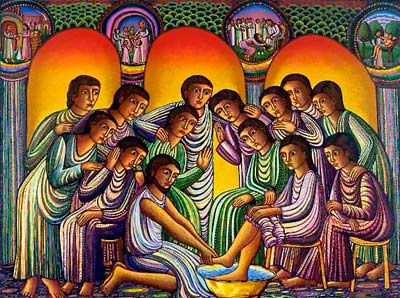
  • Love creates humility in us (which takes some doing). As I learn to love I find myself stripped down and washing somebody’s feet. I become a servant who is learning to scrub between the toes if that’s what it takes.
  • To love you must love others just like Jesus loves you. (Yikes!) “The extra mile,” all of that. So tell me, how much has He loved you? Isn’t that supposed to teach you something? Remember, love is a fruit of Him living inside of you.
  • To love creates growing joy. This joy will protect us from legalism. When joy is operational every burden is light–we do our tasks smiling. I heard a preacher speak about J.O.Y. Jesus, Others, and You. In order of importance.
  • To love is to learn how to pray. Intercession is like oxygen to a fire. It’s like one of those old fashioned bellows to a sputtering flame. It pumps air into the pile of twigs and wood to spread the fire and ignite a blaze. We pray and love starts spreading.

To live with hard mental and physical issues as an authentic Christian is profoundly difficult. We get so self-absorbed at times. But being a disciple of love isn’t just for healthy believers, it’s also for us who struggle.

Grace is increased exponentially to those of us with deep physical problems.

I totally believe this. God takes special care as He works on and in us. We can count on Him to give us the extra attention we need as we learn love.

I’ve found that suffering is like learning another language. Changed by His love we are speaking to others in a way they understand. We can communicate with others because we’ve learned how to “speak their language.” We have been taught by God to speak into broken lives because we’ve been broken too.

1 John 4:19

Always Be Children, [Always]

Matthew 18:1-3, ESV

I have always believed that maturity brings wisdom and growth, a beautiful journey to embark on. When it comes to spiritual matters, it is an opportunity to delve deeper into the richness of faith. I eagerly embraced the challenge of expanding my understanding and exploring the profound teachings. Jesus’ devoted disciples, too, were presented with invaluable guidance and encouraging direction:

15 “Now they were bringing even infants to him that he might touch them. And when the disciples saw it, they rebuked them. 16 But Jesus called them to him, saying, “Let the children come to me, and do not hinder them, for to such belongs the kingdom of God. 

17 Truly, I say to you, whoever does not receive the kingdom of God like a child shall not enter it.”

Luke 18:15-17

Jesus makes a special effort to get his followers to see their need. He voices the dictate that they must become children again; that they must learn that the basics are the core. We won’t grow out of them.

Real faith remains childlike even as it gets old.  

As we see the children that are in our midst, we should see in them the pattern for us as we connect with the Lord, and with each other. It’s a paradox, but we mature as children, and this doesn’t ever change. Jesus told us that the Kingdom belongs to those whose faith is childlike.

Childlike faith seems to have three focuses:

  1. Areas of intimacy, coming together in the presence of the Lord as His sons and daughters.
  2. Areas of relationships, between each other as brothers and sisters in love with each other.
  3. Issues of spiritual warfare, facing the daily battle with sin and darkness with a steady awareness of the ones alongside us.

Holding a child’s faith has an extraordinary power to shape our lives in profound ways. It’s a delicate balance of innocence, trust, and vulnerability that leaves an indelible mark on our hearts and souls. The childlike belief in something greater than ourselves and it opens up a world of possibilities and invites us to embrace the wonders of the unknown with open arms.

Our Father is with us.

But what does it truly mean to hold onto a child’s faith? It goes beyond the simple act of believing in something beyond our understanding. It requires a humility that allows us to acknowledge our own limitations and embrace the beauty of our imperfections. In a world that often values strength and self-assuredness, the child’s faith reminds us of the importance of embracing vulnerability and being open to being led in fresh ways.

Picture for a moment the scenario of being suddenly clothed in nothing but our humility. It is a humbling thought, isn’t it? In that state, stripped of all pretenses and facades, we are forced to confront our true selves. We are reminded of our humanity, and our weakness with the swirling world around us. It’s in those vulnerable moments that we truly come to appreciate the depth and power of a child’s faith.

In a society that often prioritizes material success, power, and self-exaltation, we may find ourselves striving to shed our humility in favor of more desirable qualities. However, it’s precisely in cherishing our humility that we can find true wisdom and grow into more compassionate and merciful people. It’s through humility that we can connect with others on a deeper level, understanding their joys and sorrows with a genuine empathy.

Let’s embrace the innocence of a child’s faith.

Let’s allow it to ‘infect’ our lives with a sense of real wonder, curiosity, and a supernatural love. Let’s never forget the lessons it teaches us about the importance of embracing humility in our journey through life.

Let’s hold onto a child’s faith tightly, for within its grasp lies the power to transform our lives and the world around us. May it be a constant reminder of the child-like beauty that exists within each and every one of us.

Humility is the stuff Jesus uses to make a place for His Kingdom.

Becoming a person of childlike faith will take a lifetime, that is why we should stay small and keep growing in our dependence on Him.

Martin Luther

bry-signat (1)