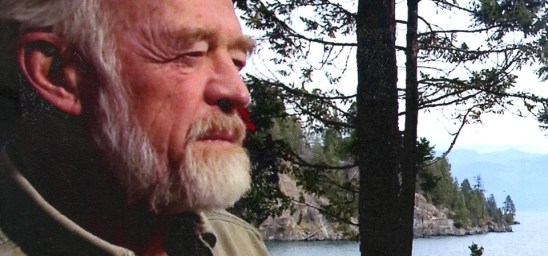
Devotions, [Eugene Peterson, Interview]

eugene-petersonInterview with Eugene Peterson

Why Can’t I Hear God? By Nancy Lovell

The musical group U2’s Bono quotes Eugene Peterson from the stage. Readers of the best selling Bible, ‘The Message,’ find themselves holding onto lines from his ‘fog-slicing’ Bible paraphrase, and many other works. For several years now, TheHighCalling.org has provided a daily prayer and reflection by Eugene Peterson. Recently, we asked the man himself: What are devotions and why do they matter in our daily work?

Why do so few people who believe in God bother to know Him?

The most obvious answer is that we’re in a hurry and not used to listening. We’re trained to use our minds to get information and complete assignments; but the God revealed to us in Jesus and our Scriptures is infinitely personal and relational. Unless we take the time to be quiet, in a listening way, in the presence of God, we never get to know him.

The same question is why so few married couples really know their spouses. People get divorced after 20 years of marriage, and the rejected spouse says, “I never knew this was coming. I thought everything was fine.” But there was not much listening in those 20 years. Devotions are the discipline of being quiet and listening for what we don’t hear in the streets, in the media, in the workplace.

What about people who sincerely set apart time, read the Bible, stay still, and hear nothing? They ask themselves whether God’s voice is anything more than their own thoughts.

We’re not good at this. We’ve had no practice doing it. No wonder we only hear our own thoughts. This is why the church is so insistent that we do this whether anything happens or not. Supported by 2000 years of history, we know that God does commune with us in our listening. But because we’re so unused to this way of communion, we don’t hear it. So it takes time.

How would you direct someone trying to start?

I would say: Get your Bible and find a place. If you can’t do this daily (some people can’t because of their life circumstances; mothers with young children are obvious instances), try for at least 20-30 minutes, two or three times a week, or four. Don’t make demands on yourself too high. Don’t ask questions about, “How long is this going to take?” Believe that something does happen in that silence—usually through Scripture, but not always—in prayerful, attentive listening, knowing that you’re in the presence of God.

I ask for a commitment of six months; so don’t come back in three weeks and say nothing’s happened. I’ve never had anyone who’s done this at least six months who came back to me and said, “I did it and nothing happened; I’m going on to something else.” Not many who give this a fair test ever say that nothing happens. Also, when I’ve asked people to do this as their pastor, I also ask them to worship regularly. This is a place where the whole community is gathered and listening and being in the presence of God.

Is that how you started?

I was lucky. In the family I grew up in, I started when I was about 14 …mostly with the Psalms, but all the Scriptures become part of it.

In your writing and speaking, you must have seen moments when a person realizes, “Yes, I want more and I want God.” What turns on the light for people?

Often the motivation is that people are tired of the way they’re living. They think there’s got to be more than just the motions they’re going through and the work they’re doing. There’s a craving and hunger that they identify with God. There’s enough pain or boredom or something to motivate them to do something that the culture’s not telling them to do. I got a letter recently from a friend of 40 years. She had been a parishioner of mine for a long time. Then she was ill, and divorced; and she quit, just gave up. She quit reading the Bible, quit going to church. Six months ago she wrote me a lovely letter that she was sitting with a group of friends and, in her words, “a rooster crowed”—it all came back and she was a Christian again and aware of the presence of God. Isn’t that a wonderful phrase? ‘A rooster crowed.’

Who knows what went into that statement of hers? Twenty years of unhappiness, pain, suffering, disillusionment …but still there was the need.She would have said during that time she didn’t believe in God. But the rooster crowed. That’s why we use the term the Holy Spirit to explain times like this. Given that it’s hard to discipline ourselves to silence, listening—and to daily time in quiet—tell us about your devotions on this website. I wrote those in the early morning for 20 years, maybe 25 years. And what I was trying to do was be present to the Scripture, listen to God, and to write as honestly as I could. I wasn’t thinking about anybody else but me.

It’s really hard to be honest as a writer. You get these wonderful ideas, and you love to manipulate words and see if you can make it sound good. It’s hard to be honest, especially working for God. That was the thing I was most aware of. “Eugene: Don’t say anything that is not relational, immediate, honest; stay present to the text and be honest before God.” I believed if I could be honest, I could draw some other people to honesty, too.

To read the rest of this interview, you will need to follow this link: http://www.christianitytoday.com/workplace/articles/interviews/eugenepeterson.html

 

cropped-christiangraffiti1-3

Feeding the Dogs, [Choosing Holiness]

A toy I grew up with, they were magnetized pushing against each other.

There is a story of a Native American elder who once described his own inner struggles to understand the Bible and Christianity.

Inside of me there are two dogs. One is black, and the other is white. The black dog is mean and tries to talk me into making the wrong choices. The white dog is good and encourages me to make the right choices. The black dog fights the white dog all day.” When asked by the friend which dog wins, the elder reflected for a moment and replied;

“The one I feed the most.”

White Dog: As a believing Christian, there is a part of us that is Christ-spirited, compassionate, trusting, open, abundant and focused on helping others. We pray and are being filled with the Holy Spirit.

Black Dog: The other part is our flesh. We can be proud, evil, self-centered, greedy, manipulative, sullen, promiscuous, drunken, and only wants to he served by others.

“An analogy is made between the good white dog, our new nature in Christ, and the bad black dog, our old fallen nature. While we cannot eliminate the old nature, we can choose to feed the white dog.”

(From “The Holy Spirit: Activating God’s Power in our Life,” by Billy Graham 1978.)
 

howlingwolf3-300x281The main key for us to remember is that these two parts are in constant struggle.

Two Scriptures to help: One– “If you use your lives to do the wrong things your sinful selves want, you will die spiritually. But if you use the Spirit’s help to stop doing the wrong things you do with your body, you will have true life.”   Rom. 8:13, NCV

Two– “Our sinful selves want what is against the Spirit, and the Spirit wants what is against our sinful selves. The two are against each other, so you cannot do just what you please.”   Gal. 5:17

In thinking this through this analogy might help.  I’m inclined to think that holiness is not so much like an “on and off” switch.  But I think it’s more like a “dimmer” switch is turned to brighten or darken a room.  I actually think there are times when we should make a deliberate decision for God.  And yet other times we just need to turn up the dimmer from 30% to 80%. Maybe all the way?

I’m just thinking out loud here.

 bry-signat

flourish31

Having a Resurrected Heart, [Brand New]

“You have been raised to life with Christ. Now set your heart on what is in heaven, where Christ rules at God’s right side.”

Colossians 3:1, CEV

Paul’s explanation is given that is meant to clarify things for us.  Perhaps it is too simple, too straight-forward.  We seem to prefer the complex; ideally a 12 point plan, on ‘PowerPoint’, that makes us feel holy and strong, and even ‘spiritual.’ We’d feel much better if it was just a question of intelligence, rational mind and ‘practical thinking.’ Paul shares with this young Church of the Colossians. By the time he gets to chapter 3, he is ready to communicate an essential truth, which is meant to challenge our weak and faulty understanding.

“You have been raised to life with Christ.” The truth is this; the real world starts for you when you understand your resurrection as already taken place.  You were once dead, and now you are alive!  The life that you live is a resurgent life.  You have awakened from death. Essentially, you entered ‘piggyback’ on Jesus.  He has carried you into the deepest place in heaven.

It all can make sense if, set your heart on what is in heaven.”  This is the first mention of us taking action. Up to now, Jesus has did everything.  But at this precise moment, we must act– to set our heart on the deep priority of eternity.  To commence becoming who you really are.  You’re now a spiritual man, or woman, who just so happens (at this point) to have a physical body.

It is a place of triumph and power, “where Christ rules at God’s right side.” This is no inconsequential place. This is the ‘very center of the center.’  The presence of God is all-powerful, and all-knowing.  And it is accurate to say that we have been brought into that same atmosphere, where we breathe in the ‘shekinah’—  that is God’s glory.

Embedded in this single verse in Col. 3:1 is a vigorously rich sense of how and what is the spiritual life.  It should never be formulaic or mechanical.  (We will not find our intellect charging the way into God’s presence.)  Simply, we must believe in our hearts what has happened already.  We enter by faith. It is so easy, but can be quite challenging. You are now a ‘citizen’ of heaven.

“But we are citizens of heaven, where the Lord Jesus Christ lives. And we are eagerly waiting for him to return as our Savior.”

Philippians 3:20

bry-signat (1) cropped-christiangraffiti1.jpg

Simply Mary at Jesus’ Feet, [Desire]

Mary-Jesus-feet

We see Mary three times in the gospels, and each time she is in the same posture — “at Jesus’ feet.” When we have our first glimpse within the Bethany home, we find Martha in her characteristic attitude– working and serving; and Mary we see sitting at the Master’s feet, sitting eagerly and listening to His words.

Our second view of Mary is when Jesus came back to Bethany after the death of Lazarus, and the sisters went out to meet Him. Again, we see her at the feet of Christ. But this time in deep sorrow, seeking comfort. And then we observe her a third time. She has come to anoint the feet of Jesus. We find her again, at Jesus’ feet, and now she is honoring her Lord.

She has this peculiar habit, and that is to be at the feet of Jesus. 

It is her natural posture. I believe that she feels entirely comfortable in this place.  I have personally seen sparrows’ nest on a sheer cliff hundreds of feet straight up, without any apprehension at all. I have been astonished at their daring and simple confidence.  And Mary has this spunk.  She has that certain easy and confident boldness.

Martha, the oldest, obviously has the theology.  We see her taking issue with Jesus, she is questioning, and confronting.  But with Mary it seems, there is a quiet contentment and a rest.  An open readiness to receive. We don’t see that too much, but Mary was a “learner.”  She had become learned in the grace of trusting simply.

The greatness of her love enabled her to kneel. 

She was centered on her Master, He was the focus of her attention.  We dare not minimize this, or try to focus on something less “holy.” This is not something we can easily duplicate, because it proceeds out of a heart that is absorbed in love.  It may appear to be unseemly, and we scratch our head with nervous skepticism.  But it seems whenever Mary comes into the presence of Jesus, she works her way to the front– so she can sit with Jesus. (Interestingly, the Orthodox Church regard Mary to be the first real disciple.)

We have so much to learn from Mary.  Our Christian life can be very shallow and seem rather anemic.  We live in a culture that is racked in intellectualism and pride.  When we engage it we may end up with a bit of haughtiness and a lot of selfishness to deal with.  Mary can be our compass, and our example as we crash through these issues into authentic discipleship.  She really does deserve to be esteemed, and recognized for inspiring us to be with Jesus.

Lord Jesus, thank you for Mary.  May I become like her and have you very close. I want to sit at your feet.  I choose you. I choose to be with you.

*

ybic, Bryan


cropped-christiangraffiti1-3