Caving Into the Presence


cave_claustro

“Let us go right into the presence of God with sincere hearts fully trusting him. For our guilty consciences have been sprinkled with Christ’s blood to make us clean, and our bodies have been washed with pure water.”

Hebrews 10:22

 I have never really understood “caving”.  Some consider it a sport, but I guess I really don’t see the athleticism of it.  People actually seem to derive some satisfaction and thrill from exploring muddy caves in the dark.  I guess I can try to grab the basic idea of it, but to me it’s a whole lot like “parachuting”.  Why jump out of a perfectly decent airplane, when you can sit in a Starbucks with a vanilla latte?  It doesn’t compute.

But there is a sense about caving that resonates with the hunger in a man’s or woman’s heart.  Hebrews tell us that we are to enter the presence of God.  The keys will be sincerity and trust.  In other words, a honesty, and a trust that will open up the passage.  Spiritual spelunkers in a quest for His glorOUCC-Cave-Climbingy.

Sometimes something will block a person.  Depression is a barrier for us.  Essentially it effects our passion and strength.  Our pursuit of God is nullified by the corrosive facets of depression and melancholy.  There is no longer any zip or zeal for His presence.  The fire of zeal we once had just fizzles out.  But to reach our goal, we need to squeeze beyond the blockage. There is a spiritual resistance.  Our infernal enemy is working against any progress.

So much involves patience and humility.  A person must continue to probe ahead but slowly and patiently, taking their time and monitoring their progress.  Humility is necessary.  An awareness of self and our dimensions in tight spots.  “Am I small enough to squeeze through that hole?”

Our scripture tells us that we have a key to the throne room of God.  Our guiltiness and our defiled conscience have both been cleansed or sanitized from anything that would corrupt us.  We haven’t done a thing.  And we are exhorted to be very bold.  Jesus has made us pure.  We are clean.

bry-signat (1)

cropped-christiangraffiti1.jpg


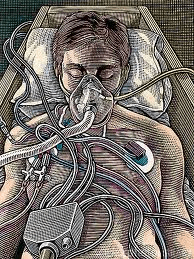
On Life Support

 untitled (2)And I will give them singleness of heart and put a new spirit within them. I will take away their stony, stubborn heart and give them a tender, responsive heart, 20 so they will obey my decrees and regulations. Then they will truly be my people, and I will be their God. 21 But as for those who long for vile images and detestable idols, I will repay them fully for their sins. I, the Sovereign Lord, have spoken!”

Ezekiel 11:19-21, NLT

This is one of those complex portions of God’s scripture where several ideas overlap. In our English translation, we read compound sentences and knotty syntax. But the thoughts are God’s, and therefore significant. Without these truths though, I believe that we can quickly slip into a ‘comatose’ condition.

First we must consider who is involved.

  1. God [speaking through the prophet] declares His intentions.
  2. His repentant people [Israel] are acted upon.
  3. But there is a third bunch, those unrepentant ones who have decided within themselves that they will stick with their idols.

God is very decisive by this point. The prophetic ministry was supposed to work, many prophets and teachers have been sent out. But with very limited success. If we pick one out, it would have to be Hosea; his ministry was dramatic– but ultimately fruitless. The only real successful prophet was Jonah– preaching to Ninevah, ironically a pagan people. But God’s own people are living in flagrant sin. They remain untouched. They’ve chosen to remain in their sinful condition.

A solid and clear promise has been given. An interior work has been promised by God, if they can only show a minute sense of life. The nation is on “life support.” The prophets attend to the needs before them. They are very far from the virile and robust nation– they are in the ICU and are showing only scanty signs of life.

This promise is that a special work will be done inside. They will become both tender and responsive again. A new receptivity and awareness will come into being. The ability to obey will ignite within. We call this “revival.” Revivalists throughout history have carried this to every generation.

As I scan over my Christian life of more than 30 years, I simply see my own “cycles” of sin and revival. I wish I could have been more consistent. But I cling to the faithfulness of God. He stays true even when I’m not. He has promised me. I’ll take Him at His word.

And I am certain that God, who began the good work within you, will continue his work until it is finally finished on the day when Christ Jesus returns.”

Philippians 1:6, NLT

God will do what He can, His efforts are heroic. He fully intends to change us— if we’re only willing.

“A revival is nothing else than a new beginning of obedience to God.” 

Charles Finney
1brobry-sig4

cropped-christiangraffiti1 (1)

)

The Micro and the Macro, by John Piper

10piper
John Piper, Pastor of Bethlehem Baptist Church, Minneapolis. Writer and Speaker, DesiringGod.org

Originally dated, July 14, 2008 | By: John Piper 

One of the reasons God rarely gives micro reasons for his painful providences, but regularly gives magnificent macro reasons, is that there are too many micro reasons for us to manage, namely, millions and millions and millions and millions and millions. God says things like:

  1. These bad things happened to you because I intend to work it together for your good (Romans 8).
  2. These happened so that you would rely more on God who raises the dead (2 Corinthians 1).
  3. This happened so that the gold and silver of your faith would be refined (1 Peter 1).
  4. This thorn is so that the power of Christ would be magnified in your weakness (2 Corinthians 12).

But we can always object that there are other easier ways for God to accomplish those things. We want to know more specifics: Why now? Why this much? Why this often? Why this way? Why these people?

The problem is, we would have to be God to grasp all that God is doing in our problems. In fact, pushing too hard for more detailed explanations from God is a kind of demand that we be God.

horseshoe-anvil-clipartThink of this, you are a blacksmith making horseshoes. You are hammering on a white hot shoe and it ricochets off and hits you in the leg and burns you. In your haste to tend to your leg you let the shoe alone unfinished. You wonder why God let this happen. You were singing a hymn and doing his will. Your helper, not knowing the horseshoe was unfinished gathered it up and put it with the others.

Later there was an invasion of your country by a hostile army with a powerful cavalry. They came through your town and demanded that you supply them with food and with shoes for their horses. You comply. Their commander has his horse shod by his own smith using the stolen horseshoes, and the unfinished shoe with the thin weak spot is put on the commander’s horse. In the decisive battle against the loyal troops defending your homeland the enemy commander is leading the final charge. The weak shoe snaps and catches on a root and causes his horse to fall. He crashes to the ground and his own soldiers, galloping at full speed, trample him to death. This causes such a confusion that the defenders are able to rout the enemy and the country is saved. Now you might say, well, it would sure help me trust God if he informed me of these events so that I would know why the horseshoe ricocheted and burned my leg. Well maybe it would help you. Maybe not.

God cannot make plain all he is doing, because there are millions and millions and millions and millions of effects of every event in your life, the good and the bad. God guides them all. They all have micro purposes and macro purposes. He cannot tell you all of them because your brain can’t hold all of them.

Trust does not demand more than God has told us. And he has given us immeasurably precious promises that he is in control of all things and only does good to his children. And he has given us a very thick book where we can read story after story after story about how he rules for the good of his people. Let’s trust him and not ask for what our brains cannot contain.

flourish1


http://www.desiringgod.org/Blog/1307_why_god_doesnt_fully_explain_pain/

Need Immediate Help? Call 1-888-NeedHim

“The Sheep Dip”

sheep+003

“It is not my business to judge those who are not part of the church. God will judge them. But you must judge the people who are part of the church. The Scripture says, “You must get rid of the evil person among you.” 

1 Cor. 5:12-13

a

We live in time of staggering sin.  It’s saturating everything and everybody— the world, and the Church . Our rebellion has gone viral.  We’ve been so inured and taken by it we find we just can’t imagine thinking apart from its influence.  Two generations ago things were astonishingly simple.  Todays sin has gotten superbly sophisticated— or has it?

Paul in his note to the Corinth church was compelled to point out a few things.  The culture in Corinth was like a communal ‘sheep dip’.  Everyone went through it.  It saturated everything— it soaked everyone, from head-to-toe.

This extreme atmosphere of sin pushed Paul to take a stand.  Most likely he would never had to do this.  But, the conditions demanded he respond to the sin that was raging everywhere.  And perhaps by doing this publicly, he could see people saved from feeling ‘the flames’.

The Church in 1 Cor. 5 felt that they were doing the right thing by accepting people living in continuous sin.  It seems as if their liberal hearts were opened to receive sinners of all varieties.  In their thinking, this made themselves as the Corinthian church quite remarkable, maybe even exceptional.

Paul however, will not be manipulated by human logic.  He instead presses us with him, to the good and the true.  He admits (point blank, mind you) that he has no authority over the lost, the secular, and the world.  He has nothing, ‘zilch’ to say about the way the heathen behave.  “It’s none of my business’ says Paul.  And he turns, and walks away.

We Christians, as believers however, are his business.  Paul, like a great ‘lens,’ focuses on you, and on me.  As part of the Church we are brought under its oversight and its direction.  It dictates to us now what is proper for us– acceptable, and honoring.  But the ‘worldling’, he goes free, doing whatever he desires. We however, come into a direct and sure correction of our ways.

What is your sphere of influence, and how far does it extend?  For Paul, he recognized his boundries.  And we must see ours.  The urge to intervene is very strong. We must back off.  But even though we detach from our worldly commitments, we are still to be a strong, sure light in their midst.  But we are not to be the judges of this world system. But the Church is a whole other matter.

bry-signat (1)

cropped-christiangraffiti1.jpg

*