“Simon, Simon, Satan has asked to sift each of you like wheat. But I have pleaded in prayer for you, Simon, that your faith should not fail.”
“So when you have repented and turned to me again, strengthen your brothers.”
Luke 22:31-32
I’ve been thinking about failure; it is something that I am really, really good at. In my over 40 years of walking with Jesus, I realized that I’ve experienced more weak moments then strong. I have easily failed more than I have succeeded. I am embarrassed by this. I’ve sinned, and failed more as a Christian, than I ever did as a pagan sinner. And things sometimes show little sign of improving.
Simon Peter is about to undergo a trial so intense and difficult, that unless Jesus intervenes it will probably destroy Peter.
(The only other blatant attack where Satan seeks permission is in the life of Job. It is reasonable to believe that the forces of hell are concentrated on Peter.)
You and I undergo some of this onslaught ourselves. We go through periods of intense trial. Everything just falls apart, and we lose hope. I’ve had several periods like that, it’s like a tornado from hell bears down upon my life.
But there is something remarkably good in all of this.
First, Jesus is praying for me to endure. He is the faithful intercessor for my soul.
Second, He gives us a modicum of understanding by warning us of the approaching storm. Peter is told ahead of time of what was going to happen.
Third, the wheat will be sifted. Sifting or winnowing of the grain is necessary, it’s a good and godly work of the Holy Spirit. It is a good thing, as it builds your faith.
Four, you will survive to strengthen your brothers and sisters.
All pain and failure gives us a mandate to serve others. Our weakness gives us a spiritual license to become a shepherd of mercy and hope. (You could say that you are now a licensed minister.)
We can ask for nothing more; it is a good and profound work to serve others.
In love’s work, only sifted people can truly serve.
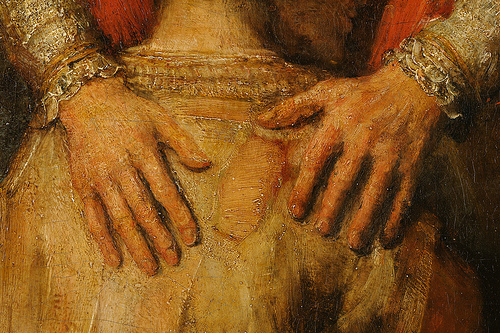
Rembrandt, “The Return of the Prodigal Son,” c. 1661
17 “But when he came to himself, he said, ‘How many of my father’s hired servants have more than enough bread, but I perish here with hunger! 18 I will arise and go to my father, and I will say to him, “Father, I have sinned against heaven and before you. 19 I am no longer worthy to be called your son. Treat me as one of your hired servants.”’ 20 And he arose and came to his father. But while he was still a long way off, his father saw him and felt compassion, and ran and embraced him and kissed him. 21 And the son said to him, ‘Father, I have sinned against heaven and before you. I am no longer worthy to be called your son.’ 22 But the father said to his servants, ‘Bring quickly the best robe, and put it on him, and put a ring on his hand, and shoes on his feet. 23 And bring the fattened calf and kill it, and let us eat and celebrate. 24 For this my son was dead, and is alive again; he was lost, and is found.’ And they began to celebrate.
Luke 15:17-24, ESV
Two hundred and eighty-nine words– these describe the life of every man, woman, and child who has ever lived. These 289 words reveal to us a God who loves far too much, way too easy. Perhaps we sort of expect that he will ‘appropriately’ punish his son– at least put him on probation at least. It only makes sense. But we find that is legalism talking.
“Every saint has a past, and every sinner has a future.”
Many of us have lived as prodigals, and we have spent our inheritance like ‘drunken sailors.’ We really have nothing at all to show for it. The prodigal, completely destitute, takes the only work he can find. (Imagine a good Jewish boy feeding hogs.)
He is so far gone that he starts inspecting the filthy slop buckets for something to eat.
Many of us will understand his despair. Often there comes to us a crystalline moment of simple awareness. The prodigal, sin-crusted and impoverished, still has a lingering memory of the Father’s house.
The servants there had far more than him right now. Sometimes I wonder if in our captivity, we instinctively want to go home, if only in our minds, to be a servant there.
The Father has dreamed of this precise moment.
The parable says, “He saw him–felt compassion–ran out to him–embraced him–and kissed him.” The Father is a whirlwind of agape love. I’ve read the Parable of the Prodigal Son a hundred times or more. It never loses its punch. I simply want to bring some observations:
We see that his father receives him with a tender gesture. His hands seem to suggest mothering and fathering at once; the left appears larger and more masculine, set on the son’s shoulder, while the right is softer and more receptive in gesture.
The son’s head is downy, almost like a newborn’s. We must enter the kingdom like little children.
The Prodigal Son seems to be protected by his father. He snuggles near the Father’s breast. It’s love that holds him there.
Consider his sandals. It has taken a long time for him to come home.
Standing at the right is the prodigal son’s older brother, who crosses his hands in stoic judgment; we read in the parable that he objects to the father’s compassion for his brother.
We see his mother in the background in the painting, and a seated steward or counselor. One stands in profound joy, the other in sits in stunned perplexity.
But Rembrandt had painted the Prodigal once before, when he was considerably younger. And it is a very good painting. The prodigal is happy and gay; there is absolutely no indication of the consequences of sin.
The Prodigal Son in the Brothel, 1635
He’s a charming young man at the height of his popularity, and we see him at a happy party. He is spending the inheritance of his father.
But Rembrandt chooses at the very end of his life to re-paint it to reflect reality.
This is one of the last paintings he will do, and it is the Prodigal Son–destitute and repenting. I can only imagine; the years have taken a toll and he doesn’t really feel his first painting is enough. He wants to paint what is true.
He now is painting our spiritual condition.
We are given a work that some critics call as the greatest painting ever completed. The painting is now in St. Petersburg, Russia. It is seldom seen by visitors. It is a clear echo of the grace of God for fallen men and women. Like the father in the painting, He’s ready to forgive every sin saturated son and daughter.
“Why have you made me your target?…Why do you hide your face?…Why should I struggle in vain?…Why does the Almighty not set times for judgment?…Why then did you bring me out of the womb?”
Job 7:20, 13:24, 9:29, 24:1, 10:18
Didn’t Job get “hammered?” His monumental suffering is unparalleled in history. He is essentially a godly man who loses everything (except his faith). Job must pick up the pieces after “catastrophic ” sudden pain and total loss.
Job is being tested with the ultimate horrors. Will he “curse God and die” as his wife suggests? Will he cave in to the final four (his friends) and agree to their twisted theology? (You have to read chapters 38-39 to find out).
The Book of Job has been regarded as inaccessible and archaic by many.
Unfortunately many believe this assessment and look elsewhere for comfort. I would agree that Job is a challenging book, but so is Macbeth or Plato. (I guess you should find an easier translation).
Job is less an explanation and more a revelation of suffering. “Why” questions go unanswered. “Who” questions matter. I suppose this seems unfair. It certainly seems so, but straight answers in a fallen world won’t get any mileage at all.
One more thing. The Book of Job is about “twisted” theology. Job’s friends “toe-the-party-line” of theology that is logical. But don’t be mislead by their pronouncements, for they seem reasonable but they are flawed. It is a doctrine without love.
“If I have the gift of prophecy and can fathom all mysteries and all knowledge, and if I have a faith that can move mountains, but do not have love, I am nothing.”
1 Cor. 13:2
You can’t split your theology from love and get away with it.
When you read “Job’s friends” you must remember that. These are lessons it takes a long time to learn.
The broken believer, hobbled by chronic illness, has much to learn from Job. He is like “the poster child” for those afflicted. My mental illness is an issue (of course) but God is fully in control. He brings beauty out of the ashes.
“To bestow on them a crown of beauty instead of ashes, the oil of joy instead of mourning, and a garment of praise instead of a spirit of despair. They will be called oaks of righteousness, a planting of the Lord for the display of his splendor.”
“A man without self-control is like a city broken into and left without walls.”
Proverbs 25:28
The writer of Proverbs can be blunt. He makes the cold observation that people can often be like a city that has no walls.
The city he alluded to was completely defenseless, vulnerable and wide open to a marauding enemy. It no longer is protected. It can be assaulted from outside and is no longer safe. It can be easily defeated by its foes.
The description is used to describe a spiritual condition of danger and defeat. A real potentiality exists of a helpless invasion by evil forces. It has no protection to speak of.
Proverbs uses this imagery to state a fundamental truth about some people.
We live in an age when everything is “open.” Seldom do we see protecting walls around the perimeter of our lives. We are open to the demonic forces of darkness. We move from crisis to crisis because we are not protected.
Nehemiah faced the stark reality of Jerusalem without walls of protection. His first order of business (before anything else) was to rebuild them. He mobilized work crews that immediately went to work restoring the cities safety.
“I went out by night by the Valley Gate to the Dragon Spring and to the Dung Gate, and I inspected the walls of Jerusalem that were broken down and its gates that had been destroyed by fire.”
Nehemiah 2:13
He knew what he was up against; a discouraged people who were extremely vulnerable. It’s also interesting that the cities enemies resisted at this crucial time. They wanted the people to fail so they would continue to defeat them.
Our culture today is no longer protected by the evil of the day. We’re victims for the most part by Satan’s tactical assaults. A generation has come and gone that has not known the defense of personal walls.
We are desperate of the ministry of Nehemiah. He is a type of Christ. Protection can only come from faith and blood of Jesus. He alone is our safe place. He alone can defend us from this present darkness.
If your life is characterized by oppression I urge you to erect a safe place for yourself and for your family. Being specific in prayer is very often your sheltered place. Take a stand and drive the enemy away. Resist him and he will flee from you.
“The world’s battlefields have been in the heart chiefly; more heroism has been displayed in the household and the closet, than on the most memorable battlefields in history.”










 Broken Believers