A Deep Crisis of Faith

faith-mental-illness

Church response to the mentally ill

By Peter Andres

Are people of faith with a mental illness different from those who have a physical illness? Much about mental illness still remains a mystery. That’s one of the reasons people are tempted to spiritualize the problem. They hope that the person with mental illness would be able to gain spiritual strength and thus gain victory over the illness.

What remains hard for many to understand is that having a mental illness and being a strong person of faith is no different than having a serious physical illness and being a strong person of faith.

How can church leaders encourage support of people with a mental illness? What does a person with a mental illness need to help him or her feel accepted and part of the congregation? How does the Christian message and experience take on meaning under these circumstances? What exactly is mental illness, anyway?

Marja Bergen, in her book, Riding the Roller Coaster (Northstone, 1999), describes her experiences living with bipolar disorder. She talks about the many important factors that helped make her life with this illness tolerable and manageable. Having a supportive husband, friends, and service systems were critical, but she also acknowledges the importance of a spiritual home.

Her church friends learned to understand her illness and provided spiritual nurture, especially during difficult times. She speaks about friendships which include a common belief as being the most valuable ones she’ll have. But she also admits that she was fortunate in this regard.

Sadly, many people with mental illness who look for spiritual help during difficult times face ignorance, stigma, avoidance, and judgment. The spiritual counsel and prayer these people receive frankly do more harm than good.

Understanding mental illness, even from the professional, scientific perspective, is still very much a work in progress. Schizophrenia and its related disorders, bipolar disorder (also known as manic depression), major depression, panic and obsessive-compulsive disorders, are all considered mental illnesses. It is estimated that between 15 percent to 20 percent of North Americans will, at some time in their lives, experience a mental illness. Most of these will suffer debilitating depression.

Evidence suggests there are probably organic (biochemical) reasons for the illness, or psycho-social origins — or a combination of the two. Treatments that deal with the symptoms include medications, psychotherapy or a blend of both.

What is clear to people working in the field is that the experience of the illness goes far beyond living with the symptoms. While a person who has a physical illness — even cancer — suffers discomfort and anxiety related to the illness, those who have a mental illness suffer from a constellation of additional issues. These all affect their ability to return to wellness. One of them is stigma, both internally and externally imposed. There’s also the loss of self-worth and self-efficacy that might come with a loss of job, friends, marriage and the feelings of being separated from God.

How can the church assist someone in a situation as devastating as this?

1. Church leaders and church members need to know that a mental illness is not the same as a spiritual crisis. Nor is the absence of healing, especially after fervent prayer, a sign of judgment or lack of faith.

2. There should be no judgment about the use of mood altering medications. Medications are commonly needed to treat the bio-chemical causes for the disorder and radically help many keep their symptoms under control.

3. Quality of life for a person suffering from mental illness does not depend on a complete remission from the illness.

What church members need to know is that many experience a recovery which allows them to return to an active and fulfilling life — but still continue to experience times that are difficult. Recovery from mental illness means: the return of a positive sense of self, usually through meaningful endeavour (work, vocation), a circle of meaningful relationships, a place to live that the person can call his or her own, and a spiritual life that feels a reconnection with God.

The recovering person can be experiencing personal brokenness and limitations, yet have valuable gifts to offer to the church community.

Peter Andres is a regional director for MCC Supportive Care Services, a non-profit charitable organization which supports people with disabilities — including people with mental health issues. He can be contacted at peter@mccscs.com.

 

Two O’ Clock in the Morning Poetry, #7

soren_kierkegaard_god_6322


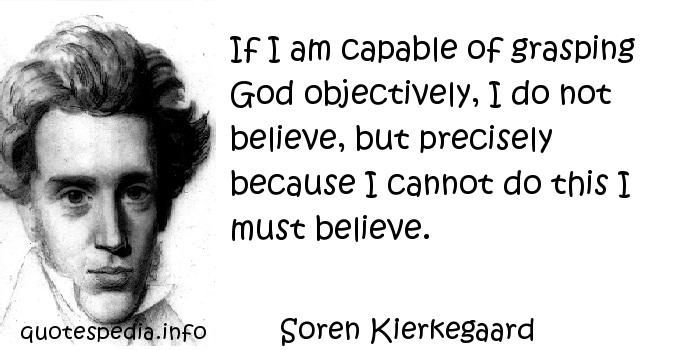
Søren Aabye Kierkegaard (/ˈsɔrən ˈkɪərkəɡɑrd/ or /ˈkɪərkəɡɔr/Danish: [ˈsɶːɐn ˈkiɐ̯ɡəɡɒːˀ] ( listen)) (5 May 1813 – 11 November 1855) was a Danish philosophertheologianpoetsocial critic, and religious author who is widely considered to be the first existentialist philosopher.[5] He wrote critical texts on organized religionChristendommoralityethicspsychology and philosophy of religion, displaying a fondness for metaphor, irony and parables. Much of his philosophical work deals with the issues of how one lives as a “single individual”, giving priority to concrete human reality over abstract thinking, and highlighting the importance of personal choice and commitment.[6] He was a fierce critic of idealist intellectuals and philosophers of his time, such as Swedenborg,[7] HegelGoetheFichteSchellingSchlegel, and Hans Christian Andersen.

Kierkegaard’s Insight into Creative People

“A poet is an unhappy being whose heart is torn by secret sufferings, but whose lips are so strangely formed that when the sighs and the cries escape them, they sound like beautiful music and then people crowd about the poet and say to him: “Sing for us soon again;” that is as much as to say, “May new sufferings torment your soul.”‘

For a person who gives out creatively means to sweat drops of blood; it is torment that teaches us new words. Pain comes surely as the morning sun rises. There maybe a hint of duplicity as the patron sees the pain– but demands his art, nevertheless.

Søren Kierkegaard

Some of Kierkegaard’s key ideas include the concept of Truth as Subjectivity, the knight of faith, the recollection and repetition dichotomyangst, the infinite qualitative distinction,faith as a passion, and the three stages on life’s way. Kierkegaard’s writings were written in Danish and were initially limited to Scandinavia, but by the turn of the 20th century, his writings were translated into major European languages, such as French and German. By the mid-20th century, his thought exerted a substantial influence on philosophy,[16]theology,[17] and Western culture.[18]

Soren-Kierkegaard-quote“Revelation is marked by mystery, eternal happiness by suffering, the certitude of faith by uncertainty, easiness by difficulty, truth by absurdity; if this is not maintained, then the esthetic and the religious merge in common confusion. … The religious lies in the dialectic of inwardness deepening and therefore, with regard to the conception of God, this means that he himself is moved, is changed. An action in the eternal transforms the individual’s existence.”

This was part of Kierkegaard’s theory of “indirect communication.” He wrote:

“No anonymous author can more slyly hide himself, and no maieutic can more carefully recede from a direct relation than God can. He is in the creation, everywhere in the creation, but he is not there directly, and only when the single individual turns inward into himself (consequently only in the inwardness of self-activity) does he become aware and capable of seeing God.” Concluding Unscientific Postscript, Hong 1992 p. 243

Despite everything people ought to have learned about my maieutic carefulness, in addition to proceeding slowly and continually letting it seem as if I knew nothing more, not the next thing — now on the occasion of my new upbuilding discourses they will probably bawl out that I do not know what comes next, that I know nothing about sociality. You fools! Yet on the other hand I owe it to myself to confess before God that in a certain sense there is some truth in it, only not as men understand it — namely, that when I have first presented one aspect sharply, then I affirm the other even more strongly. Now I have my theme of the next book. It will be called: Works of LoveJournals of Soren Kierkegaard VIII 1A4 ~~source, Wikipedia

Soren-Kierkegaard_Design-Crush

Two O’ Clock in the Morning Poetry, #3

Collector_Trench

Middle Parts of Fortune, by Frederic Manning

“The air was alive with the rush and flutter of wings; it was ripped by screaming shells, hissing like tons of molten metal plunging suddenly into water, there was the blast and concussion of their explosion, men smashed, obliterated in sudden eruptions of earth, rent and strewn in bloody fragments, shells that were like hell-cats humped and spitting, little sounds, unpleasantly close, lie the plucking of tense strings, and something tangling his feet, tearing at his trousers and puttees as he stumbled over it, and then a face suddenly, an inconceivably distorted face, which raved and sobbed at him as he fell with it into a shell-hole.”

(Accounts of The Great War) 
R
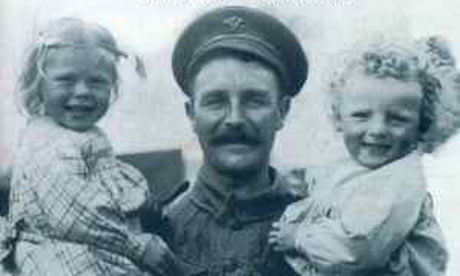
FredricmanningManning was an Australian aspiring intellectual, already in his mid-30s when he enlisted as a private soldier in 1915. His prewar existence in England was dogged by unfulfilled literary hopes and emotional confusions. He served for only a few months in France, and his military career ended in alcoholism and disgrace. But in 1929 he composed a novel, obviously autobiographical, about three soldiers’ experience of the trench nightmare, which is outstanding. Almost certainly the finest work of its kind to emerge from the war. (Penguin)
&

Manning continued to write. In 1917 he published a collection of poems under the title Ediola. This was a mixture of verse predominantly in his former style alongside war poems heavily influenced by the imagism of Pound, which deal introspectively with personal aims and ideals tempered in the crucible of battle. He contributed to anthologies, for example, The Monthly Chapbook which appeared in July 1919 edited by Harold Monro, containing twenty-three poems by writers including John Alford, Herbert ReadWalter De La MareOsbert SitwellSiegfried SassoonD. H. LawrenceEdith SitwellRobert NicholsRose Macaulay and W. H. Davies alongside Manning and Aldington. He wrote for periodicals, including The Criterion, which was produced by T. S. Eliot.

&&&

Poetry did not pay, and so in 1923 Manning took a commission from his publisher John Murray to write The Life of Sir William White, a biography of the man who, as Director of Naval Construction, led the build-up of the Royal Navy in the last years of the nineteenth century. Galton had died in 1921, which not only left Manning effectively homeless, but also lacking a forceful directing influence in his life. He lived for much of the time at the Bull Hotel in Bourne, apart from a short spell when he owned a farmhouse in Surrey. At this time he was friendly with T. E. Lawrence, then serving in the Royal Air Force at RAF Cranwell, some twenty miles (a motorcycle ride) from where Manning was living. In 1926 he contributed the introduction to an edition of Epicurus’s Morals: Collected and faithfully Englished by Walter Charleton, originally published in 1656, published in a limited edition by Peter Davies. — from Wikipedia and Penguin

&

Bonus–

wwi13
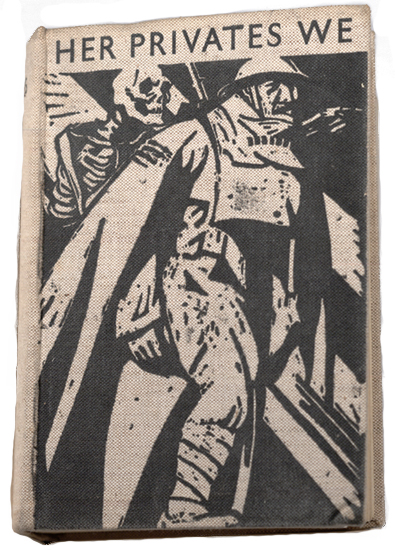
“Her Privates We” 1930, Cover art

Hell and Hope

inferno

Sometimes, I feel like a tour guide for believers that are walking through hell. I point out the different strugglers, and urge each one not to linger too long but to keep moving. We look on those trapped (they have no hope within them) but we hope that they are yet to reach out for the Savior. It is distressing, and yet somehow we understand them just a little bit.

Our journey out and down each sad corridor can be painfully disturbing for us. There are so many different types of prisons and chains used to confine and control. Dante wrote his “Inferno” (Italian, for hell), and somehow he in some curious way walks through the different levels (varieties) of hell with us. Virgil (Dante’s own tour guide) takes Dante through some pretty hairy stuff, and they pass through the very gate, which bears an inscription, of the infamous phrase “Lasciate ogne speranza, voi ch’intrate“, or “Abandon all hope, ye who enter here.”

Our own rescue from this dreadful place is based on that singular word, “hope”. Somehow, hope has distilled inside us, and that alone can enable us to walk out as the freed. We have chosen not to abandon hope, but to use it as our passport out of the bottom of hell itself. We show it to each guardian, and then pass through without any hinderance.

  • And so at last the poor have hope. (Job 5:16)
  • Having hope will give you courage. You will be protected and will rest in safety. (Job 11:18)
  • Lord, you know the hopes of the helpless. Surely you will hear their cries and comfort them. (Ps. 10:17)
  • All day long I put my hope in you. (Ps. 25:5)
  • Let your unfailing love surround us, Lord, for our hope is in you alone. (Ps. 33:22)
  • O Lord, you alone are my hope. (Ps. 71:5)
  • Your word is my source of hope. (Ps. 119:114)
  • “Listen to me, all who hope for deliverance— all who seek the Lord!” (Isa. 51:1)
  • And his name will be the hope of all the world.” (Matt. 12:21)
  • Even when there was no reason for hope, “Abraham kept hoping.” (Rom. 4:18)
  • We, too, wait with eager hope. (Rom. 8:23)
  • Rejoice in our confident hope. (Rom. 12:12)
  • The Scriptures give us hope and encouragement as we wait. (Rom. 15:4)
  • Three things will last forever—faith, hope, and love. (1 Cor. 13:13)
  • That you can understand the confident hope he has given us. (Eph. 1:18)
  • Our hope is in the living God, who is the Savior of all. (1 Tim. 4:10)
  • In order to make certain that what you hope for will come true. (Heb. 6:11)
  • This hope is a strong and trustworthy anchor for our souls. (Heb. 6:19)
  • Let us hold tightly without wavering to the hope we affirm. (Heb. 10:23)
  • They placed their hope in a better life after the resurrection. (Heb. 11:35)
  • You have placed your faith and hope in God. (1 Pet. 1:21)
  • If someone asks about your Christian hope. (1 Pet. 3:15)

I suppose we must say (it’s clear) that hope is what sets us free from the difficulty that rests in our minds. Whatever DSM-IV has branded us, whatever a psychiatrist has declared us to be, and whatever our therapist has told us– our hope, that’s in Christ, will open all doors that are closed and locked.

Hope really is the Christian’s freedom from hell. Those of us who have been freed from our incarceration from our mental illness are amazingly liberated. I know the lostness of being very much lost. But hope is everything. When our hope somehow connects with Jesus, our souls are set free. We walk out of hell, with our souls soaring clean.

kyrie elesion, Bryan

*