“For God knew his people in advance, and he chose them to become like his Son, so that his Son would be the firstborn among many brothers and sisters.”
Romans 8:29, NLT
“Just as we are now like the earthly man, we will someday be like the heavenly man.”
1 Corinthians 15:49
Much speculation has been made regarding these two ‘pinnacle’ verses. We must approach them humbly to see what they are all about. We must see for ourselves all that concerns us. “They will not hear the voice of a stranger,” (John 10:5).
The Father has decreed, “Christlikeness.’ This is a mandate from the One who loves us unconditionally. (There are no whips being used.) We really need to enter this holy process with a sure confidence of a solid love.
His face burns brighter when we are positioned appropriately in His glory.
It begins now. The heavenly Father’s exclusive purpose is to “bring many sons to glory” (Heb. 2:10).We do not have to wait until heaven to become like Jesus. We can accelerate the joy by starting today. And when He comes, He will ‘clean house,’ (so to speak). Holiness is mandatory to everyone who wishes to walk with Him.
You are one of the selected. Few have the options and opportunities that have been offered. To ‘put on’ Christlikeness is a rare privilege. From this point on, you will move through the confusion as one assured of his place and calling. He has ‘marked’ you, you are His. Everything will move aside in the light of His calling.
I so want you to ‘long for heaven.’ It is the place where we will dwell permanently. But at this point, the Father needs you to ‘hash it out’ on planet Earth. There is a need for volunteers who will come from ‘free will.’ After all, we get to choose Him who holds our destinies within; He alone carries our burdens and sins. He knows me thoroughly, yet loves me still.
You need to decide soon of your next step. But know this– Christlikeness will never be forced or coerced. Yet it is the ‘ride of a lifetime.’ Sheer boredom will probably ‘do-you-in’ if you choose to just ‘pray the prayer’ and walk away.
But you will never know the thrill of standing under God’s grace blasting full over your thirsty heart.
How do you handle pain as a believer? What do you do when you want to curl up in a ball and want to die? Understand that pain isn’t in God’s original plan. We who are hurt have got to be very much aware of this.
There are many different kinds of pain: post-surgical, chronic, and self-inflicted. The pain of separation or divorce or misguided children can get pretty destructive. There’s the pain of misunderstanding or something inflicted by a bad relationship with someone.
There are far too many possibilities and far too much hurt to go around.
At times you can’t even imagine how you’re going to handle another day. Sometimes the doctors have the arrogance to tell you that you need to get used to it because it’s never going to get better. So now you must sort things out–and apart from a miracle, it’s only going to get worse. I understand this. Truly.
Here are ten thoughts that come to my mind. They’re not in any order. (Maybe they should be? IDK.)
One
Treat false humility as a worse disease than you’re facing physically. You’ll be very tempted to milk your pain for all its worth. You’ll try to take advantage of others, and you’ll put yourself in the best possible light. But pain and ego were never meant to mix–especially as a disciple of Jesus. Renounce them now. Turn from it constantly.
Two
Never find fault with God. He’s not to blame whatever the evil one tells you. Our Father loves you deeply, and He will carry you all the way through this. Satan always tells lies. You must take a stand against him. Put on your armor! Super-glue Ephesians 6:19-18 into your thought life–and never let go!
Three
You can never lose track of a very real eternity. My special verse is Revelation 21:4, “And God shall wipe away all tears from their eyes; and there shall be no more death, neither sorrow, nor crying, neither shall there be any more pain: for the former things are passed away.” Please keep this front and center. It’ll help a lot!
Four
You’ll start to learn to see others differently. There’ll always be another who has it worse. Think about them, and all that they must deal with. It helps a lot. Also, you’ll discover that your pain will be like new glasses for a strange source of spiritual astigmatism. You’ll see things far more clearly now.
Five
Your walk will deepen. You’ll learn to be joyful when all you want to do is cry. The littlest things become a cause of great joy. God values your singing more now, especially when you’re singing out of excruciating pain. The Word, and worship music, all seem to be more meaningful. Surround yourself with music (and preaching too), anything that builds you up inside.
Six
You’ll discover the art of weaving your pain into your discipleship. Sleepless nights become diving boards for prayer, reading, and worship. You’ll change and deepen, and that’s always good. Also, be open to new ways of ministry. Look for doors to open up. (They may be different than you think.)
Seven
You’ll discover that there can be solace in medications and treatment. I know that this, but sometimes a handful of Motrin or other pain meds will be a real relief. Also, listen closely to your doctor and therapist. Pray for them, pray they’ll have special wisdom for your situation.
Eight
You start to see that you’ll never be able to do this alone. God is giving you a gift. He will give you insight. You’ll also start to see people less in terms of ‘rank’ and more in the light of what they’ve had to suffer. As you begin to see pain and sorrow as odd friends, they’ll often show you who your true brothers and sisters are.
Nine
You’ll understand the Father’s love in a new way. Like an old-style pharmacist who measured out powder instead of pills, we find God measures out exactly what we need. He never gives you a single grain of medicine more than is necessary. Trust him. All that happens to you has come through nail-pierced hands. He understands pain and He understands you.
Ten
You must learn to laugh again. Little things become a source of real joy. The smallest things will make you laugh. Get a joke book, that may help, especially when you get sour and withdrawn. “A cheerful disposition is good for your health; gloom and doom will leave you bone-tired” (Pro. 17:22, MSG).
(This list is not complete. I apologize, there are many others that really should be added, but maybe this is a start.)
Also–just one more (number 11 maybe?) Be easy on yourself. You’ll find that you’ve much to learn. And that’s okay. Just open up your heart, and look to Jesus.
We must be aware that our pain allows us access to His careful grace. Our trials, properly received, endow us with special abilities.
They’re now our new ‘superpowers.’ 😁
You should learn to embrace your pain and your sorrows, and not many can do this. Our own suffering comes to us at too high of a cost to us. They’re precious and way too valuable to neglect. Squeeze them and extract all that they can give.
Here’s a quote that has always sustained me. It’s really good for me to remember, and it may help you.
“Some Christians are called to endure a disproportionate amount of suffering. Such Christians are a spectacle of grace to the church, like flaming bushes unconsumed, and cause us to ask, like Moses: Why is this bush not burned up?'”
–John Newton
Exodus 3:2-3
A good site is Joni Eareckson Tada. She’s a believer who has suffered a great deal and has a ministry to the afflicted, Joniandfriends.org.
I have another site you might want to checkout: alaskabibleteacher.com.
It is a bad habit to try to teach without personal knowledge. We can preach, and yet we do not possess. This is one of the occupational hazards of those of us in our profession. It also seems to carry a horrible curse of spiritual sterility, that the wise believer can discern.
It’s been over 30 years since a diagnosis of severe clinical depression was made. I believe I was BP in my teens. Life is a roller-coaster for me, up and down, with a twist or two along the way. I am now fairly aware at 65 that much of my earthly existence has already been lived. Life can become such a grind. I’m tired and broken and ready for eternity.
But my scars have taught me so much. I understand, and I’m more aware of others. As a teacher, a pastor, it is a very good thing I believe. I also now have a profound desire to step into eternity. That will be a wonderful day. A moment of all moments. The ultimate moment.
“‘One should go to sleep as homesick passengers do, saying, “Perhaps in the morning we shall see the shore.”
–Henry Ward Beecher
Billy Bray was an illiterate Cornish evangelist in the 1850s. He was heard to pray this: “Lord, if any have to die this day, let it be me, for I am ready.” By faith, I think I do understand these sentiments. I am ready to go as well.
I love collecting good quotes. But here’s two more good ones:
“God buries His workmen but carries on His work.” -Charles Wesley
“If we really think that home is elsewhere and that this life is a “wandering to find a home,” why should we not look forward to the arrival?” – C.S. Lewis
Sorry if I’m being too maudlin. But the battle is so long, and it doesn’t ever let up, does it? We all can become weary after a while. What we need is to be ‘shut in’ with the Lord. The Word reminds us:
”Strengthening the souls of the disciples, encouraging them to continue in the faith, and saying that through many tribulations we must enter the kingdom of God”
Acts 14:22
“Tribulations” are common, and each must battle through them. And without being melodramatic, we each must walk through the blazing furnace. But I can also boldly attest that there is more than enough grace for each of us. We just need to become desperate enough. (Which shouldn’t be too hard).
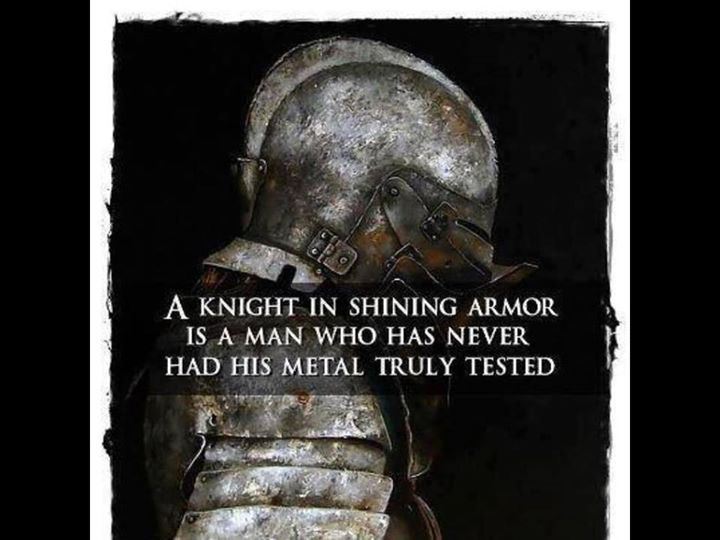
Armor is given. Wearing it means you’ll survive (and thrive) to see another day. Those who may suggest that the Christian life is a “bed of roses,” I would say that they haven’t read Ephesians 6. If there is no war, why would the Holy Spirit tell us to put it on?
“Finally, be strong in the Lord and in the strength of his might.11 Put on the whole armor of God, that you may be able to stand against the schemes of the devil.”
Ephesians 6:10-11
We are just starting to learn we must fall in love with Jesus. He receives us with a massive kind of love. And His mercy meets us at every doubtful corner. You have His Word on it. Simply ask Him to come to you.
I’ve put together a collection of quotes one of my favorite authors, Brennan Manning. I have found that when he writes, he penetrates. What he writes goes deep into the soul of losers: junkies, drunks, and mentally ill people–he tells us of God’s love like few have ever done.
To Manning, every person is redeemable, none are too far gone. Brennan Manning was a strong voice to the weak, the lame, the mentally challenged, and for the prodigal.
I blame him for the theme of this post–that brokenness is our path out of depression: Bipolar, Schizophrenia, OCD, PTSD, Schizoaffective disorder, and addictions.
*******
“There is a beautiful transparency to honest disciples who never wear a false face and do not pretend to be anything but who they are.”
“My deepest awareness of myself is that I am deeply loved by Jesus Christ and I have done nothing to earn it or deserve it.”
“To live by grace means to acknowledge my whole life story, the light side and the dark. In admitting my shadow side I learn who I am and what God’s grace means.”
“To be alive is to be broken; to be broken is to stand in need of grace.”
“Christianity doesn’t deny the reality of suffering and evil… Our hope… is not based on the idea that we are going to be free of pain and suffering. Rather, it is based on the conviction that we will triumph over suffering.”
“I am what I am in the sight of Jesus and nothing more. It is His approval that counts.”
“[Be] daring enough to be different, humble enough to make mistakes, wild enough to be burnt in the fire of love, real enough to make others see how phony [you] are.”
“The blood of the Lamb points to the truth of grace: what we cannot do for ourselves, God has done for us. On the cross, somehow, someway, Christ bore our sins, took our place, died for us. At the cross, Jesus unmasks the sinner not only as a beggar but as a criminal before God.”
“Do the truth quietly without display.”
“It is for the inconsistent, the unsteady disciples whose cheese is falling off their cracker.”
“The dominant characteristic of an authentic spiritual life is the gratitude that flows from trust—not only for all the gifts that I receive from God, but gratitude for all the suffering. Because in that purifying experience, suffering has often been the shortest path to intimacy with God.”
“The greatest single cause of atheism in the world today is Christians, who acknowledge Jesus with their lips and walk out the door and deny him with their life style. That is what an unbelieving world simply finds unbelievable.”
“The saved sinner is prostrate in adoration, lost in wonder and praise. He knows repentance is not what we do in order to earn forgiveness; it is what we do because we have been forgiven. It serves as an expression of gratitude rather than an effort to earn forgiveness.”
“In essence, there is only one thing God asks of us–that we be men and women of prayer, people who live close to God, people for whom God is everything and for whom God is enough. That is the root of peace.”
***********
I really hope some of these quotes have connected. Brennan Manning has authored several books all of which I can heartily recommend.








 Broken Believers