Recurring Depression and Fruitful Ministry

Charles Spurgeon, “The Prince of Expositors” 1834-1892

DOES RECURRING DEPRESSION PREVENT A FRUITFUL MINISTRY?

The ‘Depression-Prone’ Preacher

by Terry Powell

Long before the proliferation of mass media, he was known and revered throughout the Christian world. Scholars of his era labeled him, “the prince of expositors.” His commentaries, devotionals, and sermons are still being published, generations after his death.

So many folks in London wanted to hear him preach that he occasionally pleaded with church members to stay home so unsaved visitors could get a seat and hear the gospel. The pages of his book, Lectures to My Students, should be dog-eared by every vocational or volunteer teacher of Bible.

Yet, depression dogged Charles Haddon Spurgeon (1834-1892) most of his adult life. A major bout with despondency occurred in 1858 when he was 24, serving as a pastor in London. That’s when he wrote, “My spirits were sunken so low that I could weep by the hour like a child, and yet I know not what I wept for.” Repeated episodes spawned these words: “Causeless depression cannot be reasoned with…as well fight with the mist as with this shapeless, undefinable, yet all-beclouding hopelessness.”

What can we learn from this depression-prone, yet outrageously fruitful leader?

  1. Depression doesn’t necessarily hinder ministry effectiveness. He often didn’t feel like serving, yet enabled by God’s grace, he kept giving himself to others. No matter how physically and emotionally drained he was, most Mondays he wrote out by longhand the previous day’s sermon so it could later be published.
  2. The pain of despondency may expand one’s usefulness by cultivating dependency and humility. Spurgeon said that despondency was “my trial, my thorn in the flesh that Satan wanted to use to take me down, and God wanted to use to deepen my dependency on Him.” A favorite verse of his was 2 Corinthians 12:9, where God told Paul, “My grace is sufficient for you, for my power is made perfect in weakness.” In reference to this verse, Spurgeon said, “My job is not to supply the power, but the weakness. That’s one job I’m good at! It’s God’s job to supply the power.”

  3. Openness about one’s depression may encourage others, and point them to God’s sustaining grace. Spurgeon’s transparency concerning his depression was rare for his day. Knowing how many people suffered in silence with this malady, he preached a message to show others how he coped with it (titled “When a Preacher Is Downcast”). From experience he learned and taught an ironic truth captured in my favorite Spurgeon quote: “God gets from us most glory when we get from Him much grace.”

  4. His life and ministry demonstrate that depression and spiritual maturity aren’t mutually-exclusive. Depression didn’t negate Spurgeon’s godliness, nor did his steadfast use of spiritual disciplines cure it.

Biographies of and articles about Spurgeon don’t always mention his predilection for depression. Yet reading about his accomplishments and ministry output will show you what God can do through a yielded person not in spite of depression, but possibly because of it. Spurgeon also suffered from severe gout in his later years, long before medical intervention could eliminate or minimize the pain.

I benefited enormously from Arnold Dalimore’s Spurgeon (Banner of Truth, 1984). Also, in a chapter of John Piper’s Future Grace, titled “Faith in Future Grace Versus Despondency,” you can read about Spurgeon’s battle with depression. In 2014, Zack Eswine wrote a more thorough coverage of Spurgeon’s despondency: Spurgeon’s Sorrows: Realistic Hope for Those Who Suffer from Depression (Christian Focus Publishers)

Terry teaches in the areas of Church Ministry and Ministry Leadership at Columbia International University in South Carolina. He has served as a Christian Education staff member for three  churches, and he’s a licensed preacher in the Presbyterian Church of America.  His current books in print are Serve Strong:  Biblical Encouragement to Sustain God’s Servants, and  Now That’s Good A Question!  How To Lead Quality Bible Discussions. Terry has been married for 46 years, and has two sons, a daughter-in-law, one grandson, and a dachshund.  His constant prayer is, “Lord, make me half the man my dog thinks I am!”

Check out his blog at https://penetratingthedarkness.com/. His ministry is focused on Christians experiencing clinical  depression and other mental issues.


The Pruning Knife

“He cuts off every branch of mine that doesn’t produce fruit, and he prunes the branches that do bear fruit so they will produce even more.”

John 15:2, NLT

In order to become fruitful we must accept the knife. 

It takes a sharp eye and a sharper knife to do the Father’s work of cutting.  He slices to the quick, and all that is not useful falls to the ground.  The vine will produce grapes, and every bit of “grape-energy” will be used productively. Fruitlessness will be cursed, and sterility is condemned.  It takes a decisive heart, as well as a wise hand to prune God’s own vineyard.

Fruitless believers may become fruitful ones.  Understand, the vine dresser does not attack the vine.  He is not malicious or vengeful.  All that He does is for the good of the vine.  He is motivated to produce fruit.  That is what He thinks about; you could say that He is preoccupied with that singular end.

Pruning and fruit are concepts that we vacillate over, some days we understand and other days we blow it off.  After over 30 years, I’ve heard every “John 15 sermon”.  And most of the time I turn down my spiritual hearing aid. That is tragic, and shows my heart has become hardened.

I need to come on board with this particular imagery.  For years I have asked God to “show me His ways”.  I’d like to believe that this understanding of pruning has changed me.  I would like to think that I have attained a clearer view of wisdom.  This pruning business is all well and good.  But being sanctified by the knife is decidedly unattractive and uncomfortable.

You must be pruned; pieces of your life are earmarked to be lopped off.  (I always wonder if the trees that are spray painted are curious over the why and the when they are to be cut?)  In regards to being fruitful we must accept the knife.  If we want to be holy and conform to the image of Christ we will be cut.  There is simply no other way.

aabryscript


He Was at Home

3032

“A few days later, when Jesus came back to Capernaum, the news spread that he was at home.” 

Mark 2:1

You can’t hide the presence of Jesus.  There is a ‘built-in’ need for Him in the hearts of men and women.  You can’t keep it quiet, it is an open secret.  Believing people let it out in many ways.  You can see it in their faces, and hear it in their voices.  They become gentle and caring, where once was selfishness and anger.  Peace is present, and a wonderful new thing called joy.  They can’t help but share about their new guest, when they speak it spontaneously spills out.

Spring flowers can’t help their beautiful fragrance.  There is a fragrance that announces that He is present.  You might say that He takes over, just as a bright light takes over the darkness.  When Jesus is present, His brightness pushes through the cracks and shines out every window.  He cannot be contained or hidden.  Love itself is invisible.  But it has an effect on all who take it in.  The very presence of Jesus transforms us.

My heart is now His home.

People travel and gather great works of art.  They collect these things of beauty and culture.  They will go out of their way to search for paintings and statues of grace and elegance, and finding them they will spend a great deal of money to obtain them.  But no one or nothing can compare to having Christ as the honored guest. The poorest farmer can be the wealthiest man. No matter how quietly Jesus enters, His presence will soon make itself known.  Where Christ truly abides, nothing but good will be observed.

Then Christ will make his home in your hearts as you trust in him. Your roots will grow down into God’s love and keep you strong.”

Ephesians 3:17, NLT

bry-signat (1)cropped-bbbanner.jpg


How Things Grow, [Work]

plow1930s

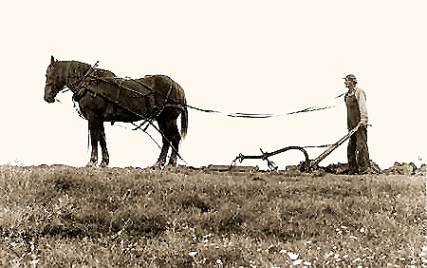
A farmer slowly walks behind his plow. The ground is hard and unyielding, but the steel cuts the heavy sod like a knife. He is preparing the soil for receiving the seed. He knows that what he is doing is imperative and he shouts out to encourage the horse. Its getting late and he wants to cut another furrow before night.

Plodding behind the plow he thinks many things. He can break up the ground, till and fertilize it, sow the seed— and then wait. He is powerless it get the seed to germinate and grow. He is limited to cultivating the soil and waiting. That is all he can really do, and he accepts this powerlessness. He can do everything right, and still not have a crop. All he can do is his part.

The farmer works in partnership with God. He is dependent on Him to grow the seed. The farmer must rely on the weather to meet and engage the planted seed. There are no shortcuts here. He does all he can, and then hopes that it is enough.

Farming is a joint endeavor between man and God. The man does what he has to do. God takes what the man has done and then finishes it. The crop will grow because He wills it. The farmer plays a part for sure, but ultimately God must become involved. Afterall, He makes the seed to sprout and grow.

We can say decisively that the pursuit of holiness in a Christian’s life is a joint endeavor between a believer and God.

Each have made the effort. The Christian does what is necessary, and then the seed is finally sown. It is then up to God to make the seed become the seedling. But each must work to finish the growth.

No one can attain holiness in their life apart from the work of preparation (it’s indeed work). The man must prepare the ground through plowing and cultivating. The farmer works the ground in order to make the ground ready. On the other hand, God provides both the environment and the growth needed to grow the seedling. Both the farmer and God must do their work.

A life of holiness is not automatic. It will never come at measured pace, trickling into our souls at a mechanized rate. (It would be nice if it would). Rather it wheat-field-landscape-picture_1920x1200_79595seems to come, in fits and spurts, sputtering rather than simply flowing.

Holiness is like a steamy Amazon jungle, vibrant and full of life. It is saturated with things living and green. It is not like an arid and sterile desert. Holiness is pulsating and powerful, full of lush growing things.

Becoming a person of holiness is the grandest adventure for the human soul. It defies our tendency to be rigid and legalistic. It is quite the opposite. It is tapping into life itself, and who is up to the task? Our morbid ideas of what holiness are not worthy of what really is.

Yes, to be holy is to work. Just as the farmer must prepare the soil for the seed, we too must guide our plows. God is ready to sow, and we should be ready to be ready. That is if we want to be fruitful and productive.

“Oh, the fullness, pleasure, sheer excitement of knowing God on earth!”

 Jim Elliot

bry-signat (1)

cropped-christiangraffiti1.jpg