Jesus is My Apple Tree

apple-tree

“Like the finest apple tree in the orchard
    is my lover among other young men.
I sit in his delightful shade
    and taste his delicious fruit.”

Song of Solomon 2:3, NLT

Jesus is my apple tree. He keeps my dying soul alive.

He is the subject of many different metaphors. We know Him as a shepherd, a door, and bread. There are many other ‘pictures’ in Scripture that speak of his ministry and life. There is one that strikes me today, that of Jesus Christ as a life-giving tree– an apple tree. Song of Solomon 2:3 and Revelation 22:1 are the ‘roots’ of this wondrous thought.

“On each side of the river grew a tree of life, bearing twelve crops of fruit, with a fresh crop each month. The leaves were used for medicine to heal the nations.”

Rev. 22:2

To think of Jesus as ‘the tree of life’ or an apple tree is both an honor to Him and a strength for us. We can swirl metaphors around all day and never exhaust their truths. Jesus, “the apple tree,” is seen imparting life and healing through His fruit. He is the source of everything good and grand in our lives. Eating His fruit is not only significant but encouraged. 

The young maiden in Song of Solomon has given us her take on Jesus– her shepherd, lover, and king. She sees him as the finest in the forest. He provides shade to her, as she eats the fruit of his branches.

Oh, what a worthy picture of Jesus our Savior.

We can look at this all day. As we come to Him we can see the One who is gifting each of us his blessings. We do well to consider him this way.  It honors Him.

There is a song, based on an anonymous poem, first appeared in a New England hymn collection by a New Hampshire preacher in 1784, so it has a history. Many people sing this as a Christmas carol, although there is nothing in the words that refer to Christmas. Go through each stanza. See if it fits you. Perhaps it will cause you to see Jesus in a new way.

Here is the poem in its entirety:

Jesus Christ, the Apple Tree

The tree of life my soul hath seen,
Laden with fruit and always green:
The tree of life my soul hath seen,
Laden with fruit and always green:
The trees of nature fruitless be
Compared with Christ the apple tree.

His beauty doth all things excel:
By faith I know, but ne’er can tell,
His beauty doth all things excel:
By faith I know, but ne’er can tell,
The glory which I now can see
In Jesus Christ the apple tree.

For happiness I long have sought,
And pleasure dearly I have bought:
For happiness I long have sought,
And pleasure dearly I have bought:
I missed of all; but now I see
‘Tis found in Christ the apple tree.

This fruit doth make my soul to thrive,
It keeps my dying faith alive;
This fruit doth make my soul to thrive,
It keeps my dying faith alive;
Which makes my soul in haste to be
With Jesus Christ the apple tree.

“Consider Jesus. Know Jesus. Learn what kind of Person it is you say you trust and love and worship. Soak in the shadow of Jesus. Saturate your soul with the ways of Jesus. Watch Him. Listen to Him. Stand in awe of Him. Let Him overwhelm you with the way He is.”   

John Piper


The Sterile Curse of Social Isolation

“Whoever isolates himself seeks his own desire; he breaks out against all sound judgment.”

Proverbs 18:1

Research reveals the reality of social isolation.  It seems more and more people are veering away from social contact. A Duke University study found that Americans are choosing to become more solitary than ever. Many are eschewing all relations all together.  This is a problem, socially and spiritually.

I’ve seen some of the statistics– fully 25% of people have no relationships at all, and something like 50% have no relationships outside of their spouse and children.  This disturbing trend is building momentum.  In 1985 the figure was just 15%.

I think that a lot of pressure may be coming from the internet, although Facebook and Twitter have reconfigured social connections. Longer work hours, the phone and streaming video, all contribute to the move away from human contact.

The commute time is also a factor.  For every 10 minutes stuck in traffic there is roughly a 10% drop in social relationships.  So if you have a bad commute on I-80 you are more likely not to want to have a friend over.

Hundred years ago our society was far more geared for personal contact.  People would regularly visit each other.  Neighbors knew each other.  There were parlor games and dinners.  Music recitations and skits.  Card parties. Television and radio had not yet grabbed the countries psyche.  Sociologists and anthropologists confirm that our history was deep in contact with each other.  We were not built for solitary living.

With community life disappearing people are turning to online relationships. Our churches are trying to adapt, as even Christians are not connecting like they should.  I have been out in the Alaskan bush villages, and the older generation is frustrated because the younger generation seems to be in trouble.  “They don’t pick berries, or hunt; all they do is sit in front of the TV playing Nintendo, or their laptops.”

We need fellowship with others, and God as well. There are very few solitary believers.

I guess the biggest issue of all is mental illness.  Social isolation is a direct part of depression and other disorders.  In order to get better, people must reach out and connect.  There is no substitute, no other option.

I see the shift in my own life. I am seeking to back off from being online 6-8 hours a day.  I am trying to be around flesh & blood as often as possible.  I am personally trying to consciously maximize that time.

It keeps me healthier.

To be healthier, we think its physical.  We have our gym memberships and we run on the treadmill.  That is good.  But I’m thinking we are losing out if we don’t workout socially (and spiritually) as well. Christians are  a special species; we need fellowship with others, and God as well. There are no solitary believers.

“A man who isolates himself seeks his own desire: To cut one’s self off from family, friends, and community is often to express a selfish desire. It shows an unwillingness to make the small (and sometimes large) sacrifices to get along with others.”

David Guzik, enduringword.com

“This is the message you have heard from the beginning: We should love one another.”

1 John 3:11, NLT

To Give Beyond Giving

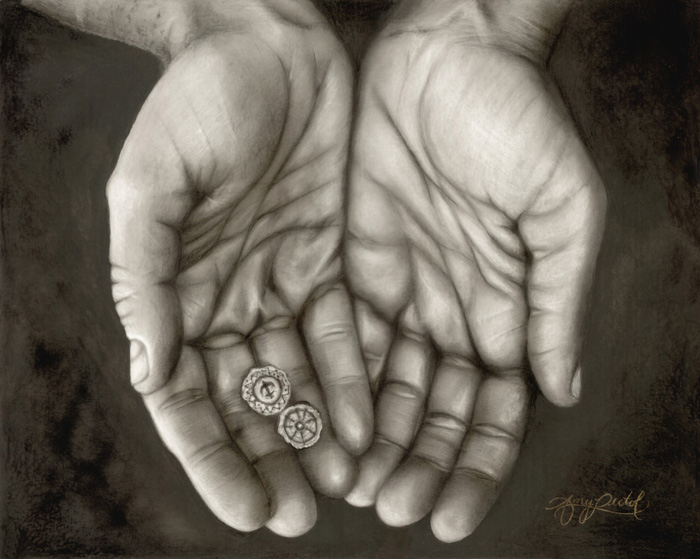
“Calling his followers to him, Jesus said, “I tell you the truth, this poor widow gave more than all those rich people.”

Mark 12:43, NCV

Heaven uses scales that earth knows nothing about.  Jesus calls out to His disciples, and they gather up close.  Life has a way of teaching us incredible things.  Circumstances usually make the best instructors.  These disciples did not need a didactic lecture.  They needed an authentic example of how of giving was processed through the economy of heaven.

The widow’s desperate poverty becomes the prime matrix of giving to the Father.  Her deposit was miniscule, hardly even enough for Jesus to even acknowledge.   Two pennies– laughable at best.  Many would give thousands more that day.  The widow gave everything she had.  The big ticket guys gave a very small precentage from their bank account.

The money box was a place of worship. 

Jesus acknowledged what this very poor widow did.  Some stood close to money box, and they would evaluate the giving of each one.  The text tells us that many came “with large sums of money.”  But Jesus declared the “widow’s mite” to be supreme.  Her pathetic gift was of a utmost value.

Upside down.  The view of heaven has turned everything on it’s head. 

Our first impression is almost always wrong.  This poor widow has been exalted to a place of example.  She now takes the spotlight as the model for us. Jesus makes her his Director of the Treasury for the KoG.  Two pathetic pennies!  And she becomes an astonishing pattern for us.


When Rags Became Grace

ebedmelech

“Ebedmelech from Ethiopia was an official at the palace, and he heard what they had done to me. So he went to speak with King Zedekiah, who was holding court at Benjamin Gate. Ebedmelech said, “Your Majesty, Jeremiah is a prophet, and those men were wrong to throw him into a well. And when Jerusalem runs out of food, Jeremiah will starve to death down there.” 10 Zedekiah answered, “Take thirty of my soldiers and pull Jeremiah out before he dies.”

11 Ebedmelech and the soldiers went to the palace and got some rags from the room under the treasury. He used ropes to lower them into the well. 1Then he said, “Put these rags under your arms so the ropes won’t hurt you.” After I did, 13the men pulled me out. And from then on, I was kept in the courtyard of the palace guard.

Jeremiah 38:8-13, CEV

At the very last, there was just one remaining.  A single man, Ebedmelech.  He was a Ethiopian; made a eunuch by the will of the king.  The situation in Jerusalem has gotten very difficult.  In an action of revenge and reprisal, certain men intend to kill the prophet Jeremiah.  They take a certain satisfaction in this, and Jeremiah is thrown into a very deep cistern.  They intend for him to starve to death, which is a terrible way to die.

The king in these last pathetic days is being manipulated by the surviving leadership of the city.  Zedekiah gives tacit approval for the destruction of Jeremiah.  He just lets it happen without a good reason.  The prophet is lowered in the muddy cistern.  Without food, he will soon starve.  In the minds of this evil mob, they have taken care of the any last vestiges of a godly ‘righteousness.’

But there is one, he is a wild card.  And no man would have guessed it.  Ebedmelech, the Ethiopian eunuch steps forward and decides to change history.  Not only his ethnicity, but his state as a castrated man are definite issues.  This mob never recognized him as someone who would intervene.  He was a non-entity, a non-factor. He was black, and a eunuch, and a nobody.

But Ebedmelech is intervening, in the face of terrible risk, he steps out boldly to make an intercession.  He doesn’t appear to be intimidated, and makes a cry for the truth.  He becomes an intense and strong advocate for the release of Jeremiah from the deep mud.

Ebedmelech is given the ‘green-light’ by king Zedekiah. Ebedmelech rounds up thirty men to assist him as he delivers the prophet.  Ropes are brought out, and out comes Ebedmelech with a big armload of rags.  They shout down to Jeremiah.  The instructions are called down to him of what needs to take place for the extraction.

It’s interesting, but the rags are the most interesting. 

They are really an extra touch, not a necessity.  The rags become essentially, a form of grace.  They would pad the ropes, providing a degree of comfort as the prophet is pulled up out of the mud.  Ebedmelech showed the heart of God in what he did.  There was his desire to somehow make the prophet comfortable.  In doing so he communicated a kindness and concern that was saturated with God’s own enveloping presence.

Our illnesses– physical or mental, have moved us to a lonely place on the edge. 

We are those on the so-called ‘margins.’ Ebedmelech has now become a carrier of God’s grace.  Jeremiah could have been lifted up by just the ropes.  It would’ve been more difficult, granted.  But the rags sent down by Ebedmelech provided the prophet an extra gentleness.  And I am certain it did not pass by without notice.  Their mention in this Book of Jeremiah is significant, and shows Jeremiah’s deep appreciation of kindness.

We can gather up much from what has been written.  We will sometimes find ourselves in parallel situations.  But our kindness and concern can make the difference.  Admittedly, they are quite insignificant–quite minor. Call it ‘icing on the cake.’ But when you show the kindness of our Father, you will infuse the situation with love, and grace.  

So be an  Ebedmelech,—  an outcast perhaps– but in a position of kindness.


bry-signat (1)

cropped-christiangraffiti1.jpg