Condemnation Can’t Stay [Guilt]

make-faucet-bucket-fountain-800x800

“Lord, I crawled across the barrenness to you with my empty cup uncertain in asking any small drop of refreshment. If only I had known you better I’d have come running with a bucket.”

-Nancy Spiegelberg

There can be no freedom from condemnation without submission to the saving life of Christ.  This is a definite and critical point.

Without a faith in Him, we are left with the option of carrying our own guilt.  This is a staggering possibility, and our lives turn to drinking and “drugging” and other things.  We must escape from all this pain and sin.  We are walking out condemnation, and the weight of this is immense.

Much of our life can be distilled from this viciousness.  We absorb it, adapt to it, thinking it will ease up some.  But it doesn’t, and it won’t.  We turn to all kinds of ‘pain absorbers’ looking to cope with this mindset.  There are escapes, and we try them all.  But ultimately we end up with one that is quite imperfect, and we ‘sort of’ become a little numb. Our hearts become numb and hard.

Condemnation twists us and who are in Christ. 

It deforms our spirit and destroys our confidence before our Father in Heaven.  His love is still being poured out, but we have placed a cover on our vessel.  We are blocking His mercy by our unwillingness to be forgiven.  All of our guilt seems a reasonable reaction to the heaviness of our sin.

Humans were not designed to handle guilt, and its “cousin” fear.  When we do try, we short-circuit.  Pain is always avoided, and that ends up corralling us into bondage.  From here, we can still mentally assent to the Bible; we can still have a sense of spirituality.  But it will always be filtered through our sense of condemnation.

Faith in the complete action of Jesus is enough.  Because I believe He carried the full weight of my sin, past—-present—future, I can walk out a free man.  Yes, sin does require justice, it is to be condemned.  But my faith, trust or confidence enables me to separate from the sin that would take me, straight to the bottom.

In this release, we are supposed to live. Freed from every condemnation. You must displace condemnation with grace.

We have the joy of the forgiven sinner, and that really makes no sense at all. 

It isn’t at all rational.  But it is legal, and it is binding.  And permanent.  There have been too many lies, for too long.  Grace is meant to be the most radical concept we have ever confronted.  And truly it is.

“Therefore there is now no condemnation for those who are in Christ Jesus.”

Romans 8:1

 

bry-signat (1)

cropped-christiangraffiti1.jpg

Present Tense Prodigals

prodigal-podcast-1

“So he returned home to his father. And while he was still a long way off, his father saw him coming. Filled with love and compassion, he ran to his son, embraced him, and kissed him. 21 His son said to him, ‘Father, I have sinned against both heaven and you, and I am no longer worthy of being called your son.

Luke 15:20-21, NLT

The Parable of the Prodigal Son has typically been taught as a ‘once upon a time’ event in the life of one wayward youth. We understand it to be such. The prodigal returns to his Father, case closed. It is a remarkable story that resonates to every broken believer.

But what if I told you that this parable is present tense. That we are continuously wandering, spending our inheritance and living off the wealth of our Father. We feel bad about this, we repent and return, only to embark on another foray into sin of our own choosing. It happens all the time.

My point is this. We seem to be always the prodigal. We never seem to outgrow this. We are constantly coming to our senses, and returning home. We seem to never get the point that our personal sin as eternal consequences. We live like there is no tomorrow, except we have to sober up and realize we have wandered far from our home.

The story of the prodigal is written to us who have repeatedly (that means very often) find themselves a good distance from where we should be. We find ourselves feeding the pigs again. We abhor our choices, and wonder again if our Father will take us back just one more time. Reason says ‘No!,’ but faith says ‘Yes!’

God’s love for us is greater than all our evil wanderings. It extends to the ups and downs of our vacillating discipleship. He sees it all and fully accepts us as His returning son. We will never tire out His constant love. We can feel ashamed of our recent behavior, but that changes nothing. We belong to Him, even if we feel wretched.

There are belivers who are overwhelmed by their sense of sin. Some of this is inflated by the devil. And yet they feel estranged from the Church. They know what they’ve done, and they can find no excuse for their actions. They’ve wandered again (for the 100th time).

The Father’s love is not subject to your obedience.

Grace is not some meager thing doled out in some stingy manner. It is given outrageously to each son or daughter without limits. Rascals are included. God is not a miser.

“But his father said to the servants, ‘Quick! Bring the finest robe in the house and put it on him. Get a ring for his finger and sandals for his feet. 23 And kill the calf we have been fattening. We must celebrate with a feast, 24 for this son of mine was dead and has now returned to life. He was lost, but now he is found.’ So the party began.

Luke 15:22-24

‘One, and your done’ doesn’t apply to your heavenly Father. His love for you can’t be reduced to this level. Pick yourself up, leave the pigs, and come home again.

bry-signat (1)

cropped-christiangraffiti1.jpg

The Ransom Note

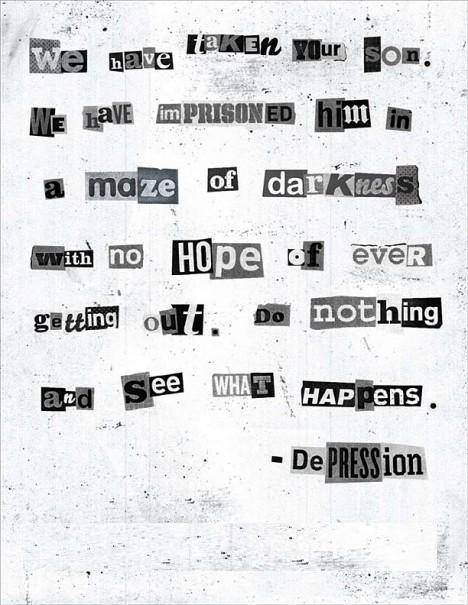
depression-note

“We collapse in the dust,
    lying face down in the dirt.
26 Rise up! Help us!
    Ransom us because of your unfailing love.”

Psalm 44:25-26, NLT

“For even the Son of Man came not to be served but to serve others and to give his life as a ransom for many.”

Mark 10:45

“God chose him as your ransom long before the world began, but he has now revealed him to you in these last days.”

1 Peter 1:20

I think that God has more or less ransacked the human language in His effort to get through to us the critical nature of what exactly has been done just for us. When it comes to our salvation and what that means to the universe, the word, “ransom” is used.

The connection for us, as we consider the implications, has mainly a connection with the crime of “kidnapping.” This is when someone is captured by other men, and held in captivity until certain terms are met. When the kidnapper feels his needs are fully met, then the hostage is released.

In the Bible sense, we should work through several verses. There are at least three Hebrew words. In the N.T. Greek just a single word to explain “ransom” is seen. And yet we can say, each word is linked back to the idea of being “helpless.” And helpless is far more than a definition, rather it is a description of a “state of being.”

We come to understand that helplessness is the natural state of human beings. We each have been captured, taken away and are being held, until terms are met for our release. I suppose that some see this helplessness easier than others. (And I’m sure a few will never acknowledge it at all). But nevertheless, it is real and it describes every single person that has ever lived.

Being completely helpless is hardly a situation we would ever choose. Having ransom demands being made to set us free is mostly awkward. And it’s an affront. Perhaps, we feel we are worth more? But the issues here are eternal, and currency concepts are never the consideration.

But there is a present need, to purchase back those who are being held as captives. The absolute clear position is that the Lord Jesus Christ, died in our place. Choosing to die for us, he was essentially tortured before his cruel death. In this decision, he himself paid my ransom. In doing this, I was set free and fully able to return home.

There are many who have been free. But there is a thing called “the Stockholm Syndrome.” This refers to those in captivity who somehow “connect” with their kidnappers through a prolonged captivity. This is to the point where they begin to act less than the victims, and more like the captor. It is confusing. They seem to go out of their way to act “pro-kidnapper”. This can get very disturbing.

We must look to our children, and closest family and our friends. They are toiling for Satan, the captor of our souls (past-tense). Many different tactics are being used– depression, addictions, lust, greed, anger, gluttony, pride, guilt and many other deceitful things. They are being held, until faith (the key) “springs” them out of their prison.

Thank you Jesus, for coming to free us. Thank you for forgiving us. We have been released, and now walk away free. You died, so we might live. We desperately want to see the others we love set free.

*

ybic, Bryan


cropped-christiangraffiti1 (3)

*