A Cross That Amuses Us

“If I see aright, the cross of popular evangelicalism is not the cross of the New Testament. It is, rather, a new bright ornament upon the bosom of a self-assured and carnal Christianity. The old cross slew men, the new cross entertains them. The old cross condemned; the new cross amuses. The old cross destroyed confidence in the flesh; the new cross encourages it.”

–AW Tozer

“Then Jesus said to his disciples, “If anyone wants to follow after me, let him deny himself, take up his cross, and follow me.”

Matthew 16:24, CSV

Take Up the Cross and Follow Him ] When He had called the people to Himself, with His disciples also, He said to them, “Whoever desires to come after Me, let him deny himself, and take up his cross, and follow Me.”

Mark 8:34

Meandering Intensely Through Grace

“For God knew his people in advance, and he chose them to become like his Son, so that his Son would be the firstborn among many brothers and sisters.”

Romans 8:29, NLT

“Just as we are now like the earthly man, we will someday be like the heavenly man.”

1 Corinthians 15:49

flourish20

Much speculation has been made regarding these two ‘pinnacle’ verses. We must approach them humbly to see what they are all about. We must see for ourselves all that concerns us. “They will not hear the voice of a stranger,” (John 10:5).

The Father has decreed, “Christlikeness.’ This is a mandate from the One who loves us unconditionally. (There are no whips being used.) We really need to enter this holy process with a sure confidence of a solid love.

His face burns brighter when we are positioned appropriately in His glory.

It begins now. The heavenly Father’s exclusive purpose is to “bring many sons to glory” (Heb. 2:10). We do not have to wait until heaven to become like Jesus. We can accelerate the joy by starting today. And when He comes, He will ‘clean house,’ (so to speak). Holiness is mandatory to everyone who wishes to walk with Him.

You are one of the selected. Few have the options and opportunities that have been offered. To ‘put on’ Christlikeness is a rare privilege. From this point on, you will move through the confusion as one assured of his place and calling. He has ‘marked’ you, you are His. Everything will move aside in the light of His calling.

I so want you to ‘long for heaven.’ It is the place where we will dwell permanently. But at this point, the Father needs you to ‘hash it out’ on planet Earth. There is a need for volunteers who will come from ‘free will.’ After all, we get to choose Him who holds our destinies within; He alone carries our burdens and sins. He knows me thoroughly, yet loves me still.

You need to decide soon of your next step. But know this– Christlikeness will never be forced or coerced. Yet it is the ‘ride of a lifetime.’ Sheer boredom will probably ‘do-you-in’ if you choose to just ‘pray the prayer’ and walk away.

But you will never know the thrill of standing under God’s grace blasting full over your thirsty heart.

cropped-christiangraffiti1-2

That Awful Wasteland of Alzheimer’s

alzheim

What is Alzheimer’s disease (AD)?

Alzheimer’s disease (AD) is an irreversible, progressive brain disease that slowly destroys memory and thinking skills and, eventually, the ability to carry out the simplest tasks of daily living. In most people with AD, symptoms first appear after age 60. AD is the most common cause of dementia among older people, but it is not a normal part of aging. Dementia refers to a decline in cognitive function that interferes with daily life and activities.

AD starts in a region of the brain that affects recent memory, then gradually spreads to other parts of the brain. Although treatment can slow the progression of AD and help manage its symptoms in some people, currently there is no cure for this devastating disease. AD is named after Dr. Alois Alzheimer, a German doctor. In 1906, Dr. Alzheimer described changes in the brain tissue of a woman who had died of an unusual mental illness. He found abnormal clumps (now called amyloid plaques) and tangled bundles of fibers (now called neurofibrillary tangles). alzheimers-brain
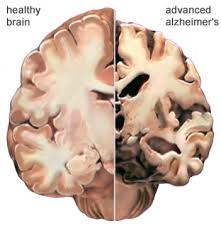
Today, these plaques and tangles in the brain are considered hallmarks of AD. The third main feature of AD is the gradual loss of connections between nerve cells (neurons) in the brain. This loss leads to diminished cell function and cell death. We don’t know what starts the AD process, but we do know that damage to the brain begins as many as 10 to 20 years before any obvious signs of forgetfulness appear. As nerve cells die throughout the brain, affected regions begin to shrink. By the final stage of AD, damage is widespread, and brain tissue has shrunk significantly.

How many Americans have AD?

According to recent estimates, as many as 2.4 million to 4.5 million Americans have AD. Unless the disease can be effectively treated or prevented, the number of people with AD will increase significantly if current population trends continue. That’s because the risk of AD increases with age, and the U.S. population is aging. The number of people age 65 and older is expected to grow from 39 million in 2008 to 72 million in 2030, and the number of people with AD doubles for every 5-year interval beyond age 65. In the years to come, AD is expected to pose physical and emotional challenges for more and more families and other caregivers, in addition to those with the disease. The growing number of people with AD and the costs associated with the disease also will put a heavy economic burden on society.

How long can a person live with AD?

AD is a slow disease that starts with mild memory problems and ends with severe brain damage. The time from diagnosis to death varies—as little as 3 or 4 years if the person is older than 80 when diagnosed to as long as 10 or more years if the person is younger. Other factors that affect how long a person will live with AD include the person’s sex, the presence of other health problems, and the severity of cognitive problems at diagnosis.

What is dementia?

Dementia is a general term that refers to a decline in cognitive function so extensive that it interferes with daily life and activities. This loss in the ability to think, remember, and reason is not a disease itself, but a group of symptoms that often accompanies a disease or condition. Many conditions and diseases cause dementia. Two of the most common causes of dementia in older people are AD and vascular dementia, which is caused by a series of strokes or changes in the brain’s blood supply. Other conditions that cause memory loss or dementia include:

•medication side effects

•chronic alcoholism

•certain tumors and infections in the brain

•blood clots in the brain

•vitamin B12 deficiency

•dehydration

•high fever

•some thyroid, kidney, or liver disorders

Many of these conditions are temporary and reversible, but they can be serious and should be treated by a doctor as soon as possible. Emotional problems, such as stress, anxiety, or depression, can make a person more forgetful and can be mistaken for dementia. Someone may feel sad, lonely, worried, or bored when facing retirement or coping with the death of a spouse, relative, or friend. Adapting to these changes leaves some people feeling confused or forgetful. Supportive friends and family or professional help from a doctor or counselor can help older adults adjust to big changes.

Source: National Institute of Aging, http://www.nia.nih.gov/

A Bit of Homespun

I’m Still Learning

I’ve learned — 1
that you cannot make someone love you.
All you can do is be someone who can be loved.
The rest is up to them.

I’ve learned — 2
that no matter how much I care,
some people just don’t care back.

I’ve learned — 3
that it takes years to build up trust,
and only seconds to destroy it.

I’ve learned — 4
that it’s not what you have in your life
but who you have in your life that counts.

I’ve learned — 5
that you can get by on charm
for about fifteen minutes.
After that, you’d better know something.

I’ve learned — 6
that you shouldn’t compare
yourself to the best others can do
but to the best you can do.

I’ve learned — 7
that it’s not what happens to people
that’s important. It’s what they do about it.

I’ve learned — 8
that you can do something in an instant
that will give you heartache for life.

I’ve learned — 9
that no matter how thin you slice it,
there are always two sides.

I’ve learned — 10
that it’s taking me a long time
to become the person I want to be.

flourishx

But Christ is the power of God and the wisdom of God to those people God has called—Jews and Greeks.”

1 Corinthians  1:24, NCV

I’m not sure who wrote this, I can’t remember even where or how I found this.   I’m obviously not the author. But it is an excellent piece of thought, I really hope it blesses you– making you see your life through some simple wisdom.

I do know that I have a Savior who is within me, living His life through me. Today, I choose to rest in His unfailing love for me.

bry-signat (1)

cropped-christiangraffiti1.jpg


