Judas Speaks

Matthew 27:3-10

My name is Judas Iscariot, and I betrayed my Lord. It really had nothing to do with avarice or greed. The money was fine, don’t get me wrong, but that isn’t why I turned Him in to the authorities. I simply did what they couldn’t. I wanted to force Jesus’ hand, so he had to drive the Romans out of our country. I was mistaken, I see that now.

Jesus loved each of us, including me. But I didn’t see it at the time.

When Jesus knelt to wash my feet, I was profoundly disturbed. And when He stripped down to his underwear, I really began to have serious doubts. Behaving like a common slave wasn’t really in my thinking. It would take extra work to shape Him, and to deaden such strange behavior. But it would be worth it in the end, if only Jesus would cooperate.

In my mind I knew that Jesus only needed the right moment to become the next ruler of Israel. That was His true destiny–and I was going to help him bring it to pass.

I knew that God had called me–this was my real purpose. I would do the work of God. I would be the kingmaker, and Jesus would certainly reward me.

Some have said that Satan was inside me.

But I hardly noticed. Instead, I was filled with excitement. Finally, the other disciples would come to my side, and together we could make it happen. Enough kneeling, no more groveling–we were going to rule Israel and end the wicked Roman occupation. I truly believed this. He was our Messiah, our deliverer.

The tricky part was to convince Jesus, to manipulate him if necessary, to get him to take control.

He had to see the opportunity that was waiting for him. He was already immensely popular among the people. We could quite easily turn all of this enthusiasm into a full-blown insurrection. But we obviously needed Him to lead us, and I could help him find His way. I knew we could do it. This was God’s will for me.

My plan was fairly simple–after I met with the Pharisees, I’d lead them to the garden where Jesus was staying. They insisted on an armed escort, just in case there was trouble among the disciples. I suppose that was prudent, but my part in all of this was simply to give Jesus a kiss on the cheek, to signify that he was the one to the soldiers.

I assumed he would resist and fight. I was wrong.

You see nothing went as planned. Jesus didn’t take charge, and he certainly didn’t overthrow the government. As a matter of fact, you could say that the opposite happened–He was silent and refused to answer most of their questions. I did hear Him say, “My kingdom is not of this world.” I should have listened.

I realized way too late, that I shed innocent blood. I went back to the priests who hired me, and I insisted they take back the silver. They refused. I threw the bag at their feet and left the temple. Ugly thoughts now filled my mind, and I knew without a doubt that I was completely lost.

A Believer in Pain

by Joni Eareckson Tada

My chronic pain makes my quadriplegia feel like a walk in the park.

People often ask how I manage my pain. Well, when its fangs sink deep into my hips and back, that’s my signal. I begin deep breathing, slow and steady. And when fiery pain threatens to overtake me—just as the flames threatened to consume Shadrach, Meshach, and Abednego in that fiery furnace found in the book of Daniel—I have a conversation with it.

I don’t say, “I can’t stand this; it’s killing me,” because words like that are fraught with anxiety. Fear only makes things worse. Instead, I calmly ask Jesus to meet me in my pain, to not let it crush me. And the Son of God never fails to meet me, just as he met those three Hebrews in that hot furnace of fire.

And what does Jesus say to me in that agonizing place of pain?

He comforts me with his own words. He will say something like, “Joni, my Spirit inspired 2 Corinthians 4:8 for a good reason. For although you are ‘hard pressed on every side,’ you will not be crushed.”

Oh, what a promise! Pain may tighten its vice grip, but it cannot crush me. As I cling to God’s promises, my pain pushes me further into Jesus’s heart. There is nothing sweeter than finding my Savior in the middle of my hellish circumstances. It helps deflect the pain and helps me to suffer well. Jesus helps me be in that unhappy place well.

All the years I’ve lived in my wheelchair, I never got delivered from pain. But I met my Deliverer in it. I didn’t get healed, but I found intimate fellowship with the Healer.

Friend, pain does not have to crush you.

As you courageously look at the stern countenance of pain and enter unafraid into its recesses, you will defang it of its terror. You’ll see that the Lord is in your pain, having transfigured it to become a place of union with him. Jesus conquered the insidious ways of pain and because of that, he is your best prescription for pain—whether it’s in your hip, your head, or your heart.

And remember, there is a glorious day coming when it says, “He will wipe every tear from their eyes. There will be no more death or mourning or crying or pain, for the old order of things has passed away.” (Revelation 21:4). Until then, when pain encroaches, start deep breathing and cling to a Bible promise. There are thousands to hold onto.

Perhaps my favorite is this one uttered by almighty God to you and me, promising, “I have made you and I will carry you; I will sustain you and I will rescue you” (Isaiah 46:4b).

And he will. He promised.

Joni Eareckson Tada

Straining at Your Oars

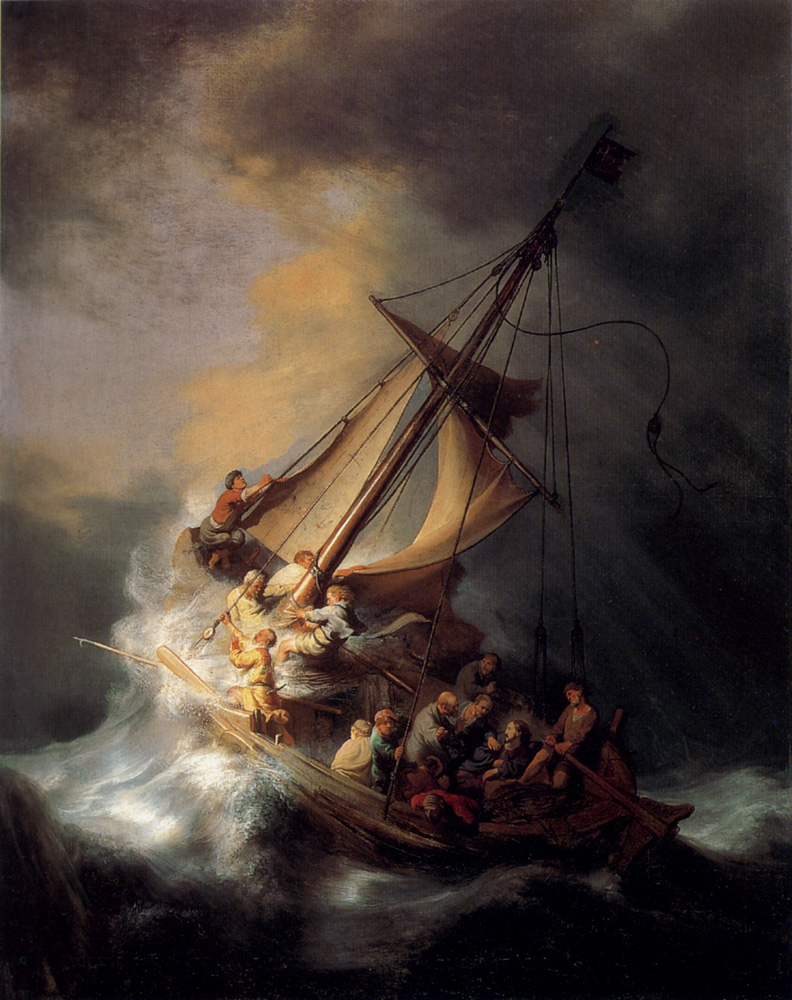
“He saw the disciples straining at the oars because the wind was against them.”

Mark 6:48

It’s good to know that Jesus sees our labor.  He truly understands all that concerns us, and he understands every issue that concerns us.  Attentive and keenly aware He comes to our boat.  It’s quite common for us to think that he isn’t aware, and we may feel that He’ll pass us by without a word.

Jesus watches over us all the time. 

He knows all about our battles, the fight we have with our flesh, the difficulty we have with the challenging people in our lives. I often struggle to steer my boat. Jesus knows when and why I labor like I do.  And He doesn’t condemn me.

The disciples were straining hard to keep the boat afloat. 

Every oar was being used and every man had his seat.  They must work together.  Some were frantically bailing, and a couple gripped the tiller. A lot of effort was being expended but nothing was working.  The wind continued to push harder against them. 

This is really quite perplexing.  If you remember, they’re simply trying to obey the command of Jesus to cross the sea. They were being obedient, and yet they were starting to sink.

Why do things have to be so difficult?

I’m intrigued by believers who expect sunshine, blue sky, and red roses just because they are doing God’s will.  They don’t seem to think through the issues of conflict and challenge, weakness and humility. That’s not how it’s suppose to work.

“It is necessary to go through many hardships to enter the kingdom of God.”

Acts 14:22

Doing the will of God will often mean that there will be a headwind directly at us.
 

The seas will become impossible, and we may even be driven back.  But special comfort comes when we realize we’re being watched.  Jesus is doing constant surveillance on us, and He sees our toil on the oars. And then He comes to us, walking on the water.

Even in our storm, our hearts should trust and rejoice.

“Lo, I am with you always, even to the end of the age”

Matthew 28:20

Under Quarantine

quarantine

Quarantines are a real possibility, even to this day. A quarantine is imposed when a disease is contagious enough that it would harm a society: Measles, Smallpox, and the recent COVID-19 are just a few physical diseases where isolation must be imposed.

It can be severe— an epidemic, with desperate consequences if not adhered to; in some rare cases, the use of deadly force has been authorized to maintain a quarantine until the disease is no longer communicable.

This may surprise you, but there are examples of ‘quarantines’ in the Bible.

The term ‘unclean’ was used for ‘leprosy.’ Those afflicted had to isolate themselves; they had to ‘announce’ their presence when in contact with society. Lepers lived in groups away from the general populace, as a result of their disease.

In Paul’s epistle to the Corinthians, he addresses another kind of ‘quarantine.’ The situation was dire; the church had advocated a Christian living with his father’s wife.

“I have already passed judgment on this man in the name of the Lord Jesus. You must call a meeting of the church. I will be present with you in spirit, and so will the power of our Lord Jesus. Then you must throw this man out and hand him over to Satan so that his sinful nature will be destroyed and he himself will be saved on the day the Lord returns.”

1 Corinthians 5:3-5, NLT

Understanding the Principle of Usefulness

Now in a large house, there are not only gold and silver vessels, but also vessels of wood and of earthenware, and some to honor and some to dishonor.”

2 Timothy 2:20, NASB

Found in God’s pantry are lots of pots and pans of various uses.  Paul writes Timothy about the ‘large house’ which is the Church inclusive. Look around Timothy, there are gold ones, and there are silver ones. They have a noble purpose fitting for such a great house. These are the ones the guests will use; they befit the significance of the Lord himself. These vessels have great value for they are made of precious metals.

There are vessels of different categories. These are the ones made of wood, and of clay. These are part of the household, make no mistake about it. But their use is one of function, they’re utilized in common and ignoble ways. (A clay ‘bed-pan’ perhaps?!)

21 “Therefore, if anyone cleanses himself from these things, he will be a vessel for honor, sanctified, useful to the Master, prepared for every good work.”

2 Timothy 2:21

Paul, the author of the New Testament doctrine of grace emphasizes the place of personal holiness. We are to ‘cleanse’ ourselves to become a vessel of honor. There is good news here:

  • All are vessels in the Father’s house. Each of us belongs to Him. He alone determines their use.
  • Things are not yet in their final state. Changes in status can be experienced. In God’s economy, clay pots can become ‘golden.’ Silver can become ‘wood.’

Some sin is contagious.

It affects believers, and the Church becomes compromised by what we’ve done. And then sometimes we are quarantined by the Holy Spirit–until the contagion passes. This spiritual disease must not be permitted.

I have experienced this several times in my own discipleship. These are not pleasant times, but there is no condemnation. I’m still His servant, His love for me stays outrageously constant. He has never turned away a sinning child who repents of their sin.

“Yes, I am His servant, but I must wait out in the hall. I haven’t been faithful. So I sit in His waiting room, waiting for His call. This is for my good. And my Father knows what is best.”