Have Courage

By Joni Eareckson Tada

 (818) 707-5664 | info@joniandfriends.org

After more than four decades of quadriplegia, I’m tired. My bones are weary from battling everything from pressure sores and pneumonia to stage III cancer. My question these days is never “Why, God?” It’s most often “How?” How do I keep on going? How do I care about others when I’m consumed with my own physical challenges? How can I be kind and civil when pain wracks me?

The other morning Ken could see the weariness in my eyes. Right before I wheeled out to go to the van, he said, “Wait here; I know exactly what you need.” He rushed back with a yellow post-it note. On it he had penned the letter ‘C’ with a felt-tipped marker. I gave him an odd look. “It stands for Courage,” he said, “the courage of Christ. I can see it in your eyes, Joni, and you can do this day. I know you can!” With that, he pressed the post-it on my shirt, right above my heart.

I can’t explain what happened next, but I could feel God’s encouragement. 

Ken only said a few words, but they were brimming with power and life. His was a declaration of the good he saw in me; or, at least the good he wanted to see. And God gave me his amazing grace to rise to the occasion.

Even the best of Christians can feel the weight of weariness. It’s why Hebrews 3:13 tells us to “Encourage one another daily.” Think of the people you’ll see today: friends recovering from surgery, neighbors dealing with grief, coworkers coping with pain. Whether you say it in an email, over the phone, or in person, your words have the capacity to change their countenance and character. And the best word? The Word made flesh, Jesus, who always has courageous words of life.

Oh, Father, I need the courage of Christ to face this day’s demands. Thank you for making me strong in him.

Joni Eareckson Tada, Founder of Joni and Friends, is an international advocate for people with disabilities. A diving accident in 1967 left Joni with permanent quadriplegia. After rehabilitation she emerged with new skills and fresh determination to help others in similar situations. She founded Joni and Friends in 1979 to minister to people living with disability. For over 40 years Joni and Friends has served thousands of families navigating disability, and has delivered over 225,000 wheelchairs and Bibles to individuals with disabilities in developing nations. Joni has survived breast cancer twice and lives with chronic pain and weakening lungs. By God’s grace Joni perseveres, keeping an active schedule, including radio recording, writing, and providing leadership and encouragement to the Joni and Friends staff. Joni and her husband Ken reside in Calabasas, California.

Should I Take Medication?

What’s Your Take on Christians Using Antidepressants?

by Pastor John Piper

I’m going to say that there are times when I think it is appropriate, but I want to go there cautiously and slowly, with warnings.

Depression is a very complex thing.

It’s got many layers. I think we all would agree that there are conditions in which nobody would deny that certain people are depressed in a pathological way because they’re immobile. They’re not even able to function.

And then there’s a continuum of discouragements and wrestlings with having an ‘Eeyore-type’ personality, which may or may not be depressed.

So that means that I want to be so careful not to have a knee-jerk reaction. When you come into my office and describe to me your discouragements, I don’t want my first response to be, “See a doctor and get a prescription.”

I fear that is way too quick today. The number of people on antidepressants as a first course rather than the last course is large.

And the assumption is that you can’t make any progress in counseling unless you get yourself stabilized or something.

So I just want to be very cautious.

As a Christian who believes that Christ is given by the Holy Spirit to deliver us from discouragements and from unbelief and sorrow and to help us live a life of usefulness, what makes me able to allow for antidepressants is the fact that medicine corresponds to physical realities.

And the physical realities are that we get headaches that make us almost unable to think. Migraine headaches can put a man out. And we are pretty much OK if the doctor can help us find some medicine that would not let us get these immobilizing headaches.

And the headaches clearly have a spiritual impact, because they’re making me unable to read my Bible and function in relation to people that I want to love and serve. And so medicine becomes spiritually effective in that way.

In the short run especially, sometimes long term—then I think, in God’s grace and mercy, we should take it as a gift from his hand.

If that physical dimension could be helped by medicine.


So we apply this principle that we all use to depression, and then the fact that the body is included in depression. Whether we should use the terms “chemical imbalances”—I’ve read both sides on that. Some people say that there is no scientific evidence for such a thing and others say that it is a given. Whatever. Everybody knows that there are physical dimensions to depression.

Losing Everything You Have

My own studies have immersed me in the awful book of Job. This man lost everything–there is much we can learn from him. But it may be a definite challenge to plow through these “dark” issues. But we need to do this, sooner or later.

First of all, Job is a mysterious book. There’s no reference to the Temple or the Temple services. No connection with other biblical writings or persons. Most students believe that the book of Job is the first one written in the Old Testament.

It’s not Jewish, but it’s not pagan either.

In a real sense, it speaks about suffering and pain. Job lost everything. And yet this book tries to explain what broken believers face every day. We all struggle. We all will experience some sort of suffering and loss.

Job connects us with those with illnesses–mental or physical.

We are people who must try to navigate through dark things. Most will never really understand this, but we are those who must face adversity and conflict. Like Job we start to ask why. We may even end up accusing God of attacking us.

We have to sort things out and believe me, it’s never easy. As we try we’ll often ask “why me?” We often accuse God. But I’m thoroughly convinced that the Almighty isn’t fazed by our questions and we should never think we’re wrong when we so challenge his goodness. He’s big enough to handle these.

In Job we’ll learn to hear God speak to us through “the whirlwind.”

I want to encourage you (the reader) to find place in your heart for this book. Job isn’t easy to read–but I’ve gained a lot by reading it in a modern translation, but anything works. Just pick it up and read. Chapters 1-3 are good.

We’ll realize all of our questions will probably not be answered, but that’s okay. The problem of our suffering will most likely remain. There are no pat answers. I’m sorry.

“Anyone who has suffered knows that there is no such thing as ‘getting a grip on oneself’ or ‘pulling oneself up by the bootstraps.’ The only bootstrap in the Christian life is the Cross, sometimes laying hold of the cross can be comforting, but other times it is like picking up a snake.””

Mike Mason

A Sound Mind

2-Timothy_1-7

“A sound mind.” For some of us that doesn’t seem remotely possible. We’ve come to believe this is only true for others, maybe, but not me. As mentally ill people we seem to think that we shouldn’t be this way. Given enough time our illness becomes fused to our spirit and soul. We buy the lie and choose to live defeated. Only the Lord Jesus can break this chain.

Healthy thinking is a wonderful gift. That’s important to note. I can’t earn it; nor can I fabricate it. It must be simply acknowledged and received as a bonus. We must come humbly and broken. I suppose that is where we become the happiest and healthiest.

In 1 Timothy 1:7 we’re told that we have a salvation that includes:

  • incredible power,
  • love,
  • and a sound (healthy) mind.

These three are a gift from God. You don’t buy a gift, nor do you earn it. Rather it comes from Someone who loves you (!) and only wants to restore you. We may have issues, but the Spirit is sound and lucid. He speaks so we understand.

Afflicted people will find what they need from the Holy Spirit of God. Mental illness isn’t a death sentence. Rather it’s a grand opportunity for God to teach us about His power in the middle of our pain.

The healthy mind is one that is clear and life-giving. It is without any sick or crippling deficiencies. It’s a mind that is vigorous and robust. Those of us who struggle with a mental illness this is fantastically good news. And it maybe that you’re certainly impaired but even then you’re given a strength to use in service in the body. Everyone has a gift and calling.

There is nothing worse than fighting through muddled thinking when you’re having mental issues. Names, dates and memories disappear in the fog. It can be frightening. I know what it’s like to be afraid of one’s own mind. It seems like it’s trying its best to kill me. (Some of you can ‘read-between-the-lines’ and understand exactly what I am saying.)

My own experience is that the Holy Spirit is working, with my meds, to hold me in a good place. Just as a diabetic must take insulin, so I need to take my antidepressants. The brain is an organ that can get sick also. We live in a fallen and broken world. We are human and therefore vulnerable just like anyone else. (Somehow, we imagine better.)

Grace does heal many, but there are some who will find ‘weakness’ becoming their real strength.

The very presence of the Holy Spirit is what enables. Broken believers are coming to see that their illnesses are helping them to be weak enough for God to use. It’s not how strong you are, but it’s how weak. “It is not that we think we are qualified to do anything on our own. Our qualification comes from God,” 2 Cor. 3:5, NLT.

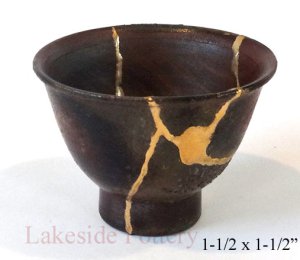
bizen-kintsukuroi-tea-cup-1 (1)

“When the Japanese mend broken objects, they aggrandize the damage by filling the cracks with gold [‘kintsukuroi’]. They believe that when something’s suffered damage and has a history it becomes more beautiful.”

–Barbara Bloom