A Hand of Kindness

His hand of kindness

I’ve no need to be reminded
Of all my failures and my sins
For I can write my own indictment
Of who I am and who I’ve been
I know that grace, by definition,
Is something I can never earn
But for all the things that I may have missed
There’s a lesson I believe that I have learned

There’s a hand of kindness
Holding me, holding me
There’s a hand of kindness
Holding me, holding onto me

–Bob Bennett, HAND OF KINDNESS
1996 Bright Avenue Songs (ASCAP)

It’s hard to forget the evil you’ve done–and forgiveness, well, dream on! I saw a video once of a parade of flagellants walking in unison, lashing themselves with whips, to somehow find peace, and some sort of atonement for their sins. I watched them, and suddenly the realization came–I was doing what they were doing, only not as public or visible.

Psychiatrists tell us that 90% of mental disorders are caused by guilt.

I believe that they’re probably a little conservative. I’ve been in some sort of ministry for 40 years now–I’ve pretty much heard it all. I ask myself and wonder, who can help the stumbling, broken, and captive hearts of men?

We’ll do anything to escape the guilt of our sin.

Sometimes an animal who’s been caught in a steel trap will actually chew their leg off to escape.

Sometimes a man will destroy himself in order to find forgiveness. Now I admit that our guilt isn’t always front and center, and seldom is it obvious–we’ve suppressed it, medicated it, and ignored it for so long, that it’s hidden and secret–even to us.

But it’s still there.

If the cross of Jesus hasn’t been applied–it’s still there, hidden and dormant. You can’t continue to paint over it, expecting to cover it with enough layers of denial. The booze and the drugs, the money and the red Ferrari, the quest for some measure of success just won’t cut it. There a 1000 ways to bury it, but your past will cripple your present, and destroy your future.

You must find forgiveness for what you’ve done, or not done!

The cross and blood are not optional. Jesus’ death and resurrection isn’t just a historical event. It’s himself–God’s lamb, offered up to forgive your sin–and your greatest evil. Those dark sins that you’ve hidden, that’s been buried so deep that even you’ve forgotten, sometimes it bursts out like a spiritual volcano, the pressure sort of builds up and then erupts. Suddenly it’s all real again–and it’s so brutal.

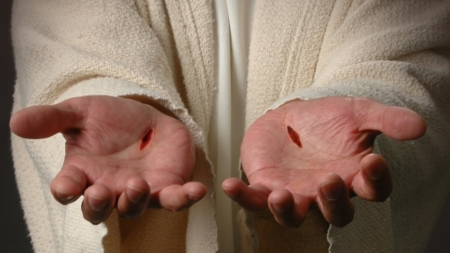
There’s a hand of kindness that’s reaching out to you at these moments.

You need to turn and believe him. No matter who you are, or how twisted and black your sin you think your sin is–maybe you’ve broken every commandment–a hundred times. I tell you, your sin has already been forgiven, your dark guilt lifted off your back. He has forgiven you. You are completely free.

Jesus died for you.

This isn’t a silly cliche. It’s not just a cute saying. All your guilt has been removed. You must believe this, it’s not an option any longer. You must know that his bloody death (he’s your sacrificial lamb) has God’s approval and removes your awful sin. His hand reaches out to you. But you must believe this. We must renounce our sin, give it up, and walk away from it. We must receive God’s gift of salvation.

If you don’t do this, you’ll die in your sins, and no one wants to see that.

If you want to think about this further, I strongly suggest you consider this–“God’s Forgiveness.”

My newest site is alaskabibleteacher.com.


The Smiles of God

sun-1443875842olr

“Heaven is where the unveiled glories of the Deity shall beat full upon us, and we forever sun ourselves in the smiles of God.”

Ezekiel Hopkins, “A Puritan Golden Treasury”


Jesus said to them, “The wedding guests cannot fast while the groom is with them, can they? As long as they have the groom with them, they cannot fast. (Mark 2:19)

This was Jesus’ idea.  He was bringing correction to the lives of those who were very serious, and especially those who felt the most religious.  Often, our native tendency is asceticism.  We evaluate ourselves religiously by our prayers and our fasts.

For serious people, we have a serious religion, and we focus on doing a serious religious activity, for that is what our serious faith demands.

Jesus pointed out that mournful faces are not indicators of a pious life.  How can His disciples mourn when Jesus the bridegroom is nearby? His disciples are going to a wedding, not a funeral!

Without question, the New Testament believers are to know repentance and self-examination.  We should grieve over our sins, but that grief is to be based on hope and joy.  Jesus changed everything.

If you are saddened by sin, that sadness must be tethered to joy and not to despair.  

The disciples could not mourn and fast while Jesus was present.   He does not wish His disciples to go mourning and fasting when they have no occasion for such exercises. His words are a defense of Christian joyfulness. Christ wants His friends to be glad. There is an utter incongruity in a sad and mournful Christian life.  It does not make sense in light of what Jesus has done.

Our sins have been forgiven–erased, cleansed, and washed away.  We have been dipped into the righteousness of the Son of God.  The fierce enemies of our souls have been eradicated by Jesus.  All of this is to bring out a song from a grateful heart.  We revel in the smile of Jesus and walk under the banner of beautiful love.  We have His forgiveness and have been given His favor.  We should be radiant!

 I pray that you will rejoice in this wonderful day He has made.


Setting Yourself on Fire

Difficulty and pain sometimes come from others, and challenges to the Lordship of Jesus often come from our unique circumstances.

But what if it was something we’ve done?

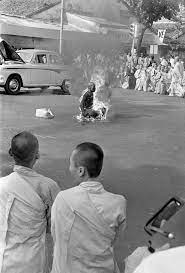
I remember the classic picture of a Buddhist monk who sat in the middle of a street. He was serene as he soaked himself with gasoline, and lit himself on fire as a protest against a war he believed was wrong and evil. He burned himself in front of the cameras.

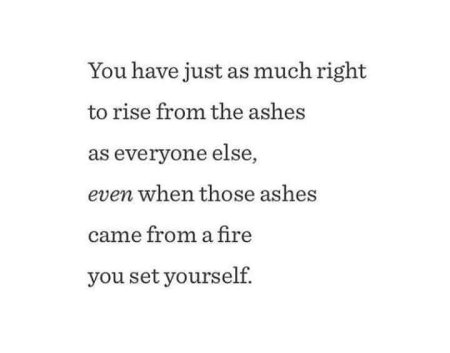
All too often we’re pretty much responsible for our own self-immolation. It is we (and we alone) that set ourselves ablaze. Sin affects our minds and hearts. We set ourselves on fire.

When we sin– when we walk in ‘known’ disobedience we always put ourselves in an awful place. We love it but learn to hate it too. But we continue to do it regardless of the awful death that ensues.

God promises to forgive us. Out of our ashes, He keeps bringing us life and hope.

You can be forgiven. You can find life again, even if you’re fully responsible for the evil we’ve done to yourself. Yes, we all sin, and yes we walk in our own personal rebellion. But Jesus knows it all. These awful things we’ve all done can be forgiven.

As a man and a preacher of the Gospel, I realize that I often choose to sin. In spite of all I know and teach I realize that I can live in the ashes of my own making. As one who also struggles with bipolar, I understand that I’m even more susceptible to doing awful things. I understand that I choose darkness even though others will call me “a man of God.”

As you read this I’m praying that you find His forgiveness and mercy. You’ve come a long way it seems, but you must see His blood that was ‘released’ from His veins and arteries for you.

He desperately loves you–even if you’ve set yourself on fire, and sit in the ashes of your doing.

“To appoint unto them that mourn in Zion, to give unto them beauty for ashes, the oil of joy for mourning, the garment of praise for the spirit of heaviness; that they might be called trees of righteousness, the planting of the Lord, that he might be glorified.

Isaiah 61:3

We Plead for Good Pastors

Within our personal issues of vulnerability, there are usually troubling problems. These are bruised and painful areas, things that result in terrible devastation in our lives and loved ones. Here are just a few of them:

  • alcoholism and drug abuse
  • mental illnesses
  • homosexuality
  • sex addictions, internet porn
  • physically disabled
  • chronic depression
  • suicidal thinking
  • religious deception, cults
  • on and on…

This isn’t a definitive list by no means. (Although each are substantial issues of pain and conflict.) But it’s strange, as defeated strugglers we often feel intimidated by leadership in the Church. We feel frustrated, and very much alone. This is a problem.

It seems all we can see is their authority, and we are afraid.  

Typically, in our fellowships, our pastors and elders are men.  And that alone can sometimes create issues in hearts looking for a tenderness that will heal. We need to make room for our sisters to help us out. (Just a thought.)

Often rather than opening our brokenness up to our shepherds, we fabricate illusions of self-sufficiency and invulnerability. But we are still afraid deep down, and our weaknesses effect us profoundly. We are afraid of disclosure. We fear that some will find out who we really are inside. It seems everyone is hiding something; especially us.

Because we’re strugglers filled with great deal of pain and confusion, we feel lost. And no one will help us.

We can easily label ourselves as “hopeless” and very lost.  Some of us secretly believe that they have committed the unpardonable sin. (But this is a lie, as God forgives every sin but one.)

Some have heard (or misheard) that they are going to hell no matter what they do, and that they are truly lost and irrevocably separated from God. They need to know this is a lie, because whenwe confess our sins, the blood of Jesus covers them ALL and cleanses us from ALL unrighteousness” (1 John 1:9).

Many of us who struggle have an ugly and a twisted sense of our leaders in the Church. We get really strange whenever we meet them– a sort of a deep change comes over us when we shake hands with them after the service. Deep inside we can be afraid of the ‘man of God,’ and think he is going to ‘see’ the sin and weaknesses in our lives, and shame us publicly (see Joshua 7).

Pastor, you should understand that some of us feel pretty much lost all the time, and afraid when we meet you.

Typically, we pretend or even avoid those who are sent to pastor us.  As a result of our flaws and weaknesses we want to separate ourselves from the Church. This reality is we feel like we don’t belong. We may feel like a hypocrite just coming to the service. We end up going out of duty or habit. That is a warning light of trouble.

Often we try to live a life insulated from any outside intervention.  We avoid people who could really help us.  We are terribly sick, and need a pastor or elder to help us work through these things. Certainly that there is often a need for scriptural correction, but always in love– and even then with some tears.

There is a spiritual war that encompasses us. The torrents of hell are released on us and we discover Satan working in various ways. Admitting you’re under attack is not weakness. (If you knew what you are really facing you’d be terrified.) But Jesus Christ stands to intervene for us. He stands and intercedes for our souls–all the time

We must pray for our pastors. Sometimes their title and gift is hard to carry. Their gifting is often limited by extraneous things, and yet Jesus, the Good Pastor comes alongside to help them. Pray hard for your pastor. Cover them and bless them.

flourish2

Continue reading “We Plead for Good Pastors”