Bedlam: Prisons and the Mentally Ill

Taking a Stand for Our Brothers and Sisters

 By Mark Earley, Christian Post Guest Columnist, Wed, Aug. 08, 2007
The least of these is my brother

In the 16th century, London’s mentally ill were often kept at Bethlem Royal Hospital. The conditions inside the hospital were notoriously poor. Patients were often chained to the floor and the noise was so great that Bethlem was more likely to drive a man crazy than to cure him. The conditions were so infamous that the nickname locals gave the hospital—Bedlam—has come to mean any scene of great confusion.

Unfortunately five hundred years later, we’re still treating the mentally ill more like prisoners than patients. Fifty years ago, more than 550 thousand people were institutionalized in public mental hospitals. Today, only between 60 and 70 thousand are, despite a two-thirds increase in the country’s population.

Since there’s no evidence that the incidence of mental illness has dropped precipitously, the mentally ill who previously had been institutionalized had to have gone somewhere. While some are being treated successfully in their communities, at homes and groups homes, but for many that “somewhere” is behind bars. This last part shouldn’t come as a surprise.

Five years ago, the Washington Post told the story of “Leon,” a one-time honor student, who had 17 years in and out of jail on various drug-related charges. It was only after several suicide attempts, including drinking a “bleach-and-Ajax cocktail,” that Leon was diagnosed with bipolar disorder. Leon’s story was a microcosm of a larger problem: “Prisons and jails are increasingly substituting as mental hospitals.”

As one advocate for the mentally ill told the Post, “a lot of people with mental illness are charged with minor crimes as a way to get them off the streets.” In effect, they are behind bars for “being sick.” Fast forward five years and little, if anything, has changed. A few weeks ago, another piece in the Post discussed the same problem.

Psychiatrist Marcia Kraft Goin told readers something that should shock and outrage them: “The Los Angeles County Jail houses the largest psychiatric population in the country.” As with the earlier Post piece, the conclusion was inescapable: “People with [untreated] mental illnesses often end up with symptoms and behaviors that result in jail time.” You don’t have to be a “bleeding heart” to understand that this is an injustice—any kind of heart will do.

Not only are the mentally ill not getting the help they need, they are as lambs to the slaughter in our crowded and violent prisons. They are being victimized twice over. They’re not the only ones being victimized.

At a time when most state prisons are unlawfully overcrowded, there are better uses for prison beds than as makeshift mental hospitals. As Goin wrote, “treating” mental illness as a criminal justice problem costs “more than treating patients appropriately in their community.”

As part of its ministry to prisoners and their families, Prison Fellowship supports community-based alternatives to incarceration. Not only because it makes “financial sense” but because it’s what Christ would have done. In Matthew 25 he called the ill and the prisoner his “brothers” and he expects us to offer them something more than bedlam.

“There but for the Grace of God go I…” –Bryan

 __________________________________

From BreakPoint®, August 6, 2007, Copyright 2007, Prison Fellowship Ministries. Reprinted with the permission of Prison Fellowship Ministries. All rights reserved.  “BreakPoint®” and “Prison Fellowship Ministries®” are registered trademarks of Prison Fellowship.

Good Links:

http://en.wikipedia.org/wiki/Bethlem_Royal_Hospital

http://www.bethlemheritage.org.uk/

http://www.pbs.org/wgbh/pages/frontline/shows/asylums/etc/faqs.html

http://www.afscme.org/publications/6042.cfm

On Being Tied to the Mast

 mast

“The heart is but a small vessel; and yet dragons and lions are there, and there poisonous creatures and all the treasures of wickedness; rough, uneven paths are there, and gaping chasms. There likewise is God, there are the angels, the heavenly cities and the treasures of grace; all things are there.”

~St. Macarius

 OK, I admit it.  I am fully capable and fully able to do just about any sin or deceit.   It’s my dubious claim to fame.  I can easily think of a 1000 things that I could do rather than serving God.  It seems my name is ‘Legion.’ To add to this, I have a chorus of support that wants me to give up my faith.  Demons are really plotting to destroy me, while all along my flesh insists on being fed with ‘fresh sin’.  (And I wonder why I’m getting gray hair.)

Within each of us is the potential and capability of doing great evil.  Each of us is contested ground, with eternal decisions hanging in the balance.

My mental illness does not give me “a get-out-of-jail-free card.”  I am just as responsible as anyone else when it comes to choosing good vs. evil.  Somehow I’d like to think that since I am deeply flawed because of my depression, it can actually make it somewhat easier to admit the truth. Maybe? (Perhaps that’s about the only edge I get.)

In Greek mythology there were three beautiful, but dangerous bird-women called “Sirens.”  With their music and voice they seduced sailors to shipwreck on the rocks.  It was said that there was few or any could resist them. Since they had to be neutralized somehow; some would plug their ears with beeswax, while others tied themselves to the mast.

The Bible has promised us the Holy Spirit.  The very presence of God has reached out His hand to hold me against the onslaught of evil forces. He truly does hold me in place, and His Word gives me the things I need to defend myself. Yes, the darkness can be very strong–but is no match to what God can do for me. We live in a very difficult age.

The intensity of seduction has increased. Tying yourself to something is probably a good idea.

“Keep yourself pure.”

1 Timothy 5:22

When the voices begin to lure you, you had best be ready with a plan.  The spiritual mast we have before us is the person of Jesus Christ.  Call on Him and then tether yourself to His mast (the cross.)  He has all power and all love for you.  You can resist the darkness, you can!

bry-signat (1)

cropped-christiangraffiti1.jpg

*

Why Are You Still Outside?

http://www.glogster.com

There are so many that are outside our walls.  Those who are blinded and confused by the Church and the gospel.

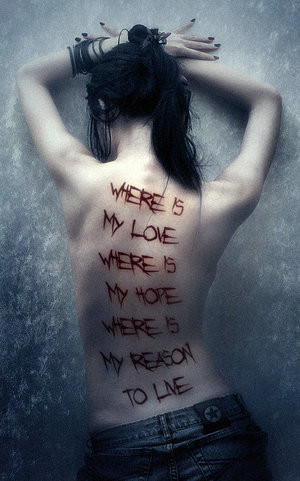
People are for the most part not this blatant or obvious in their pain.  But it is what they are asking that tunes us in. “Where?”

Humans have been created with a special spot inside them.  This place is designed by our Creator for his use only.  Life just doesn’t make sense unless he is the center.  Christians are just people who are trying to be fueled by God’s Spirit.

Answers abound to questions unasked.  Confusion is rampant and it seems no one can get a unified direction for his companions.  This is precisely why the Bible brings a piercing and clear call to the children of man.  Its promises are not dated, they are not obsolete.

They are many who have gone before us, thousands of generations who have found light and solace for darkened and wounded hearts.  They testify to us of the spiritual reality that can be found in God and in his Word.  We are not called to perfection, but a real obedience of faith and love.

At this throbbing moment in history, Jesus is calling so many to “follow”. 

He is populating eternity with beggars, the sick, the poor the addicted.  He loves “sinners”.  He loves the mentally ill.  The Bible tells us, “that he ever lives to make intercession for them”.

You have a purpose, and life does have clear meaning.  Don’t lose hope and don’t try to fill yourself with foolish and empty pursuits.  Come to Jesus, ask for forgiveness.  Find the people that will help solidify and confirm your decision.  Feel free to contact me about your decision to follow Jesus.

“Jesus told him, “I am the way, the truth, and the life. No one can come to the Father except through me.”

John 14:6


For more info on becoming a believer please contact 1-888-NEED-HIM.

12294678_10153401645779102_3023020617843023621_n


cropped-christiangraffiti1 (1)

OCD: Rituals and Obsession

“I couldn’t do anything without rituals. They invaded every aspect of my life. Counting really bogged me down. I would wash my hair three times as opposed to once because three was a good luck number and one wasn’t. It took me longer to read because I’d count the lines in a paragraph. When I set my alarm at night, I had to set it to a number that wouldn’t add up to a ’bad’ number.”

“I knew the rituals didn’t make sense, and I was deeply ashamed of them, but I couldn’t seem to overcome them until I had therapy.”

“Getting dressed in the morning was tough, because I had a routine, and if I didn’t follow the routine, I’d get anxious and would have to get dressed again. I always worried that if I didn’t do something, my parents were going to die. I’d have these terrible thoughts of harming my parents. That was completely irrational, but the thoughts triggered more anxiety and more senseless behavior. Because of the time I spent on rituals, I was unable to do a lot of things that were important to me.”

People with obsessive-compulsive disorder (OCD) have persistent, upsetting thoughts (obsessions) and use rituals (compulsions) to control the anxiety these thoughts produce. Most of the time, the rituals end up controlling them.

For example, if people are obsessed with germs or dirt, they may develop a compulsion to wash their hands over and over again. If they develop an obsession with intruders, they may lock and relock their doors many times before going to bed. Being afraid of social embarrassment may prompt people with OCD to comb their hair compulsively in front of a mirror-sometimes they get “caught” in the mirror and can’t move away from it. Performing such rituals is not pleasurable. At best, it produces temporary relief from the anxiety created by obsessive thoughts.

Other common rituals are a need to repeatedly check things, touch things (especially in a particular sequence), or count things. Some common obsessions include having frequent thoughts of violence and harming loved ones, persistently thinking about performing sexual acts the person dislikes, or having thoughts that are prohibited by religious beliefs. People with OCD may also be preoccupied with order and symmetry, have difficulty throwing things out (so they accumulate), or hoard unneeded items.

Healthy people also have rituals, such as checking to see if the stove is off several times before leaving the house. The difference is that people with OCD perform their rituals even though doing so interferes with daily life and they find the repetition distressing. Although most adults with OCD recognize that what they are doing is senseless, some adults and most children may not realize that their behavior is out of the ordinary.

OCD affects about 2.2 million American adults, and the problem can be accompanied by eating disorders, other anxiety disorders, or depression.  It strikes men and women in roughly equal numbers and usually appears in childhood, adolescence, or early adulthood. One-third of adults with OCD develop symptoms as children, and research indicates that OCD might run in families.

The course of the disease is quite varied. Symptoms may come and go, ease over time, or get worse. If OCD becomes severe, it can keep a person from working or carrying out normal responsibilities at home. People with OCD may try to help themselves by avoiding situations that trigger their obsessions, or they may use alcohol or drugs to calm themselves.

OCD usually responds well to treatment with certain medications and/or exposure-based psychotherapy, in which people face situations that cause fear or anxiety and become less sensitive (desensitized) to them.

Source: http://www.nimh.nih.gov/index.shtml

cropped-christiangraffiti1 (1)