More Voltage, Please!

Schnorr_von_Carolsfeld_Bibel_in_Bildern_1860_001

“Then Moses said to Aaron, “This is what the Lord was speaking about when he said,
    ‘I must be respected as holy
       by those who come near me;
    before all the people
       I must be given honor.’ “
So Aaron did not say anything about the death of his sons.”

Leviticus 10:3, NCV

We dare not become casual by our contact we have with the Lord.  Intimacy is obvious, but it must be done with certain precautions.  He asks for us to respond with a sense of holiness.  It is vitally important to Him, and it is vital for us.  We must honor Him as the One who is holy.

The closer we come, the more significant our response.  We are carefully monitored, to see what we will do after we confront the reality of Him.  He insists that we should honor Him as ‘holy’.  He passionately desires and requests that we do what is appropriate and honorable as we meet Him.

Giving Him honor is critical.  It should be the first thought of every man or woman who presses in to know Him.  Honoring Him as holy is not regarded as an option to be debated or brought out for consideration.  It is essential to follow Him faithfully.

We live with ‘lightning’, and a flamethrower, it seems.  He is a tiger who we have grabbed by the tail, we have but a few options.  One is too release our hold and let Him go.  The second is too hold on to Him with all our strength.  He loves those who make the second choice.  Grab hold of the Lord Jesus, and hang on for dear life!

“Who among us shall dwell with the devouring fire?
Who among us shall dwell with everlasting burnings?”

Isaiah 33:14, NKJV

He is dangerous, but in a good way.

We should anticipate Him coming and disrupting our Sunday services.  We need our ushers to hand-out ropes and life-jackets before the service starts.  We should expect Him to explode in our congregations, in a whirlwind of holy love.  He wants us to expect Him. We must be changed by the power of the Holy Spirit.

There is a sense here in Leviticus 10 of something that is needful and mandatory on our parts.  Often we will discover that entering and abiding in His presence requires us to honor His holiness.  When we do so, we find we will trigger a response from the Lord, which will it turn be a true blessing to our own souls.

The moment you come to realize that only a holy God can make a man godly, you are left with no option but to find God, and to know God, and to let God be God in and through you.   

Major Ian Thomas

bry-signat (1)

cropped-christiangraffiti1.jpg

Forgiven First

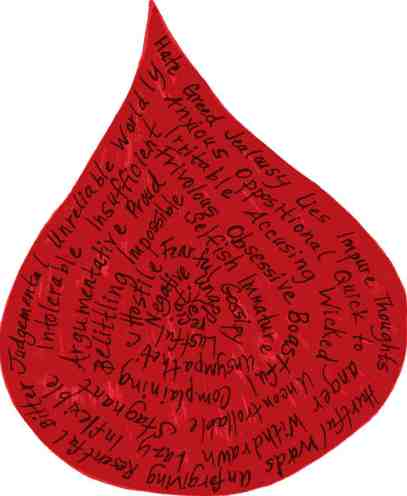
Forgiven-drop

This evening I got tired of the TV. Or maybe tired of the control it emits over me. I picked up one of the many Bibles I have in my loft. I do think it is ‘funny/sinister’ of the real pressure it takes to open its pages. I have no doubt it is the darkness of my flesh and the wickedness of demons. Melodramatic? I think not.

But this is what I read and thought.

“Jesus climbed into a boat and went back across the lake to his own town. Some people brought to him a paralyzed man on a mat. Seeing their faith, Jesus said to the paralyzed man,“Be encouraged, my child! Your sins are forgiven.”

Matthew 9:1-2, NLT

Jesus is mobile. He moves and goes where His Father goes. At this moment He is needed in Capernaum. He is to meet a small crowd– and a paralyzed man on a mat. Jesus travels, but this man can only be carried. So Jesus Christ the Son of God, comes to him.

The Lord’s eyes alertly move over these people. People are the reason He came. This crippled man has been waiting. Jesus looks, and all He sees is “faith.” And He knows that the Father has led Him here.

The Word says that He could see their faith. Funny. What does faith look like? It seems like that is the first thing He saw, and noted. I’m not sure about the man on the mat. Did he have faith? Or had it been ‘burned out of him’ by too many doctors, and too many ‘treatments’? It is good to surround yourself with others who will believe when you can’t.

Jesus finally spoke, and its worth noting His first utterance was to proclaim forgiveness. Not healing. Forgiveness! What did this man’s friends think? I see them feel tenative, and maybe a bit shocked about this. What evil did their friend commit? What had he hidden from them, the way we try to hide things from each other?

The healing is going to come. This man will stand. He will carry his mat and go home. (V. 6). But perhaps the paralysis wasn’t the main reason he was there.

Maybe, his biggest need was to be forgiven?

Man has two basic needs.

  • One, to be forgiven of awful sin. Washed and cleansed. Forgivemess.
  • Two, to become a good person. Kind and humble. Healing.

There will always be those looking on who will condemn and challenge what is taking place. For them, it has nothing at all to do with the hearts of people. That means nothing to them. Rather for these, it has to do with a rigid and lifeless religion– with its 613 laws, and tithing of dill and mint.

What do you really need? Forgiveness? Or something else? Psalm 103:3-4, are verses for the redeemed.

“He forgives all my sins
    and heals all my diseases.
He redeems me from death
    and crowns me with love and tender mercies.”

*

“God pardons like a mother, who kisses the offense into everlasting forgiveness.”  

Henry Ward Beecher

bry-signat (1)

cropped-christiangraffiti1.jpg

$

Pouring Oil on the Waves (Peace)

“Storm Warning”

“…And through him God reconciled everything to himself.  He made peace with everything in heaven and on earth by means of Christ’s blood on the cross.”

Colossians 1:20, NLT

Jesus has brought a complete peace into God’s world. Everything is now reconciled, taken care of by what Jesus has done. The precise word is “shalom.” It has within it the idea of ‘wholeness, or healthiness.’ It is in a general sense, being ‘made whole or complete.’ This present ‘sickness’ has become obsolete. That is our message.

There is no room really for any “peace” without completeness, it just isn’t possible. The “peace” that the Bible teaches is far more comprehensive, and total. The word in Hebrew, has a strong attachment to health, harmony and prosperity. It has the sense of being well, with the complete absence of turmoil or conflict.

“And he will be called:
Wonderful Counselor, Mighty God,
    Everlasting Father, Prince of Peace.
His government and its peace
    will never end.”

Isaiah 9:6-7, NLT

Peace is more than a snazzy marketing approach. At its basic sense it is what He fully intends for the “peoples of the earth.” But this all comes to us with a price. In Isaiah 53:5, (ESV)

“But he was pierced for our transgressions;
he was crushed for our iniquities;
upon him was the chastisement that brought us peace,
and with his wounds we are healed.”

The brutalization of Jesus had a purpose. He “brought us peace.” And we needed peace, desperately. But, oh, the cost!

In ancient times, sailors in a nasty tempest, would pray to their gods, and then pour oil on the waves. They believed the oil, poured out in barrels would settle the violent seas. (I suppose they figured the viscosity of the oil on the waves, would give them some time to manage their ship.)

Today, we know that it doesn’t work this way. Our storms however, are just as bitter, and challenging. Things get so tumultuous, and savagely extreme. But somehow, we want to pour God’s peace on our awful storm. Inherently we know that His peaceful presence can restore some sanity on our crazy lives.

Jesus is “the Prince of Peace.” We look right at Him when things get so ugly. He has come to do this. He is God’s solution to our sad conflict. He brings the oil, for our storm.

bry-signat (1)

cropped-christiangraffiti1.jpg

Tensile Prayer

“Please be assured that from the first day we heard of you, we haven’t stopped praying for you, we are simply asking God to give you wise minds and spirits attuned to his will, and so you can acquire a thorough understanding of the ways in which God works.”

“We concentrate on this, and pray that you’ll live well for the Master, making him proud of you as you work hard in his orchard. As you learn more and more how God works, you will learn how to do your work.”

“We pray that you’ll have the strength to stick it out over the ‘long haul”—not the grim strength of gritting your teeth but the “glory-strength”  God gives. It is strength that endures the unendurable, and then spills over into joy, thanking the Father who makes us strong enough to take part in everything bright and beautiful that he has for us. ”

–Amen.

This is a paraphrase that I made of Colossians 1:9-12, using the Message Bible.  This is one of those “scripture” prayers, often found in the Psalms, but also in the Epistles.  It does seem as Paul actually prayed as he wrote.  This prayer is indeed evidence of this.  It has the wonderful side effect of praying while doing something else, and what that might look like, especially when done discreetly and appropriately.

“Tensile” is a most interesting word, and concept.  It has the idea of being stretched without being torn apart.  A perfect word to describe intercessory prayer.

Do we really pray enough?  It isn’t a question of “volume”  but of quality, and precision.  When I am focused and begin to be directed to a certain person, or a very idea— I start to pray, focused and accurate.  But in the “quantity” aspect.  I do admit I often falter and fumble this.

The content of this man’s prayer was fabulous, and incredibly strong.  It does seem that it covers quite a few bases.  We can draw out so much.  And yet I keep coming back to the manner in which  Paul prayed.  I wonder if we could be taught to do the same?

Somehow we start praying in this same level. By faith we can weave that  tensile strength into hearts of those we love, and understand the hearts of our brothers, or sisters.

bry-signat (1)

cropped-christiangraffiti1.jpg