Freezing a Brother

 Bearing with one another and, if one has a complaint against another, forgiving each other; as the Lord has forgiven you, so you also must forgive.”

Colossians 3:13, ESV

Since this blog originates in Alaska, and since winter is upon us, this post seems fitting. It’s cold. And, well, I’ve been thinking about things that have happened to me recently.

We have a sinful tendency to “freeze” people that offend us.

We do it with our words, attitudes, actions. It is called unforgiveness, or stigma, or just plain contempt. It locks another person in a place were they will stay forever, and you won’t ever have to deal with them.

We glaciate others with extraordinary ease.

Someone offends me, or irritates me and I blast them. In my mind I solidify them into one spot, and there they are locked. Sealed away, and out of my thinking. I sometimes call it “discernment.” And then I can avoid those pesky urges to humble myself.

I have been frozen by others, and to be quite honest, I have been the ‘freezer’ as well.

The sad part is that we ourselves are so far from perfect. When we zap someone we will never, ever ‘receive’ from that person. We can even preclude them as outside of the grace of God. (And usually that’s what happens.)

“You offend me, and I will never forget it, and you will never be more than an evil miscreant to me.” My rationale is “life is too short for hassling with jerks like you.” But yet I can’t fully accept that idea. That is not God’s will for me, and I know it.

We end up debasing ourselves by our own unforgiveness.

We restrict others from the Holy Spirit’s transforming ability. In our mind’s eye, the wicked person will never be able to offer up anything of value. We freeze–locking them into a place. And a vast amount comes from an unforgiveness that is ‘fallen,’ and an unbelief in God’s grace and power.

Mr-Freeze-1Furthermore, any use of our ‘freeze gun’ freezes us as well. Unforgiveness turns on us (which we didn’t count on) and the effect is cumulative. We can only absorb so much an we get hard and cold.

One more thing. We do this to whole groups of people. The alcoholics, the mentally ill, other races. This can be called prejudice or stigma. Ask yourself this–have you ever been stigmatized or demonized?  You will usually know it. But we cannot afford to be controlled by our unforgiveness.

There is far too much at stake.

“And whenever you stand praying, if you have anything against anyone, forgive him and let it drop (leave it, let it go), in order that your Father Who is in heaven may also forgive you your [own] failings and shortcomings and let them drop.”

Mark 11:25, Amplified

*bry-signat (1)Related articles:

Can You Say No?

objection2 (1)

11 “For the grace of God has appeared that offers salvation to all people. 12 It teaches us to say “No” to ungodliness and worldly passions, and to live self-controlled, upright and godly lives in this present age.”

Titus 2:11-12

My life runs better when I learn to say “no.”

I can’t make it any simpler. We have become part of a culture that almost always says yes. To deny ourselves the fulfillment of our particular desires seems impossible– considering our track record. We pretty much seek out our particular pleasure, and then take our lumps and absorb all the consequences.

Things then, digress and “solidify” from this point. Deeply ingrained habits become almost impossible to break. We are now being held in a very certain bondage. And all because we can’t say “no”.

Quote23-300x74

Perhaps this will become a learning point, when we start to say “no” to our desires. We can’t let temptation have its way, we must stand and say “no!” It is no sin to be tempted, Jesus was tempted, and yet did not sin against His Father.

When we consistently say no and to deny ourselves, we’re actually starting to obey and it’s then we begin to follow Him. Your discipleship depends on this.

“If anyone would come after me, let him deny himself and take up his cross and follow me.”

Mark 8:34

The deep and earnest passion of our Father is that we learn to do this. To joyfully discover each morning  we are “will-doers.” But in order to do this we must also be “no-sayers.”

There is an unholy trinity that is working against us: the world, our flesh, and Satan. When our enemy tempts us, we must object. We must take a stand against his schemes.

Will you just say “no” to the enemy? Can you say “no?” These are questions that only you can answer.

1brobry-sig4 (2)

cropped-christiangraffiti1-3-1


A Savior of “Crazy People”

“For you are all children of the light and of the day; we don’t belong to darkness and night.”

1 Thess. 5:5

This is my personal testimony of the grace of God.

A year before I received Christ as my Savior, I was hospitalized in a U.S. Army psychiatric ward.  My uniform was replaced with the distinctive attire of a mental patient.  Ironically, I’d been attached to the same hospital working on the pediatric floor. 

And to make things only slightly more surreal was that a medic there on the psych ward was someone I bought drugs from!

Previous to this hospitalization, I had dropped two hits of LSD and found myself in an awful mess.  It was night out and I was hallucinating badly.  I had lost control of my thoughts.  I had pretty much flipped out and it entered my drug-saturated brain that the darkness would kill me, that very night!

Utterly convinced I was going to die, my mind seized upon the street lights outside. 

If I could stay in that illuminated circle I would escape dying. Somehow I knew that the light would save me. So I remained under that street light for several hours.  As I stood I could see very clearly the boundary between the light and the dark.  I knew I was safe as long as I didn’t wander, I knew I would stay safe.

But despite that very traumatic experience, the drugs and my mental instability continued to slide. 

I was now shooting up cocaine, crossing my “no needle rule.”  I also became quite the heavy drinker, with whiskey for breakfast.  I had one basic rule though.  As a medic who worked in maternal/child health, I had one of the best assignments in the Army.  Many people coveted it, and I was not going to endanger it with drugs or alcohol. 

I never went on duty loaded.  That was my rule. I would be the best medic the Army ever had.

Shortly after my psych ward discharge, I was reassigned to Labor & Delivery on the night shift.  One slow time I was pulled from my duty there to go on an ambulance run as the medic in charge.  We were called to the officer’s housing where an older man had died in bed. This got me thinking.  Back at the hospital, I returned to L&D.  But on the way back I took a shortcut through a ward on another floor.  That’s when I found it!

On a waiting room table was a small book called, “More Than a Carpenter” by Josh McDowell.  I picked it up, reading it right on duty because there was no one in the delivery room.  By the end of my shift, I was well on my way to becoming a Christian.  It was a book solidly speaking of the light, and of the dark.  And I knew beyond a doubt that I couldn’t remain in the dark anymore.

I was honorably discharged from the U.S. Army in June of 1982. 

I became a born-again believer shortly after that.  I went to Bible College that October.  Life has become radically different, and over time, I became a missionary, pastor, and Bible college instructor. 

I married my sweetheart and I now have a wonderful family. I attend a great and wonderful church faithfully.

I want to tell you that Jesus is real, He is alive and the Bible is true.  I have been lifted from the dark and I am not afraid anymore.  Jesus is my light.

“The people who sat in darkness
    have seen a great light.
And for those who lived in the land where death casts its shadow,
    a light has shined.”

Matthew 4:16

Some Very Good Links:

“How to be Saved,” gotquestions.com

Alaska Bible Institute, my Bible College, (a great school)

“More Than a Carpenter”, by Josh McDowell, (check it out on Amazon) 


Rembrandt’s Prodigal Son

Rembrandt-The_return_of_the_prodigal_son
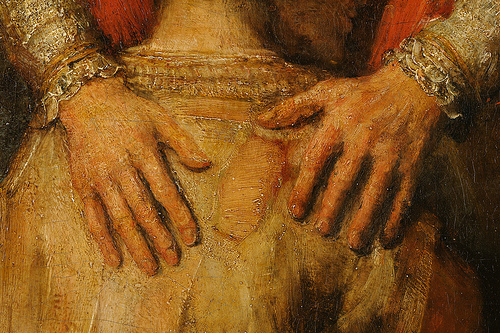
Rembrandt, “The Return of the Prodigal Son,” c. 1661

17 “But when he came to himself, he said, ‘How many of my father’s hired servants have more than enough bread, but I perish here with hunger! 18 I will arise and go to my father, and I will say to him, “Father, I have sinned against heaven and before you. 19 I am no longer worthy to be called your son. Treat me as one of your hired servants.”’ 20 And he arose and came to his father. But while he was still a long way off, his father saw him and felt compassion, and ran and embraced him and kissed him. 21 And the son said to him, ‘Father, I have sinned against heaven and before you. I am no longer worthy to be called your son.’ 22 But the father said to his servants, ‘Bring quickly the best robe, and put it on him, and put a ring on his hand, and shoes on his feet. 23 And bring the fattened calf and kill it, and let us eat and celebrate. 24 For this my son was dead, and is alive again; he was lost, and is found.’ And they began to celebrate.

Luke 15:17-24, ESV

Two hundred and eighty-nine words– these describe the life of every man, woman, and child who has ever lived. These 289 words reveal to us a God who loves far too much, way too easy. Perhaps we sort of expect that he will ‘appropriately’ punish his son– at least put him on probation at least. It only makes sense. But we find that is legalism talking.

“Every saint has a past, and every sinner has a future.” 

Many of us have lived as prodigals, and we have spent our inheritance like ‘drunken sailors.’ We really have nothing at all to show for it. The prodigal, completely destitute, takes the only work he can find. (Imagine a good Jewish boy feeding hogs.)

He is so far gone that he starts inspecting the filthy slop buckets for something to eat.

Many of us will understand his despair. Often there comes to us a crystalline moment of simple awareness. The prodigal, sin-crusted and impoverished, still has a lingering memory of the Father’s house.

The servants there had far more than him right now. Sometimes I wonder if in our captivity, we instinctively want to go home, if only in our minds, to be a servant there.

The Father has dreamed of this precise moment.

The parable says, “He saw him–felt compassion–ran out to him–embraced him–and kissed him.” The Father is a whirlwind of agape love. I’ve read the Parable of the Prodigal Son a hundred times or more. It never loses its punch. I simply want to bring some observations: 

  • We see that his father receives him with a tender gesture. His hands seem to suggest mothering and fathering at once; the left appears larger and more masculine, set on the son’s shoulder, while the right is softer and more receptive in gesture.
  • The son’s head is downy, almost like a newborn’s. We must enter the kingdom like little children. 
  • The Prodigal Son seems to be protected by his father. He snuggles near the Father’s breast. It’s love that holds him there.
  • Consider his sandals. It has taken a long time for him to come home. 
  • Standing at the right is the prodigal son’s older brother, who crosses his hands in stoic judgment; we read in the parable that he objects to the father’s compassion for his brother.
  • We see his mother in the background in the painting, and a seated steward or counselor. One stands in profound joy, the other in sits in stunned perplexity.

But Rembrandt had painted the Prodigal once before, when he was considerably younger. And it is a very good painting. The prodigal is happy and gay; there is absolutely no indication of the consequences of sin.

The Prodigal Son in the Brothel, 1635

He’s a charming young man at the height of his popularity, and we see him at a happy party. He is spending the inheritance of his father.

But Rembrandt chooses at the very end of his life to re-paint it to reflect reality.

This is one of the last paintings he will do, and it is the Prodigal Son–destitute and repenting. I can only imagine; the years have taken a toll and he doesn’t really feel his first painting is enough. He wants to paint what is true.

He now is painting our spiritual condition.

We are given a work that some critics call as the greatest painting ever completed. The painting is now in St. Petersburg, Russia. It is seldom seen by visitors. It is a clear echo of the grace of God for fallen men and women. Like the father in the painting, He’s ready to forgive every sin saturated son and daughter.

The Father’s Prodigal

bry-signat (1)