The Glory of Gripping Things

Acts 17:33 Artwork | Bible Art

I never had an opportunity to attend a seminary, and only have a three year diploma from a Bible Institute. But I’ve had to rely on the Holy Spirit in ways that a seminary trained pastor will never really understand. I’ve come to see the wisdom in the way God has led me.

“It is the glory of God to conceal things, but the glory of kings is to search things out.”

Proverbs 25:2

Concealing things and searching for things are contrasting actions. God hides things purposefully–they are sort of like a spiritual version of “Where’s Waldo.” Certain things are hidden, but always in plain sight.

Searching for things should definitely be our own response. The word used in Hebrew means to investigate, but with a planned purpose. It’s more than curiosity, rather it’s a passionate curiosity. And the Holy Spirit is always pleased with that.

In the New Testament book of Acts (17:11) we can see this attitude of the Bereans. They were the only ones in Scripture to be called “noble minded” for their serious study and thought. When they heard Paul’s teaching they sat down, opened their Bibles and began to investigate for themselves.

But it will always take humility. Always.

Intellect is important but it’s not enough. The list seen below is something to work through, and the issue is one that has been a challenge for me through 40+ years of following Jesus.

Here’s a study that I’m confident will bless you.

Justification & Sanctification– Gripping the Two
  •  Justification is free (John 4:1)
  • Sanctification is costly (Lk. 14:25-33)
  • Justification is instantaneous (Jn. 3:8)
  • Sanctification is a lifelong process (Jn. 8:31)
  • Justification is by faith (Eph. 2:8)
  • Sanctification is by faithfulness (1 Cor. 4:2)
  • Justification is not of works (Eph. 2:9)
  • Sanctification is of works (Eph. 2:10)
  • Justification involves Christ’s love for me (Jn. 3:16)
  • Sanctification involves my love for Christ (1 Jn. 4:19)
  • Justification concerns Christ’s righteousness (2 Cor. 5:21)
  • Sanctification concerns my righteousness (Lk. 14:25-33)
  • Justification involves my position in Christ (Col. 2:11-14)
  • Sanctification involves my practice (Col. 3:1-11)
  • Justification considers what God has done (1 Cor. 15:3-4)
  • Sanctification considers what I am doing (Lk. 14:25-33)
  • Justification is God’s commitment to me (1 Jn. 5:9-13)
  • Sanctification is my commitment to God (Jn. 14:15)
  • Justification requires obedience to one command: to believe the Gospel (Ac. 6:7)
  • Sanctification requires obedience to all of Christ’s commands (Matt. 28:19-20)
  • Justification focuses on the cross which Jesus took up once and for all (1 Cor. 1:18)
  • Sanctification focuses on the cross which I am to take up daily (Lk. 9:53)
  • Justification is finished at the moment of faith (Jn. 5:24)
  • Sanctification is not finished until I go to be with the Lord (1 Cor. 9:24-27)

Discerning between the two should only be a blessing. In some sense working through the differences between justification and sanctification should energize you, and bring truth to your walk. Now you might disagree, but let it be after you’ve worked through this list.

“I have more understanding than all my teachers, for your testimonies are my meditation.”

Psalm 119:99

The author of the above ‘list’ is unknown. May they be blessed by this if they should read this post.
 
 
cropped-christiangraffiti1 (3)
 

Comprehensive Protection

daniel3

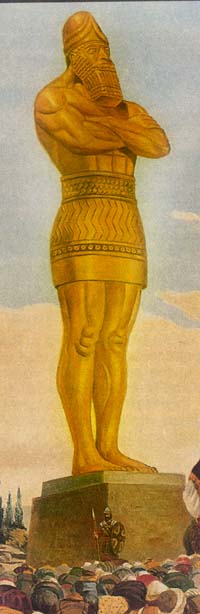
The Book of Daniel contains the acts and welfare of the Jewish people in Babylon. They are captives and so many of the stories shared here are accounts of spirituality under duress. King Nebuchadnezzar, in an attempt to unify his kingdom, proclaims himself to be a god. He commissions a 90-foot statue to be erected; he orders that, on a prearranged moment, all would fall down and worship.

Thgold statueere are three Jewish men: Shadrach, Meshach, and Abednego who are brought to the king with the charge of ‘failure to worship.’ They refused to bow at the statue at the signal. They were observed standing when everyone else was kneeling. Non-compliance to the king meant the death penalty, but that doesn’t deter the three.
Their faith will not allow them to sin in this way.

They are resolute. The first, second, and third commandments clearly forbid the worship of all idols. There were no other options. Perhaps they valued their souls more than they valued their lives. In some things, there can be no accommodation– no compromise. Standing before the king and threatened with death, they declare their allegiance to the living God.

Dan. 3:16-18:

 “Shadrach, Meshach, and Abednego answered and said to the king, “O Nebuchadnezzar, we have no need to answer you in this matter. 17 If this be so, our God whom we serve is able to deliver us from the burning fiery furnace, and he will deliver us out of your hand, O king. 18 But if not, be it known to you, O king, that we will not serve your gods or worship the golden image that you have set up.”

The king is enraged.

Few have ever spoken and defied him like this (and lived). He orders the furnace to be heated up like never before.  Here the king is making a statement. He will not tolerate this kind of ‘rebellion’ in his kingdom. All of his governing leaders will witness what he does to ‘traitors.’ These Hebrews must be made an example.

Then King Nebuchadnezzar was astonished and rose up in haste. He declared to his counselors, “Did we not cast three men bound into the fire?” They answered and said to the king, “True, O king.” 25 He answered and said, “But I see four men unbound, walking in the midst of the fire, and they are not hurt; and the appearance of the fourth is like a son of the gods”

(v.v. 24-25)

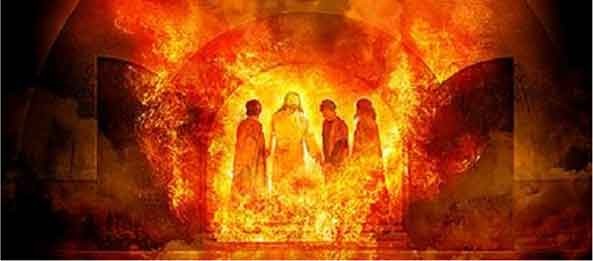
Shadrach, Meshach, and Abednego are thrown into the fire. The men who escorted them are killed by the heat. Ironically, Nebuchadnezzer can’t protect his own men from death while the three Jews are not touched, not even a little.

They are joined by a fourth man and they walk around in the midst of the flames.

Suddenly, Nebuchadnezzer realizes that the God of Israel is not only a real God, but a force to be reckoned with. The men’s faith has saved them. (And his men are dead.)

The complete story is quite compelling. The king orders all that the real God be worshipped. Henceforth, no one shall ever speak against this God. Shadrach, Meshach, and Abednego are promoted in the kingdom.

The lessons for today are many,

  1. God’s Word is to be obeyed no matter what it costs.

  2. When confronted, we must never hedge over our beliefs.

  3. God is present with us in our furnace, we’re never alone.

  4. In the fire, our faith will ultimately triumph. One way or another.

We may be standing in similar times. Faith will be tested. The Word must be believed and trusted. It is ‘comprehensive protection’ for our lives. Obedience to God will lead us into difficult places, but faith will triumph.

“When you have no helpers, see your helpers in God. When you have many helpers, see God in all your helpers. When you have nothing but God, see all in God. When you have everything, see God in everything. Under all conditions, stay thy heart only on the Lord.”

    Charles Spurgeon

Grabbing On to Psalm 27!

This is a perfect Psalm for broken believers–those who sometimes struggle to believe. We can understand because we each have encountered difficult things–hard things. So buckle up, here are my comments on Psalm 27. I really hope that they might help you through your personal mess.

I sometimes use the Message Bible:

Light, space, zest—
    that’s God!
So, with him on my side I’m fearless,
    afraid of no one and nothing.

When vandal hordes ride down
    ready to eat me alive,
Those bullies and toughs
    fall flat on their faces.

Man alive, we tolerate so much darkness. But the believer understands that God not only chooses him/her, but protects them. There is going to be difficulty, that much I understand. I can’t and won’t sugarcoat this. I’m not naive.

“Vandal hordes;” and “bullies and toughs” are motivated by darkness–Satan’s kingdom. The psalmist David sees trouble up ahead, he’s very real here and definitely not a ‘pie-in-the-sky’ optimist. But he’s very much convinced of their defeat.

When besieged,
    I’m calm as a baby.
When all hell breaks loose,
    I’m collected and cool.

I’m asking God for one thing,
    only one thing:
To live with him in his house
    my whole life long.
I’ll contemplate his beauty;
    I’ll study at his feet.

There’s a place of safety for David. He’s being blasted right and left by the enemy, but in that place, he finds “calmness.” He’s protected and you could say he wears spiritual body armor. Wearing that David discovers that he’s bullet-proof, for he wears a vest of spiritual steel.

The house of God is crucial, and he wants to live in it, to “contemplate” the wonder of the Spirit of God. David sees it as his castle that stands in resistance against all those who want to destroy him. And believe me, it is his complete focus.

He injects the word “study” which tells us that he’s found Someone that teaches him the things he needs.

That’s the only quiet, secure place
    in a noisy world,
The perfect getaway,
    far from the buzz of traffic.

God holds me head and shoulders
    above all who try to pull me down.
I’m headed for his place to offer anthems
    that will raise the roof!
Already I’m singing God-songs;
    I’m making music to God.

David is aware that the world is a noisy place (v. 5). But he knows that the very presence of God is a place of quiet and security, it’s “the perfect getaway,” that exists for everyone who believes.

Worship is critical here.

I think it not only exalts and glorifies God but it also is the best way of protecting himself. David is exuberant here, he can hardly contain himself! Perhaps we really don’t understand–it seems rather excessive–may be too zealous for us.

In v. 6 we see the spiritual effort of God holding David in place. He understands that there are many who are trying their best “to pull” him away from the security of God.

7-9 Listen, God, I’m calling at the top of my lungs:
    “Be good to me! Answer me!”
When my heart whispered, “Seek God,”
    my whole being replied,
“I’m seeking him!”
    Don’t hide from me now!

9-10 You’ve always been right there for me;
    don’t turn your back on me now.
Don’t throw me out, don’t abandon me;
    you’ve always kept the door open.
My father and mother walked out and left me,
    but God took me in.

Wow! “the top of my lungs” is pretty intense. The passage speaks of seeking–that’s the key of this whole thing. To be an authentic seeker has to be a “heart” issue, and never a brain thing. Heart followers certainly understand the difference.

Note that the presence of God is David’s entire focus. One of his petitions here is “don’t hide from me now.” As a New Testament guy, I know that it isn’t really possible. Jesus promised me He would dtay with me. See John 14:15-17.

If you’re struggling, like David did, you’re in good hands. Even though it seems like God is distant, He’s not. “God took me in” is a statement of real faith. David knows that the Father’s love is beyond the love of a father or mother.

And now the comes the finale!

11-12 Point me down your highway, God;
    direct me along a well-lighted street;
    show my enemies whose side you’re on.
Don’t throw me to the dogs,
    those liars who are out to get me,
    filling the air with their threats.

13-14 I’m sure now I’ll see God’s goodness
    in the exuberant earth.
Stay with God!
    Take heart. Don’t quit.
I’ll say it again:
    Stay with God.

“Point me” and “direct me” is David’s discipleship to his Father’s ways. He speaks of enemies (“dogs” and “liars”) who are trying very hard to destroy him. “Out to get me” is David’s assessment of the hard things that come.

David is convinced that God is always very good to him, he understands this. It’s the same for the NT believer, although Satan nips at our heels, God protects us–He’s on our side.

He exhorts us twice to “stay with God.”

Maybe that’s where a lot of issues come. “Don’t quit” is David’s plea. This is stated throughout Paul’s epistles written for us.

What a wonderful Psalm. So much security here (as well as the opposition). Psalm 27 is written to us rascals and inconsistent believers in Jesus. I exhort you to spiritually digest this passage. It’s yours!

Illustration: Solomon’s Temple. I’m using “The Message,” a translation by Eugene Peterson.

My Enemy is at the Door

strongtower2

“And he said, “Listen, all Judah and inhabitants of Jerusalem and King Jehoshaphat: Thus says the Lord to you, ‘Do not be afraid and do not be dismayed at this great horde, for the battle is not yours but God’s.”

2 Chronicles 20:15, ESV

flourish10

We certainly don’t face a human army, yet the spiritual battle is just as consuming. Satan and his hordes are working 24/7 to capture our hearts and minds. He wants to enslave our spirits, and to assimilate us into his rebellion against God. For the broken believer, we know where we are weakest. Satanic influence can be fierce. However we are not alone.

Jehoshaphat’s own situation was precarious. Vastly out numbered, his own troops were about to be slaughtered and Jerusalem captured. Jehoshaphat responds by praying. He acknowledges God, and asks for divine help. We find him desperate, and that is how humility grows.

‘Do not be afraid and do not be dismayed at this great horde, for the battle is not yours but God’s.”

When God intervenes, we can only watch (and trust) His deliverance. King Jehoshaphat arranged for his army to be led by singers. There is a confidence here. Praise and worship is the way the enemy is defeated. “The battle belongs to God.” A great victory is won.

Make God your general. Infuse the atmosphere with prayer and praise. Impossible things are about to happen. Victory can be yours if you can only ‘get out of the way.’ This is the wisest and the safest course. (My worst defeats have come when I try my hardest to battle on my own.) When the enemy is pounding at the door, ask Jesus to answer it. He alone will bring you the victory.

P.S. Find a psalm– and then hide yourself in it.