Rembrandt’s Prodigal Son

Rembrandt-The_return_of_the_prodigal_son
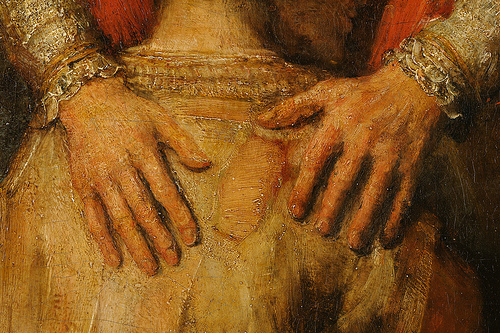
Rembrandt, “The Return of the Prodigal Son,” c. 1661

17 “But when he came to himself, he said, ‘How many of my father’s hired servants have more than enough bread, but I perish here with hunger! 18 I will arise and go to my father, and I will say to him, “Father, I have sinned against heaven and before you. 19 I am no longer worthy to be called your son. Treat me as one of your hired servants.”’ 20 And he arose and came to his father. But while he was still a long way off, his father saw him and felt compassion, and ran and embraced him and kissed him. 21 And the son said to him, ‘Father, I have sinned against heaven and before you. I am no longer worthy to be called your son.’ 22 But the father said to his servants, ‘Bring quickly the best robe, and put it on him, and put a ring on his hand, and shoes on his feet. 23 And bring the fattened calf and kill it, and let us eat and celebrate. 24 For this my son was dead, and is alive again; he was lost, and is found.’ And they began to celebrate.

Luke 15:17-24, ESV

Two hundred and eighty-nine words– these describe the life of every man, woman, and child who has ever lived. These 289 words reveal to us a God who loves far too much, way too easy. Perhaps we sort of expect that he will ‘appropriately’ punish his son– at least put him on probation at least. It only makes sense. But we find that is legalism talking.

“Every saint has a past, and every sinner has a future.” 

Many of us have lived as prodigals, and we have spent our inheritance like ‘drunken sailors.’ We really have nothing at all to show for it. The prodigal, completely destitute, takes the only work he can find. (Imagine a good Jewish boy feeding hogs.)

He is so far gone that he starts inspecting the filthy slop buckets for something to eat.

Many of us will understand his despair. Often there comes to us a crystalline moment of simple awareness. The prodigal, sin-crusted and impoverished, still has a lingering memory of the Father’s house.

The servants there had far more than him right now. Sometimes I wonder if in our captivity, we instinctively want to go home, if only in our minds, to be a servant there.

The Father has dreamed of this precise moment.

The parable says, “He saw him–felt compassion–ran out to him–embraced him–and kissed him.” The Father is a whirlwind of agape love. I’ve read the Parable of the Prodigal Son a hundred times or more. It never loses its punch. I simply want to bring some observations: 

  • We see that his father receives him with a tender gesture. His hands seem to suggest mothering and fathering at once; the left appears larger and more masculine, set on the son’s shoulder, while the right is softer and more receptive in gesture.
  • The son’s head is downy, almost like a newborn’s. We must enter the kingdom like little children. 
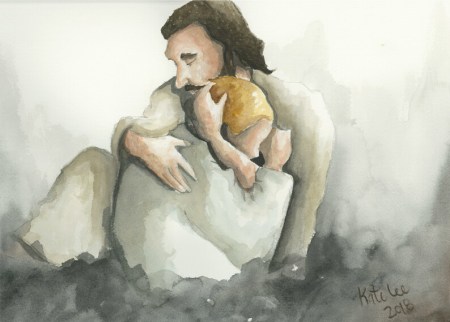
  • The Prodigal Son seems to be protected by his father. He snuggles near the Father’s breast. It’s love that holds him there.
  • Consider his sandals. It has taken a long time for him to come home. 
  • Standing at the right is the prodigal son’s older brother, who crosses his hands in stoic judgment; we read in the parable that he objects to the father’s compassion for his brother.
  • We see his mother in the background in the painting, and a seated steward or counselor. One stands in profound joy, the other in sits in stunned perplexity.

But Rembrandt had painted the Prodigal once before, when he was considerably younger. And it is a very good painting. The prodigal is happy and gay; there is absolutely no indication of the consequences of sin.

The Prodigal Son in the Brothel, 1635

He’s a charming young man at the height of his popularity, and we see him at a happy party. He is spending the inheritance of his father.

But Rembrandt chooses at the very end of his life to re-paint it to reflect reality.

This is one of the last paintings he will do, and it is the Prodigal Son–destitute and repenting. I can only imagine; the years have taken a toll and he doesn’t really feel his first painting is enough. He wants to paint what is true.

He now is painting our spiritual condition.

We are given a work that some critics call as the greatest painting ever completed. The painting is now in St. Petersburg, Russia. It is seldom seen by visitors. It is a clear echo of the grace of God for fallen men and women. Like the father in the painting, He’s ready to forgive every sin saturated son and daughter.


The Father’s Prodigal

bry-signat (1)


Pushing Through

“Snuggle in God’s arms. When you are hurting, when you feel lonely, left out. let Him cradle you, comfort you, reassure you of His all-sufficient power and love.”

     Kay Arthur

There is a lifeline if you are:

  • A weary leader, caregiver, or simply a burned-out believer.
  • Navigating the heavy fog of grief, anxiety, or emotional numbness.
  • Quietly asking yourself, “Why do I still feel so empty?”
  • Aching to feel close to Jesus again.

You don’t have to fix yourself to be found. You’re not too broken—you are already being held.

Have Courage

By Joni Eareckson Tada

 (818) 707-5664 | info@joniandfriends.org

After more than four decades of quadriplegia, I’m tired. My bones are weary from battling everything from pressure sores and pneumonia to stage III cancer. My question these days is never “Why, God?” It’s most often “How?” How do I keep on going? How do I care about others when I’m consumed with my own physical challenges? How can I be kind and civil when pain wracks me?

The other morning Ken could see the weariness in my eyes. Right before I wheeled out to go to the van, he said, “Wait here; I know exactly what you need.” He rushed back with a yellow post-it note. On it he had penned the letter ‘C’ with a felt-tipped marker. I gave him an odd look. “It stands for Courage,” he said, “the courage of Christ. I can see it in your eyes, Joni, and you can do this day. I know you can!” With that, he pressed the post-it on my shirt, right above my heart.

I can’t explain what happened next, but I could feel God’s encouragement

Ken only said a few words, but they were brimming with power and life. His was a declaration of the good he saw in me; or, at least the good he wanted to see. And God gave me his amazing grace to rise to the occasion.

Even the best of Christians can feel the weight of weariness. It’s why Hebrews 3:13 tells us to “Encourage one another daily.” Think of the people you’ll see today: friends recovering from surgery, neighbors dealing with grief, coworkers coping with pain. Whether you say it in an email, over the phone, or in person, your words have the capacity to change their countenance and character. And the best word? The Word made flesh, Jesus, who always has courageous words of life.

Oh, Father, I need the courage of Christ to face this day’s demands. Thank you for making me strong in him.

Joni Eareckson Tada, Founder of Joni and Friends, is an international advocate for people with disabilities. A diving accident in 1967 left Joni with permanent quadriplegia. After rehabilitation she emerged with new skills and fresh determination to help others in similar situations. She founded Joni and Friends in 1979 to minister to people living with disability. For over 40 years Joni and Friends has served thousands of families navigating disability, and has delivered over 225,000 wheelchairs and Bibles to individuals with disabilities in developing nations. Joni has survived breast cancer twice and lives with chronic pain and weakening lungs. By God’s grace Joni perseveres, keeping an active schedule, including radio recording, writing, and providing leadership and encouragement to the Joni and Friends staff. Joni and her husband Ken reside in Calabasas, California.

A Sound Mind

2-Timothy_1-7

“A sound mind.” For some of us that doesn’t seem remotely possible. We’ve come to believe this is only true for others, maybe, but not me. As mentally ill people we seem to think that we shouldn’t be this way. Given enough time our illness becomes fused to our spirit and soul. We buy the lie and choose to live defeated. Only the Lord Jesus can break this chain.

Healthy thinking is a wonderful gift. That’s important to note. I can’t earn it; nor can I fabricate it. It must be simply acknowledged and received as a bonus. We must come humbly and broken. I suppose that is where we become the happiest and healthiest.

In 1 Timothy 1:7 we’re told that we have a salvation that includes:

  • incredible power,
  • love,
  • and a sound (healthy) mind.

These three are a gift from God. You don’t buy a gift, nor do you earn it. Rather it comes from Someone who loves you (!) and only wants to restore you. We may have issues, but the Spirit is sound and lucid. He speaks so we understand.

Afflicted people will find what they need from the Holy Spirit of God. Mental illness isn’t a death sentence. Rather it’s a grand opportunity for God to teach us about His power in the middle of our pain.

The healthy mind is one that is clear and life-giving. It is without any sick or crippling deficiencies. It’s a mind that is vigorous and robust. Those of us who struggle with a mental illness this is fantastically good news. And it maybe that you’re certainly impaired but even then you’re given a strength to use in service in the body. Everyone has a gift and calling.

There is nothing worse than fighting through muddled thinking when you’re having mental issues. Names, dates and memories disappear in the fog. It can be frightening. I know what it’s like to be afraid of one’s own mind. It seems like it’s trying its best to kill me. (Some of you can ‘read-between-the-lines’ and understand exactly what I am saying.)

My own experience is that the Holy Spirit is working, with my meds, to hold me in a good place. Just as a diabetic must take insulin, so I need to take my antidepressants. The brain is an organ that can get sick also. We live in a fallen and broken world. We are human and therefore vulnerable just like anyone else. (Somehow, we imagine better.)

Grace does heal many, but there are some who will find ‘weakness’ becoming their real strength.

The very presence of the Holy Spirit is what enables. Broken believers are coming to see that their illnesses are helping them to be weak enough for God to use. It’s not how strong you are, but it’s how weak. “It is not that we think we are qualified to do anything on our own. Our qualification comes from God,” 2 Cor. 3:5, NLT.

bizen-kintsukuroi-tea-cup-1 (1)

“When the Japanese mend broken objects, they aggrandize the damage by filling the cracks with gold [‘kintsukuroi’]. They believe that when something’s suffered damage and has a history it becomes more beautiful.”

–Barbara Bloom