How Things Grow, [Work]

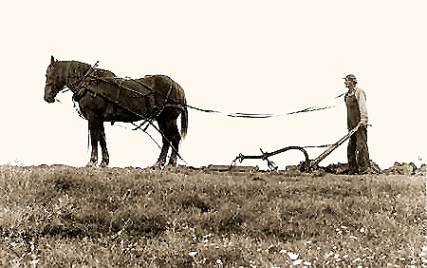
plow1930s

A farmer slowly walks behind his plow. The ground is hard and unyielding, but the steel cuts the heavy sod like a knife. He is preparing the soil for receiving the seed. He knows that what he is doing is imperative and he shouts out to encourage the horse. Its getting late and he wants to cut another furrow before night.

Plodding behind the plow he thinks many things. He can break up the ground, till and fertilize it, sow the seed— and then wait. He is powerless it get the seed to germinate and grow. He is limited to cultivating the soil and waiting. That is all he can really do, and he accepts this powerlessness. He can do everything right, and still not have a crop. All he can do is his part.

The farmer works in partnership with God. He is dependent on Him to grow the seed. The farmer must rely on the weather to meet and engage the planted seed. There are no shortcuts here. He does all he can, and then hopes that it is enough.

Farming is a joint endeavor between man and God. The man does what he has to do. God takes what the man has done and then finishes it. The crop will grow because He wills it. The farmer plays a part for sure, but ultimately God must become involved. Afterall, He makes the seed to sprout and grow.

We can say decisively that the pursuit of holiness in a Christian’s life is a joint endeavor between a believer and God.

Each have made the effort. The Christian does what is necessary, and then the seed is finally sown. It is then up to God to make the seed become the seedling. But each must work to finish the growth.

No one can attain holiness in their life apart from the work of preparation (it’s indeed work). The man must prepare the ground through plowing and cultivating. The farmer works the ground in order to make the ground ready. On the other hand, God provides both the environment and the growth needed to grow the seedling. Both the farmer and God must do their work.

A life of holiness is not automatic. It will never come at measured pace, trickling into our souls at a mechanized rate. (It would be nice if it would). Rather it wheat-field-landscape-picture_1920x1200_79595seems to come, in fits and spurts, sputtering rather than simply flowing.

Holiness is like a steamy Amazon jungle, vibrant and full of life. It is saturated with things living and green. It is not like an arid and sterile desert. Holiness is pulsating and powerful, full of lush growing things.

Becoming a person of holiness is the grandest adventure for the human soul. It defies our tendency to be rigid and legalistic. It is quite the opposite. It is tapping into life itself, and who is up to the task? Our morbid ideas of what holiness are not worthy of what really is.

Yes, to be holy is to work. Just as the farmer must prepare the soil for the seed, we too must guide our plows. God is ready to sow, and we should be ready to be ready. That is if we want to be fruitful and productive.

“Oh, the fullness, pleasure, sheer excitement of knowing God on earth!”

 Jim Elliot

bry-signat (1)

cropped-christiangraffiti1.jpg

God Will Sustain You

elijah-2

“Some Christians are called to endure a disproportionate amount of suffering. Such Christians are a spectacle of grace to the church, like flaming bushes unconsumed, and cause us to ask, like Moses: ‘Why is this bush not burned up?’

The strength and stability of these believers can be explained only by the miracle of God’s sustaining grace. The God who sustains Christians in unceasing pain is the same God — with the same grace — who sustains me in my smaller sufferings. We marvel at God’s persevering grace and grow in our confidence in Him as He governs our lives.”

— John Newton, 1725-1807, Author of “Amazing Grace”

“The angel of the Lord appeared to him in a blazing fire from the midst of a bush; and he looked, and behold, the bush was burning with fire, yet the bush was not consumed.”

Exodus 3:2, NASB

u

u

cropped-christiangraffiti1-3-1

The Lady and the Knight in Shining Armor

“Be kind to one another, tenderhearted, forgiving one another, as God in Christ forgave you.”

Eph. 4:32

“It’s unfortunate and I really wish I wouldn’t have to say this, but I really like human beings who have suffered. They are kinder.”

Emma Thompson

She has nailed down a thought here.  It is only a starting point, a beginning that one should work-out, over and over.  We begin at this realization that there can be a definite link between suffering and kindness.  It’s like two wheels of a bicycle.

I’m in love with kind people.  All the people I have met who were truly wonderful, had very kind hearts.  Kindness set them apart.

Historically, kindness was regarded as one of the “Knightly Virtues” of medieval times.  Having it was to be a mark of chivalry.  In theology, it was one of seven virtues, that mirrored the “Seven Deadly Sins.” It seems to me that believers who practice kindness are to be regarded as part of a spiritual nobility.

This connection between suffering and kindness isn’t so much as a “cause and effect,” but rather a ‘fruit’ which has to ripen, or mature.  Pain is not always this productive in our lives.  It can bring bitterness and loss as easily as it can bring kindness and gentleness.  And many of us who struggle with mental illness or substance abuse understand this all to well.

The apostle Paul was right to link his sufferings to spiritual growth.  If you can do this you are moving in the right direction.  It will not lift you out of the pain; you will still have the sense of being overwhelmed, but you will see through it with the eagle eye of faith.

Why is it that so many who have suffered, will go on to become kind people?

It may have to do with two dynamic principles. The first metaphor would have to be the smelter/the potter.  These are significant because they illustrate how believers are always in process.  We are in flux, either moving under the hand or under the heat.

The second metaphor is the grape vine dresser/bread maker.  These strike me as harsh, although it may not always feel that way.  But both are definite “hands-on” from a supervisory source–the Holy Spirit.

Suffering is a lot like learning another language.  Some days it will just click, and then other days you can’t remember your previous lesson.  But if you are really patient you will learn to speak the dialect of suffering.  Learning languages can open up the world to you.  If you learn to speak “suffering” you will be able to touch the hearts of millions.

But there needs to be patience.  You must wait for “kindness.”  Transformation will never be smooth or easy.  There are no switches for God to flip to make you Christlike.  You will not wake up tomorrow morning with the character of Jesus–his mercy, love, wisdom and kindness.  I’m sorry.  (Choose to dispute this, and I will let you.)

flourish-bird

“I prefer you to make mistakes in kindness than work miracles in unkindness.”

Mother Teresa’s counsel 

“God has chosen you and made you his holy people. He loves you. So you should always clothe yourselves with mercy, kindness, humility, gentleness, and patience.”

Col. 3:12, NCV 

1brobry-sig4 (2)


cropped-christiangraffiti1-2


Please Shut the Door, [Prayer]

“When you pray, go into a room alone and shut the door. Pray to your Father in private. He knows what is done in private, and he will reward you.”

Matthew 6:6, CEV

“We are to be shut out from men, and shut in with God.”

Andrew Murray

Prayer is a deep and awesome thing.  And yet in a sense our physical life must have cheeseburgers and spaghetti.  Food powers us, and we are fueled by it’s energy.  Prayer is also necessary to propel us, for it is our spirit’s nourishment.

We cannot survive without food. We see pictures of emaciated children in some African country, and they are just  skin and bones.  It is a sick evil.  But there are Christians who are like this spiritually.  They are starving because they are not praying.

Jesus told His followers, to go into a room alone.  Then shut the door.  We must learn that God is in the secret.  If we should meet with Him, we must be as secretive.  “Shut the door,”  what happens in there is not for public display. We must be quite discrete in our times with Him.

When I was at in my first year at Bible school, I heard a guest speaker teach from Matt. 6:6.  I was pumped up by it, praying with the door shut was a new idea for me.  When I got to my dorm room, I went straight for my closet to put this new revelation into action. Kneeling there in the closet, with the door slid shut, I tried to pray.  And after a bit I fell asleep, still on my knees.

About an hour later I woke up with a start.  I had no idea where I was, and in my disorientation I slid open the closet door with a loud bang.  I tried to stand, but my legs couldn’t support me.  I lurched out in the room and fell in a pile.  My roommate was startled to say the least.  He had been in the room studying quietly by himself, when suddenly this ‘wildman’ burst out of the closet and immediately collapsed.  It was hysterical!

So much for my first attempt at praying in secret.

The quest for spiritual growth will have to lead us into the closet.

The injunction to close the door can be understood in a variety of ways.  The act of isolating ourselves is a physical one.  But we must understand we need to shut up all our social entanglements and obligations.  We isolate ourselves so we can be intimate with Him.

We just need to figure out just how we are to do this.  We shouldn’t give up when it doesn’t bring wondrous results.  We are all students in this, we will advance at times, and then retreat.  But every second in the closet can be an intimate blessing to our souls.

“He that loveth little prayeth little; he that loveth much prayeth much.” 

– Augustine


bry-signat (1)

cropped-christiangraffiti1.jpg