Messy Spirituality– Mike Yaconelli

Brokenness never means uselessness

“Messy Spirituality:” A Book Excerpt by Mike Yaconelli

For as long as I can remember, I have wanted to be a godly person. Yet when I look at the yesterdays of my life, what I see, mostly, is a broken, irregular path littered with mistakes and failure. I have had temporary successes and isolated moments of closeness to God, but I long for the continuing presence of Jesus.

Most of the moments of my life seem hopelessly tangled in a web of obligations and distractions. I want to be a good person. I don’t want to fail. I want to learn from my mistakes, rid myself of distractions, and run into the arms of Jesus. Most of the time, however, I feel like I am running away from Jesus into the arms of my own clutteredness. I want desperately to know God better. I want to be consistent. Right now the only consistency in my life is my inconsistency. Who I want to be and who I am are not very close together. I am not doing well at the ‘living-a-consistent-life’ thing.

I don’t want to be St. John of the Cross or Billy Graham. I just want to be remembered as a person who loved God, who served others more than he served himself, who was trying to grow in maturity and stability. I want to have more victories than defeats, yet here I am, almost 60, and I fail on a regular basis.

If I were to die today, I would be nervous about what people would say at my funeral. I would be happy if they said things like “He was a nice guy” or “He was occasionally decent” or “Mike wasn’t as bad as a lot of people. ”Unfortunately, eulogies are delivered by people who know the deceased. I know what the consensus would be.“Mike was a mess.”

You might say Christianity has a tradition of messy spirituality. Messy prophets, messy kings, messy disciples, messy apostles. From God’s people getting in one mess after another in the Old Testament to most of the New Testament’s being written to straighten out messes in the church, the Bible presents a glorious story of a very messy faith. Sounds like you and I are in good company.

A few years ago, I was introduced to a group of uncouth Christians who call themselves “the Notorious Sinners.”  These are men from all walks of life who meet once a year to openly share their messy spirituality with each other. The title ‘Notorious Sinners’ refers to the scandalous category of forgiven sinners whose reputations and ongoing flaws didn’t seem to keep Jesus away.

In fact, Jesus had a habit of collecting disreputables; he called them disciples. He still does. I like people who openly admit their ‘notoriousness’—people who unabashedly confess they are hopelessly flawed and hopelessly forgiven. Graciously, these men invited me to be a part of their group. The ‘Notorious Sinners’ meet yearly at spiritual-retreat centers, where from the moment we arrive, we find ourselves in trouble with the centers’ leadership.

We don’t act like most contemplatives who come to spiritual-retreat centers— reserved, quiet, silently seeking the voice of God. We’re a different kind of contemplative— earthy, boisterous, noisy, and rowdy, tromping around our souls, seeking God, hanging out with a rambunctious Jesus who is looking for a good time in our hearts.

A number of us smoke cigars, about half are recovering alcoholics, and a couple of the men could embarrass a sailor with their language. Two of the ‘Notorious Sinners’ show up on their Harleys, complete with leather pants and leather jackets. I admit I run with a rough crowd—Christians whose discipleship is blatantly real and carelessly passionate, characterized by a brazen godliness. Unafraid to admit their flaws, unintimidated by Christians who deny their own messiness, these guys sometimes look like pagans and other times look like Jesus.

They are spiritual troublemakers, really, which is why they look like Jesus (who was always causing trouble himself ). They are full of mischief, laughter, and boisterous behavior, which is why they look like pagans. Truly messy disciples. The ‘Notorious Sinners’ are definitely a bizarre mix of the good, the bad, and the ugly, living a spirituality which defies simple definitions.

Oh, and they are some of the most spiritual men I know.”

___________________________
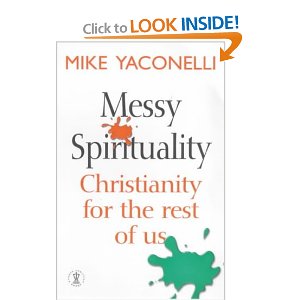
Messy Spirituality [Book] by Michael Yaconelli, Karla Yaconelli in Books

$6 online

By Michael Yaconelli, Mike Yaconelli, Karla Yaconelli – Zondervan (2007) – Paperback -192 pages-ISBN 0310277302

I Guess I’m Not a Very Good Christian . . . Do you feel like: I don’t pray enough I don’t read my Bible enough I don’t share my faith enough I don’t love God enough I’m not committed enough I’m not spiritual enough Then this book is for you.

Messy Spirituality was written for the silent majority of us who have been convinced that we just don’t do Christianity right. We spend most of our lives worried about what we don’t do instead of what we have done, focused on our imperfections instead of God’s fondness for the imperfect. Why?

Because we’ve been bombarded with books, tapes, talks, seminars, and movies convincing us that real Christianity is all about perfection. Michael Yaconelli dares to suggest that imperfection, infiniteness, and messiness are, in fact, the earmarks of true Christianity; that real Christianity is messy, erratic, lopsided . . . and gloriously liberating.

What if genuine faith begins with admitting we will never have our act completely together? Maybe messy disciples are exactly the kind of imperfect people Jesus came to earth for and whose company he actually enjoyed–and still enjoys.

If you want to find Jesus today, look for him in the midst of burned-out believers, moral misfits, religious incompetents . . . men and women whose lives are, well, messy.

Messy Spirituality is a strong antidote for the spiritual perfectionism in us all. Here are truths that can cut you loose from the tyranny of ought-to’s and open your eyes to the deep spirituality of being loved, shortcomings and all, by the God who meets you and transforms you in the midst of a messy and unpredictable life.

 PDF File can be found at http://mikeyaconelli.com/yaconelli/words/SelectedYac.pdf

Pondering Brokenness, [Acceptance]

Broken-Fresco-Assisi-Italy-1999-1024x750 (1)
Broken Fresco– Assisi, Italy

Many voices tell me that there must be distinct lines between sinners (like, me) and Church people. These borders keep order and provide security to those on the ‘inside’ of our Faith. This seems more from a reaction to control than actual sin.

But there are so many people with mental illness: Depression, anxiety, bipolar disorder, schizophrenia, addictions, PTSD, and many others. We are truly an afflicted people.

donkey_boat-300x245
Fitting in isn’t always easy

“Most of the verses written about praise in God’s Word were voiced by people faced with crushing heartaches, injustice, treachery, slander, and scores of other difficult situations.” 

Joni Eareckson Tada

There needs to be an adjustment to the status quo. Room must be made for the ‘losers’ and the misfits. These are people for whom Christ died. They are special to God.

According to federal  law, buildings must be accessible to the handicapped. Special signs are placed in the parking lots, for special parking and wheelchair ramps need to be installed. This is well and good. But let’s extend this ‘deliberateness’ to those with other needs as well.

“The power of the Church is not a parade of flawless people, but of a flawless Christ who embraces our flaws. The Church is not made up of whole people, rather of the broken people who find wholeness in a Christ who was broken for us.”

–Mike Yaconelli

I encourage you to become proactive when it comes to “opening up” the Church to include ‘the brokenness of the other.’ Even a smile can make the difference to the down-trodden soul. Love the unlovely,  just like Jesus.

bry-signat (1)

cropped-christiangraffiti1.jpg


Dismayed by My Own Fallenness

“As the Scriptures say,

“No one is righteous—
    not even one.
11 No one is truly wise;
    no one is seeking God.
12 All have turned away;
    all have become useless.
No one does good,
    not a single one.”

Romans 3:10-12

Scripture never, ever flatters the human ego.  It acts on us directly, “dividing the spirit from the soul.”  I find no glowing review of our “noble” humanity. The opposite is true.

At our deepest core, the Bible teaches that we are depraved—separated from truth and goodness.  In theology this is called, “original sin.”  (I don’t think there is really anything original about it.) There is also a concept called “contrition.”   It means, “having sorrow or sadness over sin involving making steps to amend your ways.”  Notice the definition instills a sense of action.  Perhaps the idea of penitence need a new emphasis?

Does your discipleship include the reality of you?

There are broad, generalized teachings that are woven into the Word— the iniquity and fallenness of men.  It consistently talks a seemless truth, without fail. ( That’s one of the reasons why I know the Bible is true.)  Yet the Father has made provision for our falseness and weakness, he sweeps nothing under a cosmic rug.  You might say the Scripture completely understands us, as us.  Our illusions and deceptions, blatant or subtle, do not confuse or mislead him.

Our discipleship must be “walked out” in brokenness. That is the only way it will work.

We have absolutely nothing to boast about.  I cannot point to this blog— or having been a missionary, a teacher and a pastor as my “good things.”  Today, I sat and became very aware of my inner wickedness. But because He directly intervenes in my life, I will not die in my sins like I deserve.

I am sad.  You see, I am fallen, a complete failure.  It’s easier to find water in the Sahara Desert than to find goodness in my heart.  As a matter of fact, I’ve taken evil to a new level.  I excel, and then I keep practicing it trying to squeeze out more and more power— pride— pleasure.

Those who mourn their contagiously evil hearts (Matthew 5:3-4) are the ones who God can comfort.  Our sadness over our sin (and the sin of the world)—is evidence of the Spirit’s action over our depravity. Look for it, and rest in the Spirit’s work.

“Original sin is in us, like the beard. We are shaved today and look clean, and have a smooth chin; tomorrow our beard has grown again, nor does it cease growing while we remain on earth. In like manner original sin cannot be extirpated [completely destroyed]  from us; it springs up in us as long as we live. Nevertheless we are bound to resist it to our utmost strength, and to cut it down unceasingly.” 

 ~Martin Luther

bry-signat (1)cropped-christiangraffiti1.jpg

Depression Metaphors, [Rust]

rusty1

Trying to explain depression takes a great deal of effort. The explanations are seldom satisfactory and sadly inaccurate. Complicating the definitions are the two types of depression, which are quite different:

  • Mild (dysthymia)
  • Large (clinical)

Both of these are radically different and present a completely set of symptoms. Psychiatrists have diagnostic criteria they use to help them make a diagnosis that will be helpful to the patient. It is kind of a hit or miss judgement call, but there is some validity to their efforts. One of their main resources is the DSM-5 that standardizes treatment of mental disorders and provides a continuity of care.

Mild depression:

Imagine an abandoned factory. You walk inside and at once crunch over the broken glass. Dust covers everything and the once ‘well maintained’ machinery is now covered with rust. It’s damp and musty. You notice graffiti and an old clock frozen in time to 7:53.

Overall, it seems a bit grim and sad. The factory is in complete disarray, but a crew could come and restore it to a functional state. It might take some serious rehabilitation, nevertheless it could happen.

Large depression:

You enter the abandoned factory and are glad you’re wearing a hard hat they gave you at the office. The floor is pretty much impassable, looking up you see that part of the roof has caved in. The machines stand in place, but are hardly recognizable; the are misshapen blobs of rust. There doesn’t seem much of anything to salvage anymore. Things couldn’t get any worse.

Depression has many facets; but it’s always destructive. I find the idea of rust the most compelling. The rust is just oxidation; not even noticeable at first. A steel girder seems strong, but left to its own the rust slowly eats away at the metal. There are molecular changes happening. The integrity of the steel will soon be compromised. It can happen quickly.

I want to encourage to get your depression treated soon. If you have a loved one who struggles get help soon. There is a fallacy about depression that it is relatively  harmless— that one can deal with the ‘blackness’ without long term consequences.

If you are a Christian, you need to find help. You can’t ignore your depressive symptoms.

bry-signat (1)

cropped-christiangraffiti1.jpg