Front and Center

John 8:3-11

Then the scribes and the Pharisees brought a woman caught in adultery, making her stand in the center. “Teacher,” they said to him, “this woman was caught in the act of committing adultery. In the law Moses commanded us to stone such women. So what do you say?” They asked this to trap him, in order that they might have evidence to accuse him.

Jesus stooped down and started writing on the ground with his finger. When they persisted in questioning him, he stood up and said to them, “The one without sin among you should be the first to throw a stone at her.” Then he stooped down again and continued writing on the ground. When they heard this, they left one by one, starting with the older men. Only he was left, with the woman in the center. 10 When Jesus stood up, he said to her, “Woman, where are they? Has no one condemned you?”

11 “No one, Lord,” she answered.

John 8:3-11

I remember how Jesus defended me. I had been led through the crowds. The temple was filled with people who were there for the festival. It was a time of joy and feasting, but not for me.

Especially not for me.

The temple police escorted me to Jesus. I was now the focus of everyone’s attention. I felt dirty and ashamed. Standing there I could feel the lustful looks from the Pharisees; but there was something else as well, a look from Jesus that I had never seen before. There was compassion there, something quite extraordinary.

I’m ashamed, I committed adultery, I had slept with another man who wasn’t my husband.

I was to be stoned, to have hard rocks thrown at me by “holy” men. The Law had pronounced my guilt, and I knew how I was to be punished. And I deserved it. Yet the man who I slept with was never charged, he escaped and it was I that would be put to death. I didn’t blame him.

My shame was now public knowledge–everyone knew, the Pharisees made sure of that.

They put me front and center. They were going to test Him. They were going to destroy me.

These men who brought me had ulterior motives, they desperately hoped Jesus would stumble. I think they wanted to prove once and all to the crowds that were watching that Jesus really wasn’t the Messiah. They wanted to trap him.

Jesus seemed to understand the implications of this satanic effort.

Only Rome had the power of execution, and yet the Mosaic Law declared that I was to die. I stood waiting, expecting the worst. What else could I do?

It’s funny, but Jesus understood all of this. He seemed to look right through this theological trick, and He responded in a way that really shocked everyone. He never spoke, but bowed low and began to write in the dirt with his finger. Amidst their vicious accusations, they pressed their case.

Jesus bent down again, and he wrote some more.

I never knew what he wrote–but I had to believe it must have been something that revealed the sin in the hidden hearts of the men who were accusing me. In that moment, they quickly dropped the case against me. They all filed out, one by one, in dramatic fashion. I now stood alone with Jesus.

And it was then that Jesus looked directly at me.

I was still afraid, but it was strange, I felt a wave of peace as well. I quietly waited, not knowing what He was going to say to me. I suppose I half expected the worst.

Yes, he did confront me. But He wanted me to acknowledge that those accusing men had left. I saw it and understood. Jesus was asking me to believe that I was now really free. But then he wanted me to understand something that seemed quite crucial.

“Neither do I condemn you,” said Jesus. “Go, and from now on do not sin anymore.”

That dear one was a powerful moment. He set me free with the understanding that He did not condemn me. But my freedom from judgement came with a catch–sort of. I knew then that my sin must be renounced. My freedom came with a price. But knowing I was completely released, meant I was now a free woman.

At that moment I understood completely.

“God pardons like a mother, who kisses the offense into everlasting forgiveness.”

    Henry Ward Beecher

My Facebook page: https://www.facebook.com/bryan.lowe

Especially Peter

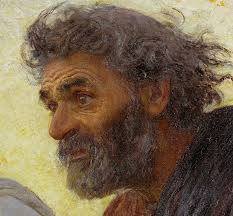
Peter Running to the Empty Tomb, Burnard, c. 1898

And now go and tell his disciples, and especially Peter, that he will go ahead of you to Galilee. You will see him there, just as he told you.”

Mark 16:7, CEV

Poor Peter. Despairing over his personal darkness he has become completely undone.  His wound is beyond any human remedy.  No one can help him at this point. We do well to mark the fall of the ‘Rock.’ Peter is now how we understand our Father’s love.

Jesus had called him, the ‘Rock.’  This would become a bestowed nickname of a future transformation.  We use granite and marble when we want something to last for ages.  It is as permanent as we can make it. Peter is definitely a work-in-progress. His character is sand. He really doesn’t measure up.

Visiting a working quarry, you’ll find large machinery.  Men scale the walls with heavy drills.  At just the right spot they begin to bore a hole.  It is hard and intense work, but they are persistent.  The rock is unyielding, but they work relentlessly.

Soon they take the hole to the proper depth.  Explosives are hauled up, and the hole is carefully packed with dynamite.  The word used in the New Testament is the word “dunamis.”  It is translated from Greek into English as “power.”  Our word for “dynamite” is also a translation of that word.

Peter needs the dynamite power of the Holy Spirit. It is explosive. 

“But you will receive dynamite when the Holy Spirit has come upon you; and you shall be My witnesses both in Jerusalem, and in all Judea and Samaria, and even to the remotest part of the earth.”
Acts 1:8

Jesus looks after each disciple before his resurrection.  He kindly gazes at Peter. Especially Peter.  He will need this new power to overcome his weaknesses. The dynamite of the Spirit will explode all over the Upper Room. Shifty Peter us about to become a rock.

His disciples, in just 50 days are going to meet the Holy Spirit. 

Peter was so transformed on Pentecost he would preach and 3,000 would believe and be baptized. He went from cowardly denier to bold preacher. The dunamis of God changed him that day (Acts 2).

As a broken believer, I see the image of Peter morphing into my own face. I have denied Him before others. I am ashamed of what I have done. My depression flares up and my heart goes down in a downward spiral. I must have the Holy Spirit’s authority to be free.

Bryan

Repeat Offenders

“Father, every family has a rascal someone who breaks the rules a juvenile delinquent of untold frustrations and sleepless nights a repeated offender and bearer of sad woe the problem child who needs the most discipline.

Is this why you love me most persistently? When you correct me, is it because I’m the one most contrary?

Or is it that you love me so much?”

 I wrote this thinking about Hebrews 12 and God’s purpose of chastening. I don’t pretend to understand this dynamic completely–all I can say is that my childhood was punctuated by much difficulty. But now, as a father (my two children are now grown), fatherhood has become far easier than my dad had with me.

7 “As you endure this divine discipline, remember that God is treating you as his own children. Who ever heard of a child who is never disciplined by its father? 10 For our earthly fathers disciplined us for a few years, doing the best they knew how.

But God’s discipline is always good for us, so that we might share in his holiness. 11 No discipline is enjoyable while it is happening—it’s painful! But afterward there will be a peaceful harvest of right living for those who are trained in this way.”

Hebrews 12:7, 10-11

I really think we understand our Heavenly Father when we spend quality time with Hebrews 12. We are given insight into His care and into our own issues. It is a good thing He gives us— it enriches our spiritual lives.

It’s never nice to be corrected.

It’s not pleasant. Part of being corrected is being reminded that we’re not as righteous as we think we are. To be corrected strikes us to a reprimand, an admonition that something isn’t right inside of us.

The Father corrects His children–in many ways through a myriad of circumstances. He loves us far too much to allow us to continue in our sin. He’s making us into the image of Christ.

We should welcome His correction. He has a plan for you.

When He disciplines you, it only proves that He is your Father. It’s critical to remember: God’s correction is always for our good. It may be painful yes, but it comes with real hope. It’s not to harm or punish you.

“Father, I’m so sorry that I grieve you as often as I do. I promise to behave. Thank you for being a faithful Father who cares deeply for my soul. Amen.”

 Hannah Whitall Smith.

Make the Decision to Be Weak


Our society has pretty much embraced the American cultural icon of the cowboy.  We revere those who ride alone and hard. We are rugged individualists and hardened men making our own way.  Our society reflects this in subdued ways.  No matter what happens, we are fiercely free and independent.  We are ‘desperadoes’–we do whatever we think is best.

John Wayne, the ‘Alamo,’ and the biker with his Harley-Davidson on Route 66 have been our inspiration.  Each are distinctly heroic and carry our hopes and dreams.

We must understand that the Bible is not an American book.

It belongs to every tribe, race, and nation. 

A cowboy did not die for our sins (which are countless).  The way of discipleship does not take us through Luckenbach, Texas. We’re not desperados. We are Jesus’ disciples.

His Words to us are bold and entirely challenging in an amazingly fresh and different direction.  We are told to wash feet, to repeatedly turn the other cheek, to surrender all our rights, and then take the lowest place there is in every situation.

Our lives truly begin when we come under the Lordship of Jesus Christ.

Humility is to become the way we think and how we act, we have become slaves to righteousness.  Our vaunted independence has been toppled. This selfish crown has slipped. My willfulness still wants to stand instead of kneeling. We discover this has been the truth all along.  We have never ever been in control. 

He has been the King since before time, and will always be, for an eternity.

“Many Christians have what we might call a “cultural holiness”. They adapt to the character and behavior pattern of Christians around them. As the Christian culture around them is more or less holy, so these Christians are more or less holy. But God has not called us to be like those around us.

He has called us to be like Himself. Holiness is nothing less than conformity to the character of God”.

Jerry Bridges

Our churches often struggle over our personal issues of pride and stubbornness. 

I pose the following questions.  Are we honestly in a condition of being weak?  Can you serve with a basin and towel?  Is your heart that of a child? Do we see the world through the ‘lens’ of a soft and broken spirit?

I write these things surveying my own life. 

Self will and my hard heart fit ‘hand-and-glove’ with being that desperado.  I ride alone, making my own way, and I don’t make any disciples. I jettison my cross— my cross of discipleship.  I serve no one, unless it suits me.  Am I His disciple, or am I a man of my own?  Is He my Lord, or have I decided to claim that right for myself?

I only hope I have spoken the truth today. Forgive me if I offended.

“Lord, I am willing to receive what You give, to lack what You withhold, to relinquish what You take, to suffer what You inflict, to be what You require.”  Amen.