Our View From the Tree

Jesus entered Jericho and was passing through. 2A man was there by the name of Zacchaeus; he was a chief tax collector and was wealthy.

3He wanted to see who Jesus was, but being a short man he could not, because of the crowd. 4So he ran ahead and climbed a sycamore-fig tree to see him, since Jesus was coming that way.

 5When Jesus reached the spot, he looked up and said to him, “Zacchaeus, come down immediately. I must stay at your house today.” 6So he came down at once and welcomed him gladly.

 7All the people saw this and began to mutter, “He has gone to be the guest of a ‘sinner.’ “

Luke 19:1-7

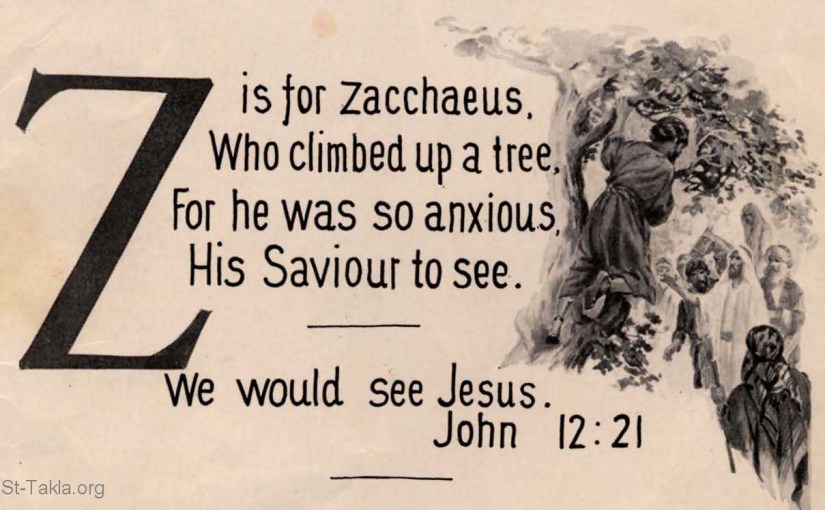
This particular story is one of my personal favorites.  Zacchaeus faced with the chance of missing Jesus shows his resourcefulness by running ahead.  He positions himself up in a tree that grew by a busy road.  Climbing up he placed himself where he could see Jesus.

I can see Jesus stopping under Zacchaeus’ tree, looks up and calls him to come down. “I must stay at your house today”, Jesus declares.  Now there is some serious protocol issues here.  A guest never invited himself to dinner, that just didn’t happen.  Also Jesus, as an esteemed religious teacher/prophet/messiah was supposed to set an example and not to associate with “sinners”. Rules are being broken.

There are many lessons here for the modern disciple.  We would do well to meditate on the many issues imbedded in the text.  The graciousness of Jesus is profound.  He is kind and yet assertive at the same time.

Imagine if this account was all  the New Testament we had, what would our mindset be like?  I think we’d all have to make some adjustments. To put it simply, Jesus is not normal.  He touches peoples hearts in unorthodox ways.

I think what blesses me the most is Zacchaeus’ decision to climb that tree.  He is a man who is “vertically challenged.” But basically he overcomes his liabilities when he commits to climb up into the branches.  He positions himself to see Jesus, and you can’t say a thing against that. Zacchaeus’ adventure is just now begun.

But isn’t that is what we do as Christians?  We put ourselves in a place where we can be close to him.  Think about the ‘disciplines’ of the Christian.  Disciplines like prayer, fasting, Bible study, tithing, baptism, serving and worship.  All of these are like branches on the Sycamore tree.  Ascending we put ourselves in place where Jesus is coming.  It is a way of seeing Jesus. But, that is surely enough.

When I pray, I do so in order to see Him more clearly.  

I can get it all confused and see it as an end in itself.  This is a common flaw in our thinking.  We forget that all these disciplines do is to help us see Jesus. Nothing more– just to see Jesus, and to be seen by Him.

Zacchaeus did not stay in the tree, you might say the tree accomplished its purpose when Jesus drew close.  Zacchaeus did not say, “Jesus, I have this wonderful spot, and it took ‘effort’ to get here. I think I will stay right here.” No, he didn’t just want to climb– he wanted to see Jesus.

“Sir, we want to see Jesus.”  John 12:21
 

bry-signat (1)
cropped-christiangraffiti1.jpg 

A Doubting Faith

faith-and-doubt“”Then the disciples came to Jesus in private and asked, “Why couldn’t we drive it out?”

He replied, “Because you have so little faith. Truly I tell you, if you have faith as small as a mustard seed, you can say to this mountain, ‘Move from here to there,’ and it will move. Nothing will be impossible for you.””

Matthew 17:19-20, NLT

The text is intriguing; it seems to direct us to consider the unbelief of the disciples. They had tried so hard to do what Jesus wanted; they get an “A” for effort, but they can’t heal this boy. They correctly discern a demons presence, but they are stymied after trying to exorcise it.

The disciples “crash and burn” is uppermost in their hearts. They have a private meeting with Jesus to determine what went wrong. Their expectations were running high; they expected success in this encounter with darkness. After all, weren’t they Jesus elite followers?

Even after Jesus had performed so many signs in their presence, they still would not believe in him.” 

John 12:37, NIV

 Jesus is on his way to be crucified. It would be fair to say that his mind was occupied with this. He is still performing healings for the needy, and although awesome things are happening, the crowds remained doubting. They would remain uncertain about him, and many would go on to mock and revile him in just a few days.

Doubt is an insidious thing. It allows one to see, but not respond. It seems to be a cowardly attitude that masks itself as safety and security. There is a willingness not to make a response when that is precisely what is being called for. It is content to live uncommitted and remain unaffiliated. Truth is neutered and we want it to be so.

I certainly don’t mean to be overly harsh to those with doubts. But there are some who put their faith in their doubts and that is slightly disturbing. They see, but do not perceive. They hear, but do not really listen.

“So faith comes from hearing, and hearing through the word of Christ.”

Romans 10:17

 Believers who doubt are in a strange place. But saving faith is always growing, in spite of one’s own skepticism. Questions are to be welcomed; honest inquiry is not a threat, but an issue of a seeking heart. Faith without evidence is no better than superstition. I think believers who never ever doubt are “a freak of nature.” Our faith may struggle, and hard questions be asked, but my faith still holds even when I doubt.

“Now faith is confidence in what we hope for and assurance about what we do not see.”

Hebrews 11:1

We are to grow in our faith. The Bible describes it as “life.” To be a believer in Jesus is a journey of confidence and hope (these words have been carefully chosen). When we find ourselves without these two working in our hearts we become unbelieving believers.

Maybe we should doubt our doubts before we doubt our faith.

“Faith never knows where it is being led, but it loves and knows the One who is leading.”   

Oswald Chambers

bry-signat (1)

cropped-christiangraffiti1.jpg

The Art of Offending Jesus

SIN_KILLS_SIGN Our actions can bless God, and others immensely. We really have no idea that we have such power in our grasp. But we do say and do things that do alter the realities of those who are trying desperately to draw close to Him. We like to be unattached from these very real things. We suppose that it is a “no-brainer,” we will always avoid any complications or entanglements, about our behavior.

However, reality is much more “unforgiving” then we imagine. How we conduct ourselves is certain, and is significant. Honestly, when we become believers and are added to His church, can we honestly behave worse than we were before our salvation from sin?

I’m afraid salvation from sin means “turning off the faucet.” We can’t avoid this, it will determine what kind of a Christian we are. What do we do? Do we continue to sin? “Well then, should we keep on sinning so that God can show us more and more of his wonderful grace? Of course not! Since we have died to sin, how can we continue to live in it?”

Romans 6:1-2, NLT

I’m truly convinced of this. Our decision to keep enjoying sin is disturbing. Our “death” in this case, has never happened. We have died to nothing, and remain untouched by the Gospel. We become just inoculated enough to make us believe that we are “ok.” Our lives keep moving, and we will never consider that we have made these wrong adjustments.11831809_417345445125926_2957479398676821867_n

Are we not “offending Jesus Christ” by not dying to our own sins? If we have pretty much remained the same kind of people, then it is very likely we have. Our enjoyment of sin indicates our real allegiance that we will have when “push comes to shove.” It really seems that we must shake off the old way before we can put on the new.

I simply suggest that you liaten to the Spirit as you make your choices.

Let him accompany you and show you what offends. I only speak boldly, because it matters more than you realize.

bry-signat (1) cropped-christiangraffiti1.jpg *

The Inertia, [Apathy]

Customer-Inertia-2

“Science may have found a cure for most evils; but it has found no remedy for the worst of them all – the apathy of human beings.”

Helen Keller

—————————————-

As I suffer with manic depression I have come to see that much grief comes not from mania, and not from the debilitating depression. These are both substantial, but my biggest issue has to do with the inertia that lies between these two poles. There is a paralysis– an apathy that immobilizes me. And this is as bad as any other state of mind.

“And Elijah came to all the people, and said, “How long will you falter between two opinions? If the Lord is God, follow Him; but if Baal, follow him.” But the people answered him not a word.”

1 Kings 18:21

My passivity is disturbing, and bipolar disorder is as much of “detachment” as it is of extremes. I sit and stare, not able to motivate myself to get up and do something. I’m not really depressed, but nor am I manic– I’m just “there” unable to find energy to do anything. Life just rolls over me.

Perhaps the most deadly sin is this “faltering between two opinions?” We are content to just sit and watch with no commitment. We’re content to let things just roll on by as we sit in our inertia and passiveness. This is the part of my BP that scares me the most (or at least it should.)

If you suddenly went up in flames I wouldn’t stir. Yes, it would get my attention, but I probably wouldn’t do anything, (I’d probably just take notes for my book.)

Inertia is not just a part of a mental illness. It effects normal people as well, and there are degrees of it. The average person it seems will avoid making a real decisive decision at all costs. Inertia can be encountered in any church (ask a pastor who tries to get volunteers) or workplace.

In his day, Elijah cried out for a decision from the Israelite people. I have to believe he was disturbed not only by the idolatry– but by the passiveness of the bystanders. Their neutrality was a big issue.

Joshua would call out to a passive people these words:

“But if you refuse to serve the Lord, then choose today whom you will serve. Would you prefer the gods your ancestors served beyond the Euphrates? Or will it be the gods of the Amorites in whose land you now live? But as for me and my family, we will serve the Lord.”

Joshua 24:15

I know my own heart, and I know my own spiritual paralysis. Rather than commit myself, I would rather settle down on a sofa and just let things happen. I’m quick to point out how those in the arena are doing it all wrong. I’m ready to criticize, but unwilling to volunteer.

Mental illness is filled with ordinary things, but often in the wrong proportions. When we do things it is extreme or not at all. My own apathy is just a mirror of what happens in the hearts of normal people.

I may be excessive, but my own issues have made me aware of what is happening in others.

—————————————–

“It is not the critic who counts; not the man who points out how the strong man stumbles, or where the doer of deeds could have done them better. The credit belongs to the man who is actually in the arena, whose face is marred by dust and sweat and blood; who strives valiantly; who errs, who comes short again and again, because there is no effort without error and shortcoming; but who does actually strive to do the deeds; who knows great enthusiasms, the great devotions; who spends himself in a worthy cause; who at the best knows in the end the triumph of high achievement, and who at the worst, if he fails, at least fails while daring greatly, so that his place shall never be with those cold and timid souls who neither know victory nor defeat.”

–Theodore Roosevelt

bry-signat (1)

cropped-christiangraffiti1.jpg