Grace: Be All You Can Be

“Grace is given to heal the spiritually sick, not to decorate spiritual heroes”

Martin Luther

There exists a mentality among Christian believers where our faith will somehow grant us a pile of ‘nice things.’  This concept tells us that material possessions are a sign of His blessing.  If we just have enough faith, we will truly live in a land of wonder, grace and material blessings.

Doing missions work in a very poor town in Mexico, I was horrified to find this twist.  (I had thought that it wouldn’t really work among the desperate.)  But an especially virulent type was working in the hearts of some of my brothers and sisters.  They latched on to this idea that since they followed God that soon they could count on special favors from Him.  (Like a car, electricity, running water.) Some ‘converted’ just to get these things from God! I refuse to judge them, since I see a variation of this in my own life.

From their cardboard shacks, they could somehow generate a special favor from the Lord.  It came as a relief to me that there were some believers, who over time, began to see that grace was really an undeserved gift; material blessings could never come in this way.  God’s grace alone would make them wealthy!

Somehow, we can get confused and believe that if we jump through the right hoops God is obligated to give us what we want.  But the true Kingdom doesn’t work like this, you can’t use Him in this way. Grace was never meant to ‘decorate’ a believer (least not primarily) but to mend us, to prepare the fallen for eternity. God is not your cosmic bellhop.

Listen! God’s grace is given to heal us.  It is a gift, and it will always be a gift.  We don’t deserve it, we don’t earn it for having enough faith.  Grace isn’t supposed to be like this, rather it’s more like an I.V. to a dying man.  It is dialysis to the woman with kidney failure. It is ‘radiation’ to the cancer patient.

The heart is deceitful above all things,
and desperately sick;
who can understand it?” 

(Jeremiah 17:9, ESV)

Grace comes to us because we are so very sick. We are deeply affected by a spiritual disease.  We should think (rather than see it as a reward) that it is the treatment for that which has deeply sickened us. His love is seen, especially seen, in the worst of us. That’s the way grace works.

God is not against us because of our sin; He is with us because of our sin.

Just thinking out loud here.  I hope I haven’t offended.

Your desperately “sick” brother,

Bryan

commentsbb@yahoo.com
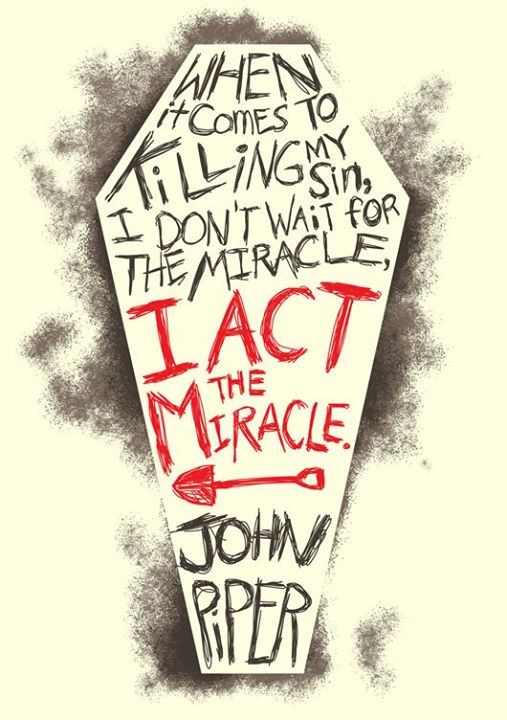
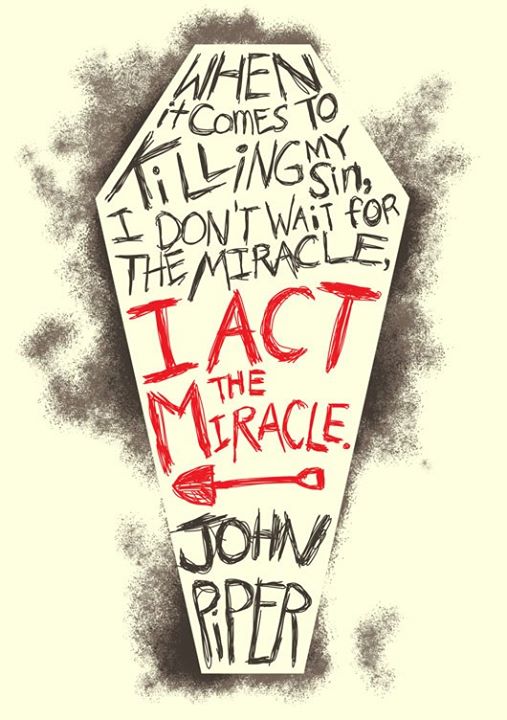
Killing My Sin, Before It Kills Me

killing-sin-act

We are for the most part anyway, eager to please God. We are Jesus’ people with the occasional brush with sin. But hey, who doesn’t? But that attitude must be questioned.

“My little children, these things I write to you, so that you may not sin.”

1 John 2:1

John hopes that his readers would make a choice— not to commit sin. After all, what soldier goes into battle with the intent of getting just a little wounded? Often we will sin just because it seems so inevitable, and we feel we can’t help ourselves. (But the reality is that we can.)

But the Holy Spirit now lives inside. Cooperation with Him is needed. Often we will work ourselves into a ‘no win scenario’ where we believe that sin rules. We can’t beat it, so we stop trying. That is common, and sad.

‘Passivity’ is defined as not participating readily or actively; inactive. When we are passive spiritually, we disengage ourselves from any effort of living holy and pure lives. Not being ‘hot’, but content to be lukewarm. At this point sin becomes, reluctantly, tolerated. “After all, I’m a sinner, what else can I do?”

Mentally ill people are often passive. We are told that we have an uncontrolled illness which dictates that we act ‘irresponsible.’ Our depression often escalates and we feel victimized by it. My experience has taught me that there are three kinds of depression:

  • organic depression, or the ‘biochemistry’ of the disease,
  • guilty depression, the kind that feels bad because of what we’ve done (or didn’t do),
  • reactionary depression, the type we feel when experiencing a loss, a loved one, or a job

Depression will almost always fall in these three categories. And passivity plays a part in all three. We  frequently feel victimized and ‘acted upon.’ When it comes to our discipleship we don’t act, we react. We are utterly convinced of the Bible— God’s truth, but we are so sporadic we can’t seem to get it to work for any length of time.

Yes, we are believers. And yes, we have issues. We’re waiting for a miracle, and hope we get a breakthrough soon.

At the base point of our lives, quite often, there is a passive attitude. Passivity aggravates our depression or mental illness. It deepens, spreading through our lives like a contagious illness. Our discipleship sputters and stalls. We no longer act on God’s Word, but we find ourselves fabricating a faith that makes allowances for our situation.

But we must ‘act the miracle.’ Everything God gives… everything… must be received by a convinced faith. We must be persuaded to give up our flawed ideas, and believe God for the real thing. I opened up this with 1 John 2:1. But there’s much more to this verse:

“My little children, these things I write to you, so that you may not sin.  And if anyone sins, we have an Advocate with the Father, Jesus Christ the righteous.”

I don’t want you to sin. Avoid sin. But even if you do— we have someone who will plead our case before God. He stands and argues our plight. He loves us that much.


bry-signat (2)

cropped-christiangraffiti1.jpg


Praying Authentically

front-prayer

Prayer often can be just a nice religious duty, that makes us feel warm and fuzzy. But such prayer the does not suit a disciple who is tired of religion, and is seeking authenticity. There are few models who can be our guides.

That one of the reasons why we need elders in our fellowships; they have been through so much, they can anchor us to all that is real. As elderd they probably had lessons in prayer.

We often will theologically play on the periphery, and cleverly deceive others and ourselves.  My own heart gets pretty creative as I display a self-righteousness. (I should win an Academy Award as ‘best actor.’) But Jesus insists on us becoming real. You might say that real is the prayer that touches his heart.

When you talk with Jesus, do you really talk to Him? Do you have a real awareness that you are really talking with Him?

Is it the real you that fellowships with the ‘real’ God?

________________________________

The following is an excerpt from A Diary of Private Prayer, by the Scottish theologian, John Baillie, 1886-1960:

Eternal Father of my soul, let my first thought today be of You, let my first impulse be to worship You, let my first speech be Your name, let my first action be to kneel before You in prayer.

For Your perfect wisdom and perfect goodness:

For the love with which You love mankind:

For the love with which You love me:

For the great and mysterious opportunity of my life:

For the indwelling of your Spirit in my heart:

For the sevenfold gifts of your Spirit:

I praise and worship You, O Lord.

Yet let me not, when this morning prayer is said, think my worship ended and spend the day in forgetfulness of You. Rather from these moments of quietness let light go forth, and joy, and power, that will remain with me through all the hours of the day;

Keeping me chaste in thought:

Keeping me temperate and truthful in speech:

Keeping me faithful and diligent in my work:

Keeping me humble in my estimation of myself:

Keeping me honorable and generous in my dealings with others:

Keeping me loyal to every hallowed memory of the past:

Keeping me mindful of my eternal destiny as a child of Yours.

Through Jesus Christ my Lord, Amen.

(Taken from Richard Foster’s Devotional Classics, pp. 126-127.)

aabryscript

More Current, Please!

angel1I have always had a crazy connection with electricity. As a young boy of six or seven I started to push nails into the wall outlets of our home. My mom would come in to find me in a heap, with the nail still in the outlet. It would blow me backwards, and I remember “smelling the ozone” from each experience. I did this fairly often. Mom grew very concerned about me.

Then I discovered the shocking world of electric fences. Most were “pulse” currents, which meant they were alternately energized– and then off. If you grabbed it at the right time, you could beat the fencer and not be shocked. Of course, complicating things would be standing on wet grass. But bringing your little brother meant you could grab his hand, touch the wire, and he would get the full voltage. This was always fun.

Coming into the presence of a holy and loving God should be a powerful jolt. But it needs to be real– never theatrical or showy. Whether it is prayer or worship, we reach into a real world. While electrical shock is detrimental, the Holy Spirit is always strengthening and affirming. My prayer the last few months has been this: “May it be the real me who connects with the real You.”

In a nuclear power plant the workers clearly understand the nature of fission. They can’t see it, or feel it. They must take precautions, because what they handle is really dangerous. In 1 Samuel 6, we read of the time when the Philistines controlled the Ark of the Covenant. But the power they received was not anything they could handle or manage. They finally sent it back. “But the Lord killed seventy men from Beth-shemesh because they looked into the Ark of the Lord. And the people mourned greatly because of what the Lord had done. “Who is able to stand in the presence of the Lord, this holy God?” they cried out. “Where can we send the Ark from here?”

God is dangerous, “my Bible tells me so.” My thinking often would regard Him as docile and tame, but I challenge you to understand differently. I submit to you that our faith should put us into a perilous place– one in which we are asked to do outrageous things. Like building an ark, or going from a slave to a prime minister, or getting out of our boat and walking on the sea. Furthermore, the Book of Revelation is John’s account of being in God’s power and majesty (Rev. 15).

“We worship a dangerous God and He is coming to threaten every area of your life.  God is a loving God, do not be mistaken about that.  His love, however, is unlike any human love; its chief concern is not to make you comfortable, but to make you free and to be free is dangerous and the act of making us free is dangerous.” Joe Spann (and below)

electric-shockPlease don’t try to domesticate God.

He is wild and pretty much unpredictable– and we will not ever tame or teach Him. You can’t manage Him, or train Him to use a box. (He will defy this.) If we are truly going to draw close it will be like stepping into a spiritual reactor, or sticking a figurative nail into a metaphorical wall outlet.

“He is about to become dangerous to your everyday trappings, dangerous to your comfort, dangerous to your retirement plan, dangerous to your schedule, dangerous to your social standing, dangerous to your secrets, and dangerous to your religion. The good news is, He is also dangerous to your limits, dangerous to your fear, dangerous to your addictions, dangerous to your sickness, dangerous to your unforgiveness, dangerous to the chains that bind you chains that you have become way too comfortable with.”

The end result of this is that He wants to make you dangerous again; dangerous to your neighbors bondage, dangerous to the pain in the people around you, dangerous to the generations of abuse and pain in your family and the families you know, dangerous to the culture you are in every single day. And He wants to make us dangerous again. Dangerous to our neighborhoods, dangerous to our friends, dangerous to our culture, dangerous to the kingdom of darkness.”

I would like to make a toast, “May you see God as He is truly, and may you stick your nail into direct contact with Him. May you never settle for less, or want for anything more.” Amen.

1brobry-sig4

cropped-christiangraffiti1 (1)


*