Love Wears Work Gloves

 “But if anyone has the world’s goods and sees his brother in need, yet closes his heart against him, how does God’s love abide in him?”

“Little children, let us not love in words or talk but in deeds and in truth.”

1 John 3:17-18, ESV

Love is a noble idea, it’s admired and extolled by practically everyone–we see it in our music and poetry, ethics and religion. For the most part it’s a word for something decent and virtuous and honorable. It’s a good thing, but I’m afraid it’s not always scriptural.

You see, Bible love wears work gloves.

It labors and sweats and works. Bible love has chores to do, and it actively looks and sees what needs to be done. 1 John 3 tells us that we shouldn’t deceive ourselves and only see the world’s definition. That love a believer has is to be different.

Love, in John’s eyes, is most assuredly “doing.” It burns spiritual calories as it labors to serve our brothers and sisters. Love finds things it can do–it doesn’t just talk but it gets busy. Love sees the need and then gets down to serve.

“You must show sincere love to each other as brothers and sisters. Love each other deeply with all your heart.”

1 Peter 1:22

Working (serving) has nothing to do with our salvation, that is a free gift. We’re saved by grace through the blood of Jesus–that’s a given. But this love isn’t  drudgery, as a matter of fact, working and serving each other is a joy. The deepest kind of joy there is.

Our words, although important, are really an insufficient way of proving our authenticity.  The love we serve another with isn’t “pretty poetry” kind of love. It’s so easy to just shout out truth and never ever show a working, serving kind of love. That sort of love is impressive, and can’t ever be duplicated.

That disconnect is a bit disturbing.

But when do we start to realize that this love is really a verb?

Our prayer and intercession really begins when we go to work for someone else. (Our lunch box is our Bible.) We read it and it energizes us to work for one  another. When we pray we truly are loving another brother or sister. It’s work that they can’t or won’t do for themselves. At least not yet. So we pray.

John is calling believers to a more real kind of love. His love is a love that sweats.

“The church is made up of individuals. It can do nothing except as its members work, and work together.”

     James H. Aughey

Dear reader–I really do pray for you. Your love impacts so many.


I Came to Love You Late

regret

Regrets are a funny thing.

You really start to gather them when you’re middle-aged. I’m 63 now and am surprised (and somewhat disturbed) by my memories of things gone by. I guess this is one of the job hazards of getting old. But that’s the deal.

I guess what really bothers me the most are all the missed opportunities.

I wonder what life could have been like if I had accepted Christ at a younger age. A lot of pain would’ve been averted and perhaps I might have loved Jesus deeper than I do now. Some of us come to love Jesus late in life. There is so much time frittered away.

I regret the years spent in rebellion and disobedience. I remember the words of a 70-year-old man who had just received Christ, “Why did I wait so long for this to happen?”

“But one thing I do: forgetting what lies behind and straining forward to what lies ahead,”

Philippians 3:13

Paul learned to adjust his vision to his calling. He no longer lets his past sin and regret define him, choosing rather forget the past and press into the future. He did understand his sin and guilt. He also knew that his sin was atoned for by Jesus’ blood. 

The solution to our regret is to focus on God’s total forgiveness. Past, Present, Future.

Paul clearly saw what lay ahead of him. Heaven was his destination, and, it’s our calling as well; it’s where we truly belong, made righteous in the loving presence of Jesus.

Peter tells us that our past sin was enough. We have wasted enough time doing evil. I don’t know about you, but I had a bellyful of sin, and it’s time for me to lay aside all my foolishness and rebellion and instead live for God. Enough is enough.

You have had enough in the past of the evil things that godless people enjoy—their immorality and lust, their feasting and drunkenness and wild parties, and their terrible worship of idols.”

1 Peter 4:3

Thinking about my past keeps me humble and broken (which is no small thing)! But it also cements me into the joy of His marvelous amazing grace. I now know Jesus’ love.

I am completely forgiven! The joy I now have is incredible.

David, that great sinner-king, also understood the joy of forgiveness. He wanted us to believe in it as well:

Oh, what joy for those
    whose disobedience is forgiven,
    whose sin is put out of sight!

Yes, what joy for those
    whose record the Lord has cleared of guilt,
    whose lives are lived in complete honesty!

Psalm 32:1-2

“We are to be re-made. All the rabbit in us is to disappear-and then, surprisingly, we shall find underneath it all a thing we have never yet imagined: a real Man, an ageless god, a son of God, strong, radiant, wise, beautiful, and drenched in joy.”

     C.S. Lewis

Blind From Birth

John 9:1-7

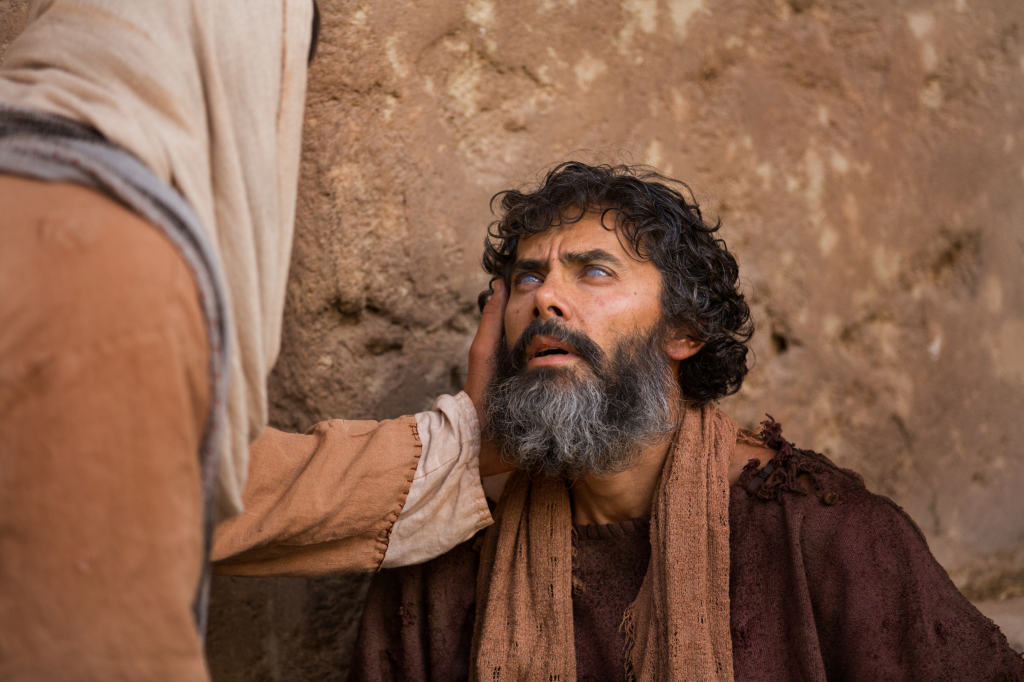
As he was walking along, he saw a man blind from birth.

“Master,” his disciples asked him, “why was this man born blind? Was it a result of his own sins or those of his parents?”

“Neither,” Jesus answered. “But to demonstrate the power of God. All of us must quickly carry out the tasks assigned us by the one who sent me, for there is little time left before the night falls and all work comes to an end. But while I am still here in the world, I give it my light.”

Then he spat on the ground and made mud from the spittle and smoothed the mud over the blind man’s eyes, and told him, “Go and wash in the Pool of Siloam” (the word Siloam means “Sent”). So the man went where nd washed and came back seeing!

Up to now I’ve tried to approach these posts from the first person viewpoint. Ihoped to understand those who met face-to-face with Jesus. I wanted to grasp what they were seeing through their own eyes. But I intend with this post to revert back to a more traditional approach to this passage.

First, we’re introduced to a man who is blind from birth.

I can’t even imagine what that would be like (just as he probably could imagine having sight). I’ve been told that he probably didn’t have a “dream” life–that requires having seen images (a dog, a tree, a mean person) and this wasn’t available to him. He never saw the color red, or seen a mountain. (He didn’t have the circuitry.)

I suppose we can only imagine what blindness like this would be.

Somehow I’ve come to an idea that this represents fallen men–we’re spiritually blind to the workings and truths of Jesus’ Kingdom. It seems a pretty good explanation of each of us–“blind from birth.”

Secondly, notice the response of the disciples who first met this unfortunate man. They don’t see his needs, rather they want to know the theology behind this. Perhaps that’s how we respond much of the time–we don’t see the needs, we only want to know the reasons. We’re not wise or discerning enough to see what’s going on–in short we’re not equipped to love or show mercy. (We haven’t got the circuitry.)

Perhaps this is how we operate as immature Christians.

We don’t engage the need, but rather we like having great theology over understanding compassion. If we really don’t love needy people, we miss so much. We don’t ever grow up. It’s easy to philosophize–it’s hard to get down and serve and really love others.

It’s funny but Jesus declares Himself to be the light of the world while speaking to the man who is born blind.

Third, we discover the gentle mercy that Jesus has when He meets needy people. Now the Lord does accommodate His followers, but not at the expense of engaging the need of the moment. Jesus is full of compassion–most especially when He meets broken people–and as His followers, we must grasp this.

Good theology is not the primary calling of Jesus’ followers.

As I mature in Christ I’m learning (slowly) that people are His real focus. He has come, not to theologize or philosophize, but to meet needs! Sure the reasons why become clearer, but that really isn’t Jesus’ primary goal. People are, not having impeccable theology.

Classes in systematic theology are good, but soup kitchens are better.

The miracle happens, and Jesus’ love and desire to restore this man is ‘front and center.’ The Lord’s methodology is interesting. Spit and mud, wiped on the blind man’s eyes. In Genesis we discover that God made man out of dirt and dust of the ground. Perhaps what He’s doing here mirrors that work.

And it’s also important to understand that Jesus never performs the exact same healing in the exact same way. For some reason He ‘tailors’ His work to the individuals deepest need. I suppose He doesn’t want us to grab a hold of a formula, as that’s what we want to have.

The story is primarily about a blind man’s healing.

It’s not theology, and it certainly isn’t about what is proper and acceptable. We really must understand this, and we really need to understand the tremendous mercy and power of God to both heal and restore.

Image: MCCC. Text from the “Living Bible,” published by Tyndale House

I’m a Riddle to Myself

They tell me that courage is to do something that frightens you. That it is being strong in the face of pain and suffering. If that’s true (and I suspect that it is) then I haven’t arrived yet. I’m a spiritual “chicken.” I’m no eagle yet.

It seems at times I’ve been ‘gifted’ with cowardice! 😁

I struggle at times with chronic depression, and am physically handicapped. I have lost the use of my right arm and hand. I no longer have any balance and must use a cane. This is due to a brain tumor I had in 2002. I’ve had over a dozen head injuries which only has compounded the ataxia.

I admit I sometimes get angry with God. I also get spiritually confused as I try to walk like Jesus wants me too. My frustration with Him is all foolishness when I think of all He has given me. I pretend at these times, and I do it well I think.

I’m also afflicted with a terrible disease called “Facebookitist.”

I find that this blog I write sometimes covers up a multitude of my own sins. You see and read what I want you to see. I polish up things to preserve a modicum of spiritual decency. I want you to see me as faithful and triumphant. A real disciple, (but alas, that’s often a bit of a stretch).

Brennan Manning

I once was confronted by a younger believer, “I don’t know you, brother, you’re like two different people.” And honestly I’m sure he was right. I am, and it disturbs and saddens me.

And what is the truth often scares me. I’m often a spiritual coward who tries to speak the things that are real and true. (A clown trying very hard to play “Hamlet.”) I occasionally realize I will write something that’s spiritually false, and that scares me. “Kyrie Eleison.” God have mercy on me, a sinner.

I think all I want is God’s stamp of approval. “Well done, good and faithful servant.”

And perhaps yours as well?

I realize that I end up wanting truth which is no small thing. Many lies must be stripped away and that seems to take time. It’s like scraping away layers of varnish on a table you’re working on. I’m pretty much coated with sin. I desperately need the truth to survive.

All I really know is that I love Jesus, and I seek to be filled with His Spirit. I keep coming, over and over, to Him. He holds on to me.

     C.S. Lewis

Jesus comes not for the super-spiritual but for the wobbly and the weak-kneed who know they don’t have it all together, and who are not too proud to accept the handout of amazing grace.”

Brennan Manning